
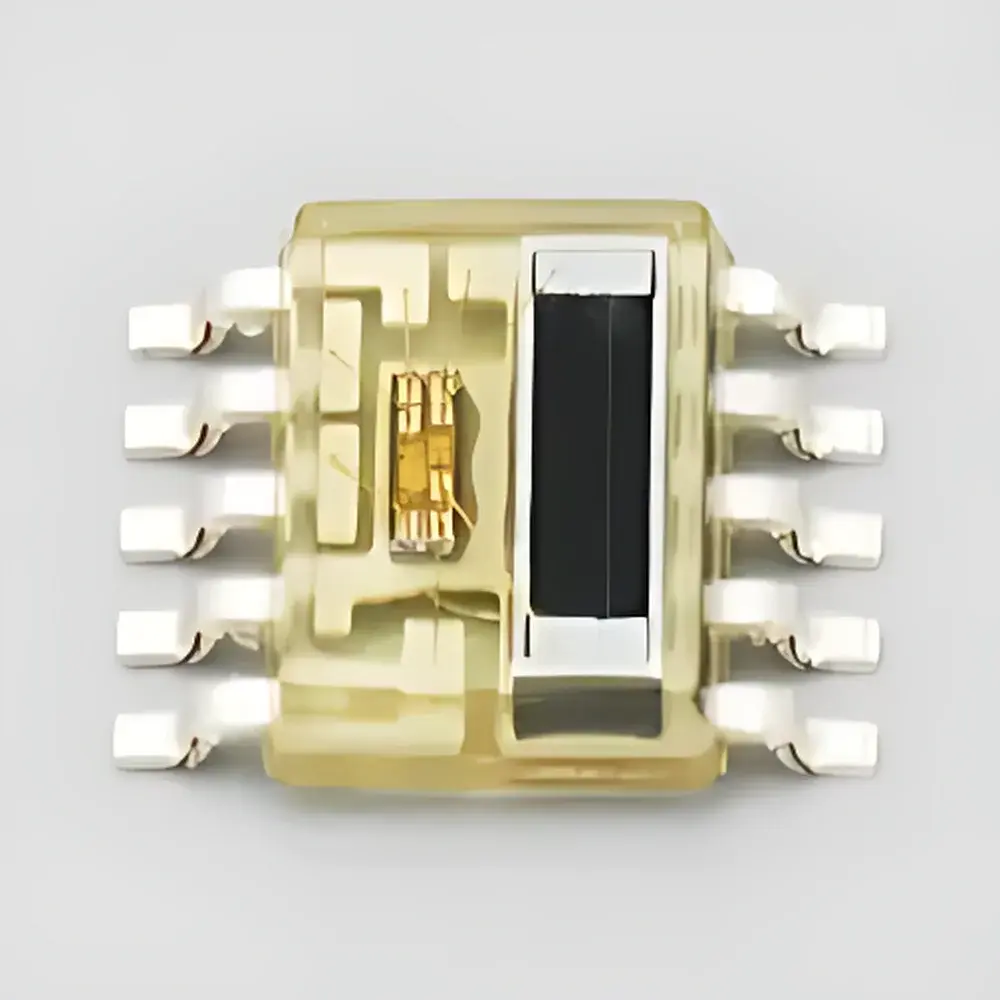
Hamamatsu S9–S11 Series Laser Synchronization Photonic Integrated Circuits
| Brand | Hamamatsu |
|---|---|
| Origin | Japan |
| Manufacturer Type | Original Equipment Manufacturer (OEM) |
| Import Status | Imported |
| Model Range | S9684, S9703-10/11, S10317-01, S11257-01DT/02DT, S11282-01DS |
| Component Category | Optical Sensor ICs |
| Package Type | Surface-Mount Device (SMD) |
| Pixel Count | 1 or 2 active photodiode elements |
| Operating Mode | Low-Voltage Operation (≤3.3 V) or Standard Operation (5 V) |
| Transimpedance Gain Options | 6× or 20× current amplification |
| Laser Power Compatibility | Optimized for low-power visible-to-NIR laser beams (e.g., 635–780 nm) |
| Compliance | RoHS-compliant, AEC-Q200 qualified variants available upon request |
Overview
The Hamamatsu S9–S11 Series Laser Synchronization Photonic Integrated Circuits are monolithic optoelectronic sensor ICs engineered for precise temporal alignment of laser beam emission in high-speed electrophotographic systems. These devices integrate a photodiode element with an on-chip transimpedance amplifier (TIA) and signal conditioning circuitry into a compact surface-mount package. Unlike discrete photodetector + amplifier solutions, the S9–S11 series delivers inherent gain stability, minimized parasitic capacitance, and sub-nanosecond rise time—critical for detecting the leading edge of low-energy laser pulses used in page-wide scanning optics of laser printers, digital multifunction peripherals (MFPs), and industrial marking systems. The core measurement principle relies on direct optical-to-electrical conversion followed by analog current amplification, enabling deterministic triggering of print engine timing sequences with jitter below 2 ns (typical). Each variant is calibrated for consistent responsivity across the 635–780 nm spectral band, matching common red and near-infrared laser diode sources.
Key Features
- Monolithic photodiode + transimpedance amplifier architecture ensures stable gain and temperature-insensitive timing response
- Two operational variants: Low-Voltage Operation (≤3.3 V supply, ideal for modern ASIC-integrated control boards) and Standard Operation (5 V, compatible with legacy print engine controllers)
- Configurable current amplification: 6× or 20× fixed-gain TIA options support system-level signal-to-noise optimization based on laser power and optical path loss
- Single- or dual-element configurations (S9684/S11282-01DS) enable redundancy or differential detection for improved noise immunity in EMI-prone environments
- Surface-mount packaging (SMD) with JEDEC-standard footprint (e.g., SOP-4, SOT-23-5) facilitates automated PCB assembly and thermal management
- Guaranteed linearity over input photocurrent range of 10 nA to 1 µA, ensuring reliable pulse detection across varying laser modulation depths
Sample Compatibility & Compliance
The S9–S11 series is validated for integration into laser scanning units operating with continuous-wave (CW) or pulsed semiconductor lasers emitting in the visible to near-infrared spectrum (635 nm, 650 nm, 670 nm, 780 nm). Devices exhibit minimal spectral sensitivity drift (<±0.5% per °C) and maintain specified rise/fall times under ambient temperatures from −20 °C to +70 °C. All standard variants comply with RoHS Directive 2011/65/EU and REACH Regulation (EC) No. 1907/2006. Select models (e.g., S11257-02DT) are available with AEC-Q200 qualification for automotive-grade reliability testing, including thermal cycling, humidity bias, and mechanical shock. While not certified as medical or safety-critical components, these ICs meet functional safety requirements for Class 1 laser product compliance per IEC 60825-1:2014 when used within properly interlocked optical subsystems.
Software & Data Management
As analog front-end sensor ICs, the S9–S11 series do not incorporate embedded firmware or digital interfaces. Their output is a conditioned analog voltage proportional to incident laser intensity, intended for direct connection to external microcontrollers, FPGA-based timing logic, or dedicated print engine ASICs. System integrators typically implement real-time edge-detection algorithms in hardware (e.g., comparator-based zero-crossing circuits) or firmware (e.g., high-resolution timer capture on ARM Cortex-M4/M7 cores). For production test and calibration, Hamamatsu provides traceable reference test reports—including dark current, responsivity (A/W), rise time (10%–90%), and gain consistency data—for each production lot. These reports support ISO/IEC 17025-compliant quality documentation and GLP-aligned manufacturing traceability when integrated into regulated printing equipment.
Applications
- Laser printer and MFP synchronization: Precise detection of laser start-of-scan (SOS) signal for drum rotation phase locking
- Digital copier imaging engines: Timing reference generation for raster image processing pipeline alignment
- Industrial laser marking systems: Beam-on confirmation and pulse validation in closed-loop control loops
- Optical encoder feedback modules: Low-latency position referencing in galvanometer-scanned systems
- R&D platforms for laser timing metrology: Reference detectors in ultrafast pulse characterization setups requiring sub-ns jitter performance
FAQ
What is the typical rise time specification for the S11257-02DT model?
The S11257-02DT exhibits a typical rise time of ≤1.8 ns (10%–90%) under 50 Ω load conditions at 25 °C.
Can these ICs be used with pulsed lasers having repetition rates above 1 MHz?
Yes—the bandwidth exceeds 200 MHz for all variants, supporting pulse trains up to 50 MHz without significant amplitude roll-off.
Is there a recommended optical filter to pair with the S9684 for ambient light rejection?
A 10 nm FWHM bandpass filter centered at 650 nm (e.g., Thorlabs FB650-10) is commonly integrated upstream to suppress fluorescent and LED background illumination.
Do Hamamatsu provide SPICE models for circuit simulation?
Yes—device-specific behavioral SPICE models (including photodiode capacitance, TIA gain, and noise spectra) are available under NDA for qualified OEM design partners.
Are evaluation boards available for rapid prototyping?
Hamamatsu offers the C12880MA evaluation kit, which includes socketed SMD adapters, adjustable bias networks, and SMA-output test points for oscilloscope-based characterization.



