
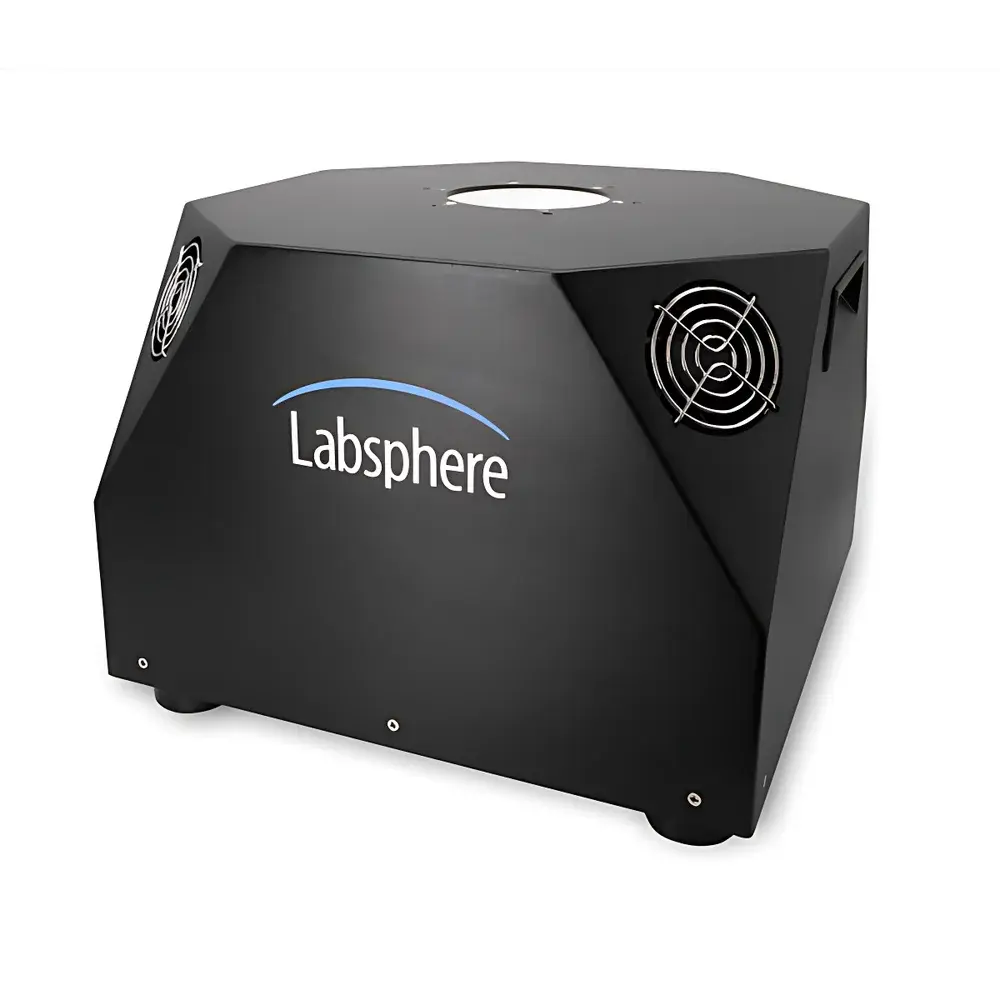
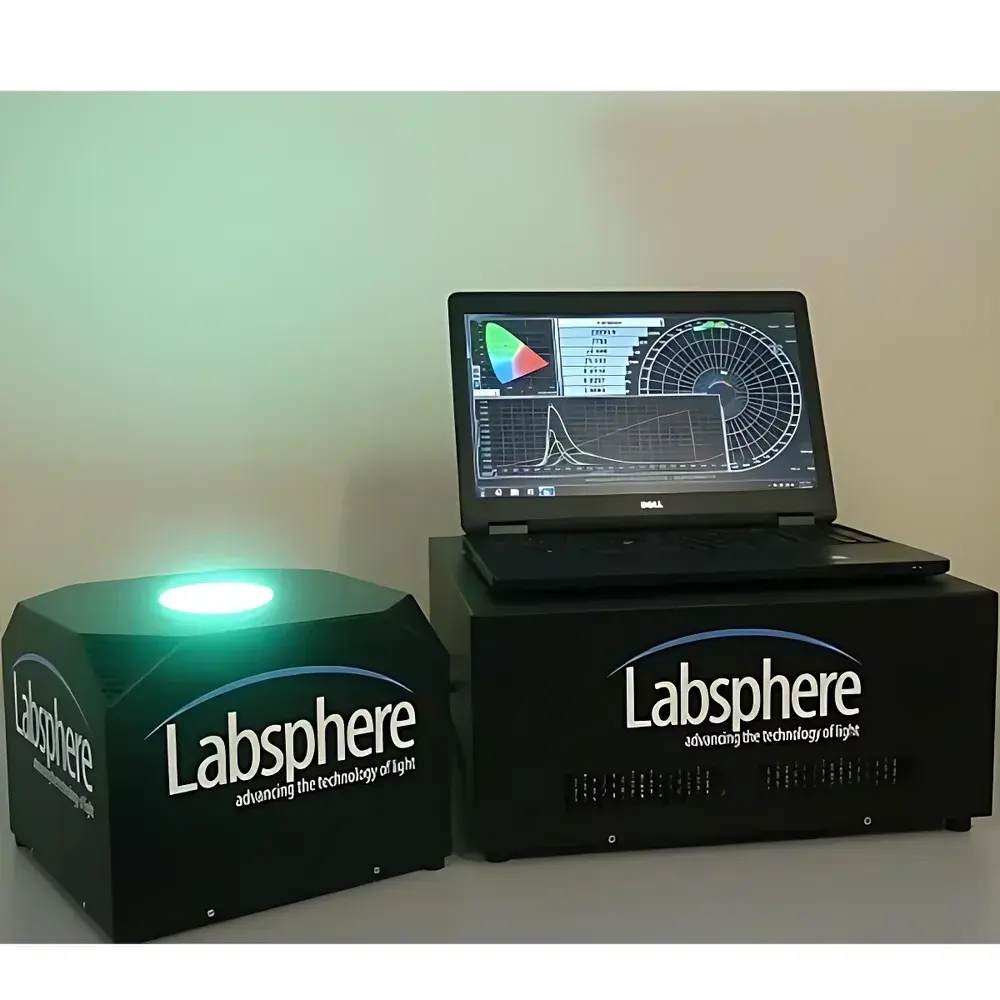
Labsphere Spectra-FT VIS-NIR Tunable Spectral Integrating Sphere Calibration Source
| Brand | Labsphere |
|---|---|
| Origin | USA |
| Model | Spectra-FT VIS-NIR |
| Output Aperture | 75 mm (Ø) |
| Spectral Range | 380–1050 nm |
| Max Luminance | 25,000 cd/m² |
| LED Channels | 32 |
| Uniformity | >98% over 360° × 200° FOV |
| Integrated Spectrometer | Yes |
| Compliance | ISO/IEC 17025 traceable calibration support, NIST-traceable spectral radiance characterization available |
| Software Control | USB/Ethernet, Labsphere SpectraSuite™ v5.0+ with real-time feedback loop |
| Operating Temperature Stability | ±0.1°C active thermal regulation |
| Radiometric Accuracy | ±2.5% (k=2, 380–950 nm, relative to NIST SRM) |
Overview
The Labsphere Spectra-FT VIS-NIR Tunable Spectral Integrating Sphere Calibration Source is an engineered optical reference system designed for high-fidelity spectral radiance and luminance calibration of imaging sensors, camera modules, and photometric instrumentation. Based on Labsphere’s proprietary Spectralon® diffuse reflectance material and precision-engineered 32-channel LED architecture, the system generates spectrally tunable, spatially uniform output across the visible to near-infrared range (380–1050 nm). Its core measurement principle relies on integrating sphere physics—where light from multiple discrete LEDs is homogenized via multiple diffuse reflections within a highly reflective, thermally stabilized cavity—to deliver calibrated, repeatable radiance fields with exceptional angular and spatial uniformity. The 75 mm output aperture supports full-field illumination for sensors up to 1/1.8″ format, while its 360° × 200° field-of-view coverage enables accurate flat-field, vignetting, and angular response characterization—critical for automotive ADAS cameras, smartphone image sensor validation, and scientific CMOS/CCD testing.
Key Features
- 32 independently controlled LED channels enabling continuous spectral shaping from 380 nm to 1050 nm, including narrowband peaks at 450, 530, 630, 750, 850, and 940 nm for spectral fidelity verification
- Integrated miniature spectrometer (CCD-based, 0.5 nm resolution) provides real-time closed-loop spectral monitoring and automatic intensity correction per channel
- Active thermal stabilization (±0.1°C) of LED submounts ensures long-term radiometric stability and minimizes spectral drift during extended test cycles
- 75 mm diameter output port delivering >98% spatial uniformity (per ISO 14524 Annex B) over a 360° azimuthal and 200° polar angular range
- Configurable output mode: selectable radiance (cd/m²) or irradiance (W/m²/nm) units with traceable SI-unit conversion factors embedded in firmware
- Rugged, fanless aluminum chassis rated for continuous operation in Class 1000 cleanroom environments; ESD-safe housing compliant with IEC 61340-5-1
Sample Compatibility & Compliance
The Spectra-FT VIS-NIR is optimized for planar optoelectronic devices requiring full-aperture, angle-resolved illumination—including CMOS/CCD image sensors, global shutter modules, stereo camera arrays, and hyperspectral detector arrays. It supports standardized test patterns per ISO 12233 (spatial frequency response), ISO 15739 (noise measurement), and JEITA CP-3409 (dynamic range evaluation). Radiometric calibration data are traceable to NIST Standard Reference Materials (e.g., SRM 2020, SRM 2030), and optional ISO/IEC 17025-accredited calibration reports are available. System firmware and control software comply with FDA 21 CFR Part 11 requirements for audit trail, electronic signature, and data integrity when deployed in regulated manufacturing environments (e.g., medical imaging device production under ISO 13485).
Software & Data Management
Controlled via Labsphere SpectraSuite™ v5.0+, the system offers programmable spectral profiles, automated ramp sequences, and synchronized trigger I/O for integration into automated test equipment (ATE). All spectral scans, intensity logs, and thermal telemetry are timestamped and stored in HDF5 format with embedded metadata (wavelength, FWHM, CCT, DUV, CRI Ra). Export options include CSV, SPC, and XML for compatibility with MATLAB, Python (via h5py), and industry-standard metrology platforms such as Keysight PathWave, National Instruments TestStand, and Synopsys Sentaurus. Audit trails record operator ID, parameter changes, calibration events, and firmware updates—fully compliant with GLP/GMP documentation requirements.
Applications
- Flat-field correction and PRNU (Photo Response Non-Uniformity) mapping for scientific and industrial cameras
- White balance convergence testing across illuminants (D65, A, TL84, F11) and dynamic CCT sweeps (2300K–10000K)
- Quantum efficiency (QE) and responsivity calibration of monochrome and color-filter-array (CFA) sensors
- Vignetting and lens shading analysis using angularly resolved irradiance profiling
- Saturation exposure threshold determination and linearity assessment per ISO 15739 Annex D
- Pixel defect detection, SNR mapping, and temporal noise characterization under controlled spectral excitation
FAQ
What spectral resolution and accuracy does the integrated spectrometer provide?
The built-in spectrometer delivers 0.5 nm optical resolution (FWHM) and ±0.3 nm wavelength accuracy (NIST-traceable), with radiometric uncertainty of ±2.5% (k=2) across 380–950 nm.
Can the system be used for absolute irradiance calibration of spectroradiometers?
Yes—when paired with an optional NIST-traceable irradiance calibration kit (Labsphere IRAD-KIT-VISNIR), it serves as a primary standard source for end-to-end spectroradiometer validation per CIE Publication 127.
Is remote operation supported for integration into automated production lines?
The system supports Ethernet/IP and USB 2.0 interfaces with SCPI command set, enabling seamless integration into PLC-controlled test stations and MES-driven workflows.
How is thermal management implemented to ensure spectral stability?
Each LED channel features individual thermistor-monitored submounts with PID-controlled Peltier elements, maintaining junction temperature within ±0.1°C during multi-hour operation.
Does the system meet requirements for automotive camera validation per ISO 20870?
Yes—the 360° × 200° uniform FOV, temporal stability (<0.2% RMS over 8 hours), and spectral repeatability (<0.5% ΔE*ab over 1000 cycles) align with ISO 20870 Annex A test conditions for ADAS sensor calibration.



