
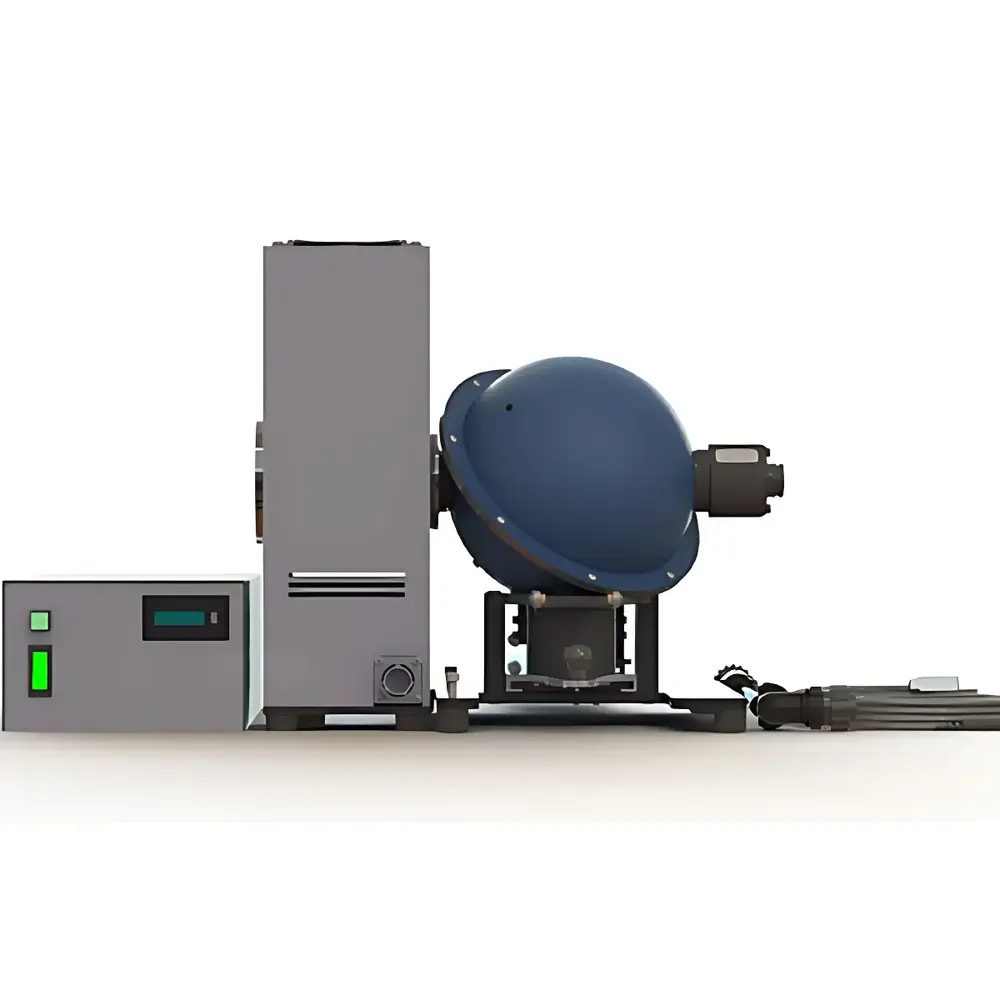
Labsphere illumia® Pro3-UV UV LED Characterization System
| Brand | Labsphere |
|---|---|
| Origin | USA |
| Model | illumia® Pro3-UV |
| Integrating Sphere Diameter | 15 cm |
| Spectral Range (Calibrated) | 200–400 nm |
| Wavelength Accuracy | ±0.4 nm |
| Integration Time | 8 ms – 900 s |
| Spectrometer | CDS-2600-UV |
Overview
The Labsphere illumia® Pro3-UV is a fully integrated, thermally controlled UV LED characterization system engineered for precision measurement of radiometric and photometric performance across the ultraviolet spectrum—from deep UV-C (200 nm) to near-UV-A (400 nm). Based on calibrated spectral radiance principles, the system employs a 15 cm integrating sphere coupled with the CDS-2600-UV spectrometer—a high-throughput, low-stray-light optical engine optimized for UV sensitivity and signal-to-noise ratio down to 200 nm. Unlike generic photometric setups, the illumia® Pro3-UV implements true radiometric traceability via NMI-traceable xenon standard lamp calibration, ensuring compliance with ISO/IEC 17025–accredited laboratory practices. Its core architecture supports simultaneous acquisition of electrical (I–V), optical (spectral radiant flux in W/nm, total radiant power in W, photon flux in mol/s), and thermal (junction temperature control and monitoring) parameters—enabling rigorous LIVT (Luminous/Radiant Flux–Current–Voltage–Temperature) analysis under steady-state or pulsed operation.
Key Features
- Full-spectrum UV radiometric characterization from 200 nm to 400 nm with wavelength accuracy better than ±0.4 nm
- 15 cm integrating sphere with high-reflectance, UV-stable Spectralon® coating (reflectance >95% at 254 nm)
- Thermoelectric temperature-controlled stage enabling precise DUT thermal management from −10 °C to +85 °C (±0.1 °C stability)
- CDS-2600-UV spectrometer featuring back-thinned CCD detector, optimized UV optics, and proprietary stray-light suppression design
- Integrated SourceMeter for synchronized forward/reverse bias current sourcing and voltage measurement (compliant with IEC 62612 and LM-80 test protocols)
- Automated LIVT sweep modes: ILV@constT, VLI@constT, TLV@constI, TLI@constV, ILV/T, and VLI/T—programmable via Integral® software
- NMI-traceable calibration using a stabilized xenon reference lamp; full calibration certificate provided per system shipment
Sample Compatibility & Compliance
The illumia® Pro3-UV accommodates surface-mount (SMD), TO-can, COB, and packaged UV-LED modules up to 25 mm × 25 mm footprint. It supports both continuous-wave (CW) and pulsed operation (with adjustable duty cycle and frequency up to 10 kHz), making it suitable for UVC germicidal irradiation (GUV), UV curing, medical phototherapy, horticultural lighting, and analytical instrumentation validation. The system meets foundational requirements for ISO 12232 (photographic exposure), ASTM E308 (computing colorimetric quantities from spectral data), and IES LM-79–15 (electrical and photometric measurements of solid-state lighting products)—with optional documentation packages available for GLP/GMP environments. All spectral data outputs include metadata compliant with ASTM E2758 for UV spectral irradiance reporting.
Software & Data Management
Integral® software provides a menu-driven, audit-ready interface designed for regulated R&D and QC laboratories. It supports full 21 CFR Part 11 compliance through user-level access control, electronic signatures, and immutable audit trails for all measurement configurations, calibration events, and raw data exports. Users define multi-step LIVT protocols—including temperature ramp rates, current step resolution (down to 0.1 mA), and integration time sequencing—with real-time overlay of spectral curves, I–V sweeps, and thermal transients. All datasets are saved in vendor-neutral HDF5 format, with built-in export to CSV, XML, and CIE 15:2018-compliant .cie files. Optional Python and MATLAB APIs enable integration into automated test benches and statistical process control (SPC) workflows.
Applications
- Development and qualification of UVC (200–280 nm) disinfection LEDs for air/water/surface sterilization systems
- Quantification of radiant efficacy (W/W), peak wavelength shift, and FWHM degradation under accelerated thermal stress
- Validation of UV-curing lamp output stability during industrial resin polymerization cycles
- Photobiological safety assessment per IEC 62471 (including effective radiant exposure calculation for UV hazard groups)
- Calibration transfer between production-line testers and metrology-grade reference instruments
- Support for DOE, JEDEC JESD22-A108, and TM-21 lifetime projection modeling using thermally stabilized LIV datasets
FAQ
What UV spectral range is supported, and how is calibration maintained?
The system is calibrated from 200 nm to 400 nm using a NIST-traceable xenon standard lamp. Recalibration is recommended annually or after 500 hours of operation above 300 nm, with full recalibration kits and service support available directly from Labsphere.
Can the system measure pulsed UV-LEDs used in sensing or time-of-flight applications?
Yes—integral triggering and configurable integration gating allow synchronization with external pulse generators. Minimum measurable pulse width is 10 µs, with jitter <100 ns.
Is thermal control limited to the DUT substrate, or does it include junction temperature estimation?
The system controls baseplate temperature with ±0.1 °C stability and supports junction temperature derivation via forward-voltage method (using pre-characterized dVf/dT coefficients), consistent with JEDEC JESD51-1.
Does the software support automated pass/fail testing against user-defined specification limits?
Yes—custom tolerancing engines allow definition of spectral, electrical, and thermal pass/fail criteria per test step, with automatic flagging and PDF report generation.
Are third-party spectrometers compatible with the illumia® Pro3-UV platform?
No—the CDS-2600-UV is tightly co-engineered with the sphere, thermal stage, and software stack; substitution compromises stray-light rejection, dynamic range, and traceability integrity.




