
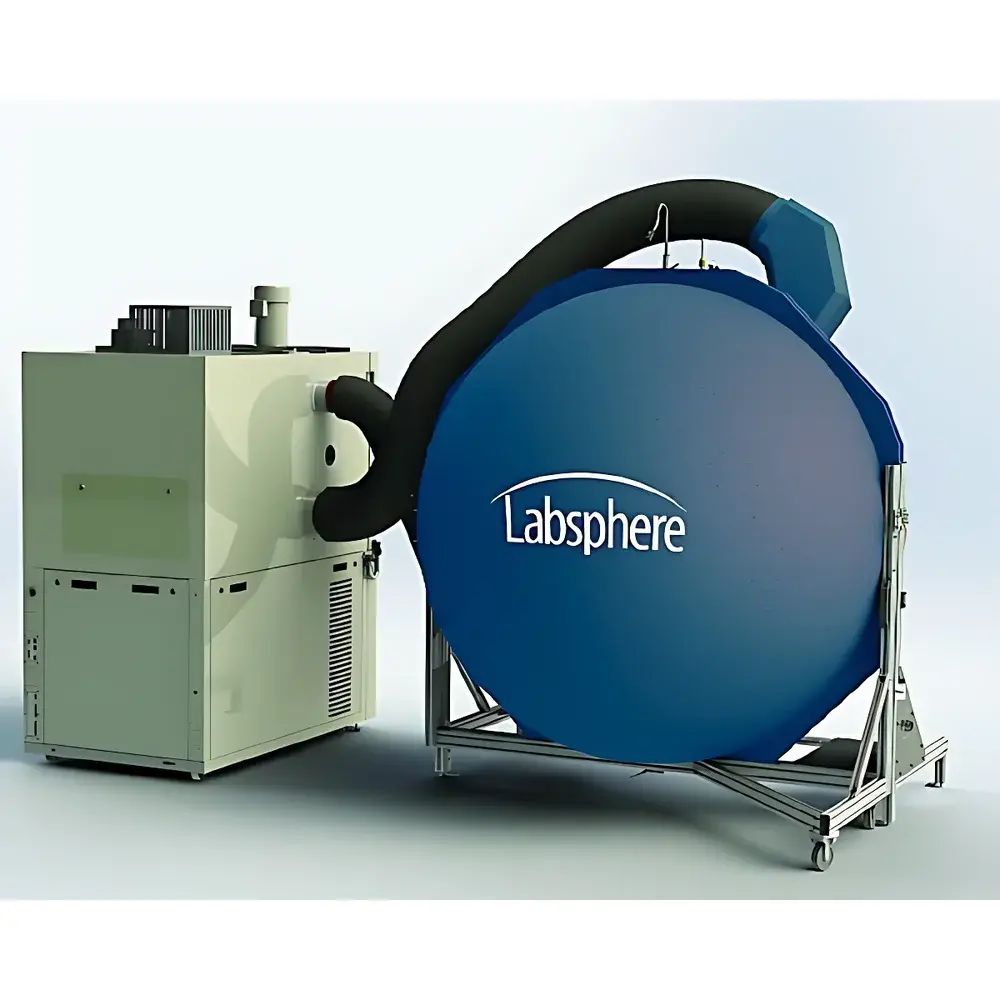
Labsphere illumia®Plus2-2600 Temperature-Controlled Integrating Sphere Spectroradiometer System
| Brand | Labsphere |
|---|---|
| Origin | USA |
| Model | illumia®Plus2-2600 |
| Integrating Sphere Diameter | 165 cm or 195 cm |
| Spectral Range | 325–1050 nm |
| Temperature Control Range | 15–80°C |
| Typical Ramp Rate (20→80°C) | 52 min |
| Detector | TE-cooled, back-illuminated CCD array |
| Exposure Time | 8 ms – 900 s |
| Compliance | IES LM-79-19, LM-82-12, LM-78-15, ISO/CIE S 025:2015 |
| Software | Integral® v5.x with automated stability assessment and CFR 21 Part 11-ready audit trail |
Overview
The Labsphere illumia®Plus2-2600 Temperature-Controlled Integrating Sphere Spectroradiometer System is an engineered solution for photometric and colorimetric characterization of solid-state lighting (SSL) devices under precisely regulated thermal conditions. It implements the fundamental principles of spectroradiometry—where spectral irradiance is measured via calibrated diffused light collection within a highly reflective integrating sphere—and integrates dynamic thermal control to emulate real-world operating environments. Unlike static room-temperature measurements, this system enables traceable, repeatable evaluation of luminous flux, chromaticity, CCT, CRI, peak wavelength, dominant wavelength, radiant flux, forward voltage, drive current, and luminous efficacy as functions of junction temperature. Its architecture adheres to the physical measurement frameworks defined in IES LM-79-19 (electrical and photometric measurements of SSL products), LM-82-12 (luminous flux and chromaticity maintenance of LED packages, arrays, and modules over temperature), and ISO/CIE S 025:2015 (spectroradiometric measurement of optical radiation). The system is not a generic spectrometer; it is a metrologically validated platform designed for R&D labs, lighting OEMs, and third-party test laboratories requiring NIST-traceable, standards-compliant thermal photometry.
Key Features
- Two configurable integrating sphere options: 165 cm (illumia®Plus2-2600-165) and 195 cm (illumia®Plus2-2600-195) diameters, optimized for spatial uniformity and signal-to-noise ratio across high-power SSL sources.
- Integrated PID-controlled thermal chamber with dual-stage feedback loop: maintains setpoint stability ±0.2°C and monitors both ambient sphere air temperature and source-level temperature via embedded thermocouples.
- CDS 2600 spectroradiometer featuring a TE-cooled, back-illuminated CCD array—enabling low-noise, high-dynamic-range spectral acquisition from 325 nm to 1050 nm with exposure times programmable from 8 ms to 900 s.
- Hardware-triggered dark measurement capability with mechanical shutter, eliminating stray-light-induced baseline drift during long integrations.
- Automated thermal ramp profiling: user-defined temperature sequences (e.g., step-and-hold, linear ramp) with real-time logging of LIV (Light–Current–Voltage) and thermal transients.
- Integral® v5.x software with built-in stability algorithms compliant with IES LM-79-19 Annex A—automatically evaluates photometric stabilization thresholds (e.g., <0.5% change over 30 s) before initiating spectral capture.
Sample Compatibility & Compliance
The system accommodates a broad range of SSL emitters—including single-die LEDs, multi-chip COBs, high-power modules, and complete luminaires—mounted on thermally managed heat sinks or PCB carriers. Fixture integration supports both vertical and horizontal orientations with standardized mechanical interfaces. All optical calibrations are performed using NIST-traceable standard lamps (e.g., FEL-type tungsten halogen standards) and validated against CIE 127:2007 and IES LM-79-19 geometric requirements. Thermal control methodology satisfies the environmental conditioning provisions of IES LM-82-12, including thermal soak time definitions and junction temperature estimation protocols. Full documentation—including calibration certificates, uncertainty budgets per GUM (JCGM 100:2008), and validation reports—is provided to support GLP/GMP audits and ISO/IEC 17025 accreditation.
Software & Data Management
Integral® v5.x delivers a secure, workflow-driven interface with role-based access control, electronic signatures, and full 21 CFR Part 11 compliance—including audit trails for all measurement parameters, calibration events, user actions, and report generation. Data export supports native .csv, .xlsx, and CIE 15:2018-compliant .cie formats. Users may define custom report templates—including multilingual text, company branding, and configurable parameter sets—for internal QA or regulatory submissions. Batch processing enables automated execution of multi-temperature test sequences with post-run statistical analysis (e.g., Δx, Δy, ΔCCT, Δlm/W vs. Tj). Raw spectral data is stored with metadata tags (timestamp, temperature setpoint, integration time, calibration ID), ensuring full traceability throughout the product lifecycle.
Applications
- Thermal derating analysis of LED packages and arrays per IES TM-21 and LM-80 extrapolation models.
- Development of thermal management strategies for automotive headlamps, horticultural lighting, and UV-C disinfection systems.
- Validation of luminaire thermal design against ENERGY STAR, DesignLights Consortium (DLC), and EU Ecodesign requirements.
- Material-level studies: phosphor thermal quenching, encapsulant yellowing, and lens transmission degradation under accelerated thermal cycling.
- Third-party certification testing for UL 1598, IEC 62471 (photobiological safety), and CISPR 15 EMC pre-scan correlation with photometric performance.
FAQ
Does the system support junction temperature estimation for bare-die LEDs?
Yes—via calibrated thermocouple placement at the thermal pad or substrate level, combined with user-input thermal resistance values (Rth) and power dissipation calculations.
Can Integral® software generate IESNA LM-79–compliant PDF reports?
Yes—preconfigured report templates meet all mandatory LM-79-19 formatting, content, and uncertainty disclosure requirements, with optional inclusion of test environment logs and calibration validity statements.
Is remote operation supported over LAN or VPN?
Yes—Integral® includes secure TCP/IP communication protocols with TLS encryption, enabling supervised remote testing while preserving audit trail integrity and user session accountability.
What is the typical calibration interval recommendation?
Annual recalibration is recommended; however, the system’s automated self-check routines and reference lamp verification protocols allow extended intervals up to 18 months under documented GLP conditions.
How is stray light minimized in the 325–1050 nm spectral range?
Through a combination of baffled sphere geometry, spectrometer-order-sorting filters, and software-based second-order correction algorithms validated per CIE 127:2007 Annex B.




