
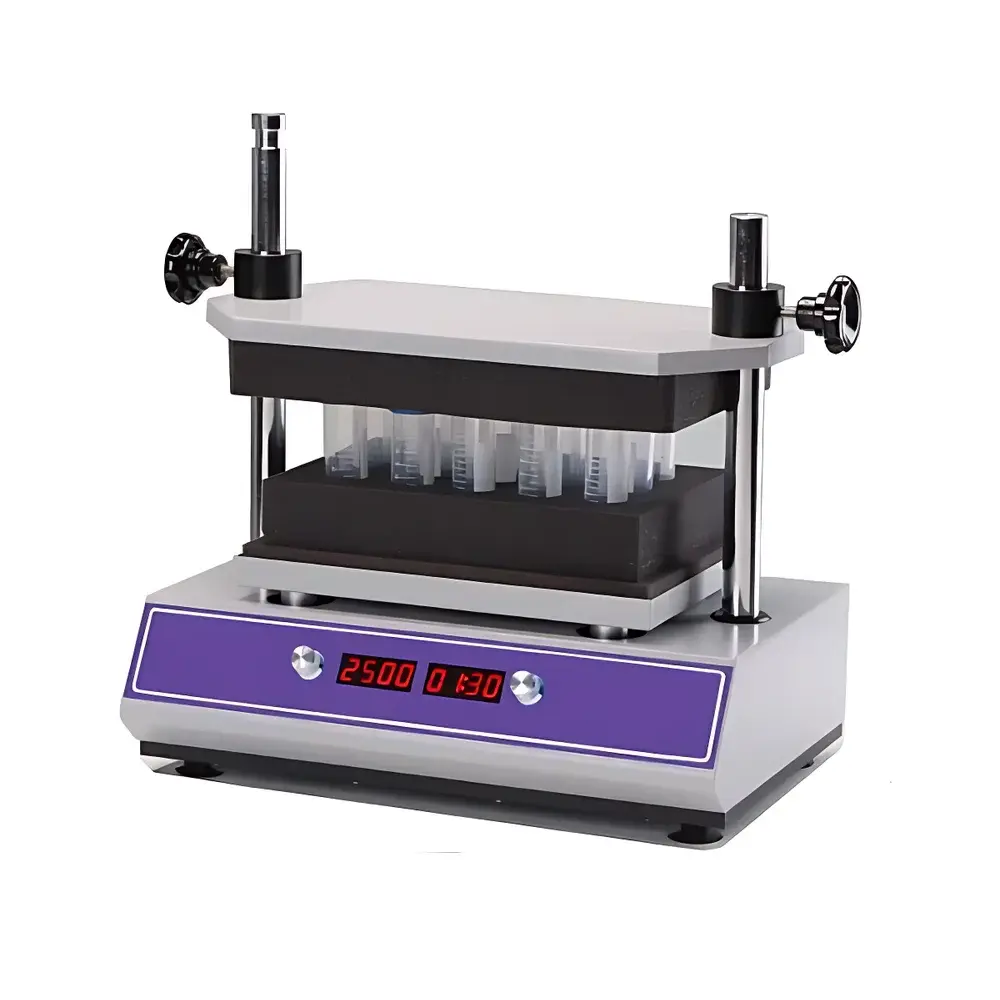
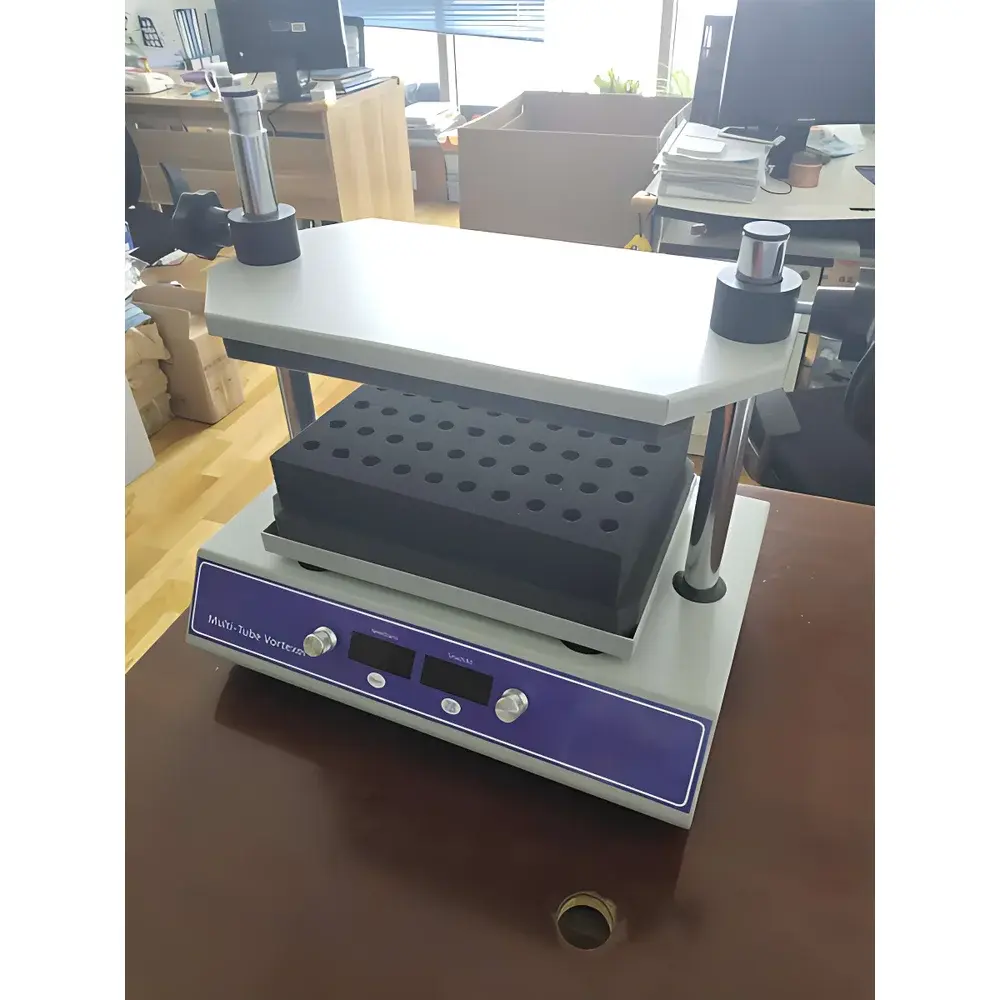
Jiayuan DJY-2500 Multi-Tube Vortex Mixer
| Brand | Jiayuan |
|---|---|
| Origin | Beijing, China |
| Model | DJY-2500 |
| Timer Range | 1 min – 99 h 59 min |
| Oscillation Amplitude | 3 mm horizontal rotation |
| Speed Range | 500 – 2500 rpm |
| Plate Quantity | 1 |
| Max Load | 4.5 kg |
| Input Power | 70 W |
| Dimensions (L×W×H) | 410 × 276 × 432 mm |
| Weight | 20 kg |
| Sample Capacity | Up to 50 tubes (configurable via interchangeable foam tube holders) |
| Operating Temperature | Ambient |
| Compliance | CE-marked design for laboratory use under IEC 61010-1 |
Overview
The Jiayuan DJY-2500 Multi-Tube Vortex Mixer is a microprocessor-controlled, high-efficiency benchtop mixing instrument engineered for reproducible, low-shear homogenization of multiple liquid samples simultaneously. Unlike orbital shakers or reciprocating platforms, the DJY-2500 employs a precisely regulated horizontal rotary motion with a fixed 3 mm amplitude—generating consistent vortexing action across all sample positions without mechanical eccentricity or vertical displacement. This design ensures uniform energy transfer to each tube, minimizing inter-sample variability and eliminating the risk of cross-contamination from splashing or condensation buildup. The device operates at ambient temperature and is optimized for applications requiring rapid equilibration of reagents, cell suspension resuspension, enzyme reaction mixing, and pre-PCR sample preparation. Its brushless DC motor delivers stable rotational output across the full 500–2500 rpm range, supporting both low-speed gentle mixing and high-speed dispersion tasks within a single platform.
Key Features
- Microprocessor-based digital control system with real-time LED display of speed (rpm) and remaining time (hh:mm)
- One-knob intuitive interface enabling seamless switching between timer mode and momentary “pulse” operation
- Soft-start acceleration profile to prevent sample splash and tube cap ejection during initiation
- Brushless DC motor ensuring speed accuracy ±3% across operating range, zero maintenance, and service life exceeding 20,000 hours
- Interchangeable foam-insert tube holders (MS200 series) accommodating standard round-bottom and conical tubes from Ø9 mm to Ø32 mm outer diameter
- Single-platform configuration supporting up to 50 tubes per run—50× Ø10 mm, 15× Ø25 mm, or mixed configurations via modular inserts
- Compliance-ready architecture: designed in accordance with IEC 61010-1 safety standards for laboratory electrical equipment; compatible with GLP documentation workflows
Sample Compatibility & Compliance
The DJY-2500 accommodates common laboratory consumables including polypropylene, glass, and PCR-grade tubes, with validated performance across volumes from 0.2 mL to 15 mL. Each MS200-series holder features laser-cut, density-graded polyurethane foam inserts that provide secure clamping force without deformation or thermal degradation. Tube compatibility includes Eppendorf-style, Falcon, and Corning formats—verified for use with viscous solutions (up to 50 mPa·s), aqueous buffers, and low-concentration cell suspensions. The unit meets electromagnetic compatibility (EMC) requirements per EN 61326-1 and carries CE marking for safe deployment in ISO 17025-accredited testing laboratories. While not a regulated medical device, its operational consistency supports adherence to CLIA and CAP pre-analytical processing guidelines when used in clinical sample preparation.
Software & Data Management
The DJY-2500 operates as a standalone instrument with no embedded software or network connectivity. All settings are retained in non-volatile memory after power cycling, and timing/speed parameters are logged locally on the LED display during active operation. For audit-trail compliance in regulated environments (e.g., pharmaceutical QC labs), users may integrate the mixer into broader electronic lab notebook (ELN) systems via external time-stamped video capture or manual entry of protocol parameters—including speed, duration, tube type, and batch ID—into LIMS-compatible templates. The absence of firmware updates or cloud dependency ensures deterministic behavior and simplifies 21 CFR Part 11 validation pathways when paired with procedural controls.
Applications
- High-throughput reagent dilution and buffer equilibration prior to ELISA, Western blotting, or immunoassay setup
- Uniform resuspension of bacterial pellets, yeast cultures, and mammalian cell lines post-centrifugation
- Homogenization of genomic DNA extraction lysates and RNA stabilization mixtures
- Pre-incubation mixing for enzymatic digestion (e.g., restriction enzymes, ligases, kinases) and RT-qPCR master mixes
- Quality control verification of sample integrity in biobanking workflows—particularly for cryovial thaw-and-mix protocols
- Supporting ISO/IEC 17025 method validation studies where mixing repeatability must be documented per SOP-087 (Sample Homogenization Consistency)
FAQ
Is the DJY-2500 suitable for use with volatile organic solvents?
Yes, provided tubes are sealed with chemically resistant caps (e.g., PTFE-lined screw caps); however, prolonged exposure to strong solvents such as chloroform or acetone may degrade foam inserts—replacement holders are available.
Can the mixer be operated inside a cold room or incubator?
It is rated for ambient operation only (0–50°C, ≤70% RH). Extended use below 15°C may affect motor torque response and LCD contrast; operation above 40°C risks thermal derating of internal electronics.
Does the device support external triggering or RS-232 communication?
No—this is a manually operated, non-networked instrument. Protocol synchronization must be achieved externally via timer relays or integrated lab automation controllers.
What maintenance is required for long-term reliability?
None beyond periodic cleaning of the platform surface and foam inserts with 70% ethanol; the brushless motor contains no brushes, bearings require no lubrication, and there are no user-serviceable parts.
How is calibration verified for regulatory submissions?
Users should perform annual speed verification using an NIST-traceable handheld tachometer and timer validation against a certified stopwatch; records should include date, operator ID, measured values, and deviation from setpoint (±3% tolerance accepted).




