
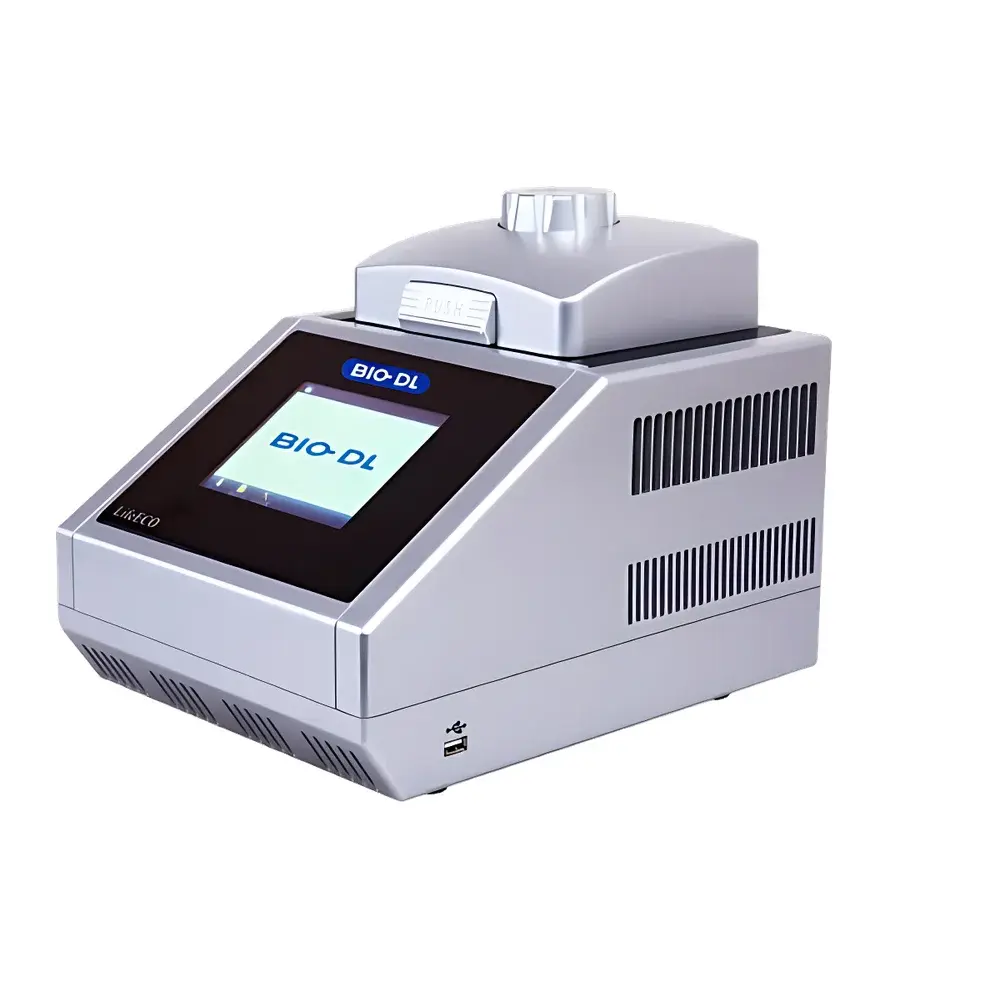
BIO-DL Life ECO Polymerase Chain Reaction Instrument
| Brand | BIO-DL |
|---|---|
| Origin | Shanghai, China |
| Manufacturer Type | Authorized Distributor |
| Country of Origin | China |
| Model | Life ECO |
| Instrument Type | Standard Thermal Cycler |
| Sample Capacity | 96-well format (0.2 mL tubes or plates) |
| Max. Heating Rate | ≥4 °C/s |
| Temperature Accuracy | ≤±0.1 °C at 55 °C |
| Well-to-Well Temperature Uniformity | ≤±0.3 °C |
| Cooling Rate | ≥4 °C/s |
| Temperature Range | 4–105 °C |
| Thermal Control Modes | Block Mode & Simulated Tube Mode |
| Gradient Range | 1–30 °C |
| Heat Lid Temperature | Adjustable from 30–110 °C with pressure regulation |
| Display | 5.7-inch color touchscreen |
| Onboard Memory | 250 protocols |
| Interface | USB port for firmware/software updates and data export |
| Power Failure Recovery | Yes |
| Soak Function | Yes |
| Certifications | Ferrotec Peltier thermoelectric modules |
Overview
The BIO-DL Life ECO Polymerase Chain Reaction Instrument is a benchtop thermal cycler engineered for precision, reproducibility, and operational flexibility in molecular biology laboratories. It employs solid-state Peltier-based thermoelectric heating and cooling technology to deliver rapid and accurate temperature transitions across the full operational range of 4–105 °C. Unlike conventional air- or water-cooled systems, the Life ECO’s semiconductor architecture enables bidirectional thermal control—achieving both ≥4 °C/s heating and ≥4 °C/s cooling rates—while maintaining exceptional thermal stability during hold phases. Its core design integrates TAS (Thermal Accuracy Stabilization), a proprietary thermal field optimization algorithm that compensates for edge effects across the 96-well block, ensuring uniform thermal exposure across all sample positions. This instrument operates under two distinct thermal control paradigms: Block Mode for maximal throughput consistency and Simulated Tube Mode, which emulates the thermal profile of individual reaction tubes to improve amplification fidelity in low-volume or heterogeneous reactions.
Key Features
- High-performance Peltier thermoelectric module (Ferrotec-certified) delivering precise, repeatable thermal cycling without mechanical moving parts or consumables.
- TAS technology minimizes radial and peripheral thermal gradients, achieving ≤±0.3 °C well-to-well uniformity across the entire 96-well aluminum block.
- Temperature accuracy of ≤±0.1 °C at 55 °C and ≤±0.2 °C above 90 °C—validated per ISO/IEC 17025-compliant calibration protocols.
- Adjustable heat lid (30–110 °C) with mechanical pressure regulation to accommodate varying tube geometries (0.2 mL single tubes, 8-tube strips, and full 96-well plates), preventing condensation and evaporation-induced concentration drift.
- 5.7-inch capacitive color touchscreen with intuitive icon-driven interface; supports multi-language UI (English, Spanish, French, German, Chinese) and protocol cloning, editing, and validation directly on-device.
- Onboard storage for up to 250 user-defined programs, including gradient PCR with programmable differential ranges from 1–30 °C across adjacent columns.
- USB 2.0 interface compliant with Windows/macOS/Linux for firmware updates, protocol import/export, and audit-trail-enabled software synchronization.
Sample Compatibility & Compliance
The Life ECO supports standard 96-well formats: skirted and unskirted microplates, 0.2 mL thin-wall PCR tubes, and 8-tube strips—compatible with common master mixes, hot-start polymerases, and probe-based chemistries (e.g., TaqMan, SYBR Green). Its thermal architecture meets critical requirements for ISO 13485-aligned IVD assay development and GLP-compliant nucleic acid testing workflows. Certification portfolio includes CE marking under Directive 2014/30/EU (EMC) and 2014/35/EU (LVD), RoHS 2.0 (2011/65/EU), MET Laboratories safety certification, and PICC product liability insurance coverage. While not FDA 510(k)-cleared, the instrument adheres to ASTM E2500-13 guidelines for verification of laboratory equipment performance and supports 21 CFR Part 11-compliant data integrity when paired with validated third-party LIMS integration tools.
Software & Data Management
The Life ECO operates independently but interfaces seamlessly with BIO-DL’s PC-based Thermal Cycler Control Suite (v3.2+), a Windows-native application supporting method versioning, electronic signature capture, and automated report generation (PDF/CSV). All protocol modifications, run logs, and system diagnostics are timestamped and stored with immutable metadata—including operator ID, ambient conditions (if external sensor connected), and thermal deviation alerts. The USB interface permits secure offline transfer of encrypted run files, enabling traceability in regulated environments where network isolation is mandated. Firmware updates include cryptographic signature verification to prevent unauthorized modification.
Applications
This thermal cycler serves routine and advanced molecular applications including end-point PCR, touchdown PCR, colony PCR, genotyping, cDNA synthesis, and pre-sequencing library amplification. Its gradient capability supports primer annealing optimization, while Soak functionality enables post-PCR hold steps for downstream enzymatic treatments (e.g., A-tailing, phosphorylation). The instrument is routinely deployed in academic core facilities, clinical research labs conducting non-diagnostic assays, food safety testing (ISO 16140-2), and environmental pathogen screening (EPA Method 1615). Its robust thermal repeatability makes it suitable for quantitative endpoint comparisons in QC/QA settings where inter-run coefficient of variation (CV) must remain below 2.5% for Ct equivalence studies.
FAQ
Does the Life ECO support remote monitoring or network connectivity?
No—this model lacks Ethernet/Wi-Fi hardware and is designed for standalone operation or local USB-based control only.
Can the instrument be calibrated in-house using NIST-traceable standards?
Yes; the device accepts external PT100 probes for independent verification of block temperature, and calibration routines follow ISO/IEC 17025 Annex B guidance for thermal cyclers.
Is gradient PCR limited to linear temperature distribution?
Yes—the gradient is applied across columns (e.g., column 1 = 55 °C, column 12 = 85 °C), forming a linear ramp; non-linear or multi-zone gradients are not supported.
What maintenance is required beyond routine cleaning?
None—Peltier modules are sealed and maintenance-free; annual verification of thermal accuracy and uniformity is recommended using certified reference materials.
Does the heat lid pressure adjustment require tools?
No—pressure is adjusted manually via dual knurled dials located at the rear of the lid assembly, allowing tool-free adaptation to tube height variations.




