
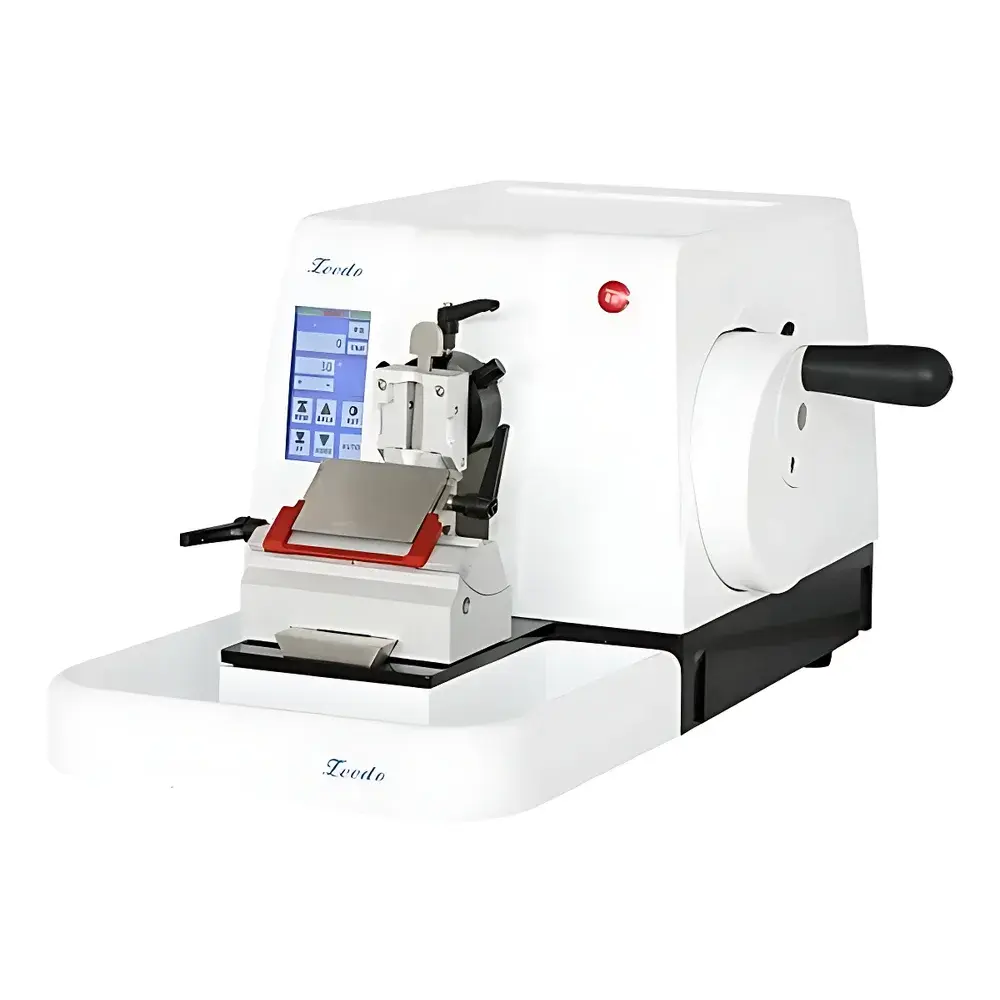
ZEEDO HS-3345 Fully Automated Rotary Microtome
| Brand | ZEEDO |
|---|---|
| Origin | Zhejiang, China |
| Model | HS-3345 |
| Max Sample Size | 55 mm × 40 mm |
| Section Thickness Range | 1–100 µm |
| Section Increment | 1 µm (1–20 µm range) |
| Retraction Range | 0–95 µm (5 µm increment) |
| Specimen Horizontal Travel | 25 mm |
| Specimen Vertical Travel | 70 mm |
| XY Stage Tilt Adjustment | ±8° |
| Language Interface | English & Chinese |
| Compliance | Designed for ISO 13485-aligned lab environments and GLP-compliant histopathology workflows |
Overview
The ZEEDO HS-3345 Fully Automated Rotary Microtome is an engineered solution for high-precision sectioning of paraffin-embedded, frozen, and semi-hard biological tissues in clinical pathology, academic research, and pharmaceutical preclinical laboratories. Utilizing a precision-engineered rotary cutting mechanism with cross-roller linear guides, the instrument delivers consistent, vibration-damped advancement of the specimen block during sectioning—enabling reproducible slice geometry critical for downstream H&E staining, immunohistochemistry (IHC), and digital pathology scanning. Its dual-mode capability supports both routine paraffin sectioning (1–100 µm) and rapid cryosectioning protocols without hardware modification, making it suitable for time-sensitive intraoperative diagnostics and longitudinal tissue banking applications.
Key Features
- Fully automated sectioning modes: continuous, stepwise, and single-section—each programmable via intuitive touchscreen interface with real-time feedback on thickness, count, and status.
- Three-stage incremental adjustment system: 1 µm increments from 1–20 µm; 5 µm from 20–60 µm; 10 µm from 60–95 µm—optimized for morphological fidelity at standard diagnostic thicknesses (3–5 µm).
- Motorized specimen retraction (0–95 µm, 5 µm steps) prevents knife-edge contact during return stroke, minimizing chatter artifacts and preserving blade integrity.
- Cross-roller linear guide system eliminates need for periodic lubrication while maintaining sub-micron positional repeatability across >10,000 operational cycles.
- Balanced handwheel assembly with counterweight mechanism ensures uniform torque distribution—reducing operator fatigue during extended manual operation or fine-tuning tasks.
- Lateral knife-carriage translation (no finger contact required) enables three distinct cutting zones per disposable blade, extending usable life by up to 3× versus conventional mounting.
- Specimen stage with ±8° XY-axis tilt adjustment allows precise angular alignment of irregular or oblique tissue blocks prior to sectioning.
- Integrated emergency stop button compliant with IEC 61000-6-2 electromagnetic compatibility and EN 60601-1 medical electrical equipment safety standards.
Sample Compatibility & Compliance
The HS-3345 accommodates standard histological cassettes and proprietary embedding molds up to 55 mm × 40 mm in footprint. It accepts both steel and disposable tungsten-carbide blades (e.g., Feather S35, Leica 819), with adjustable knife angle (0–5°) and clearance (0.5–3.0°) to optimize chip removal for soft neural tissues or dense calcified specimens. The instrument meets structural and functional requirements referenced in ISO 20610:2018 (microtomes — terminology and performance criteria) and supports traceability workflows aligned with CLIA, CAP, and ISO/IEC 17025 accreditation frameworks. All firmware logs—including user ID, timestamp, thickness setting, and cycle count—are retained for audit-ready GLP/GMP documentation.
Software & Data Management
The embedded control system runs a dual-language (English/Chinese) GUI with non-volatile memory storing up to 50 customizable protocol presets. Sectioning parameters are exportable via USB 2.0 as CSV files for integration into LIMS platforms. While the device does not include cloud connectivity or FDA 21 CFR Part 11-compliant electronic signatures out-of-the-box, its audit trail architecture—recording all parameter changes, mode selections, and emergency interventions—is structured to support validation under internal SOPs governing regulated environments.
Applications
- Routine histopathology: serial sectioning of FFPE blocks for diagnostic evaluation in hospital labs and reference centers.
- Preclinical toxicology: standardized sectioning of rodent organ tissues for dose-response assessment in GLP-compliant studies.
- Neuroscience research: ultra-thin (1–3 µm) sections of resin-embedded brain tissue for electron microscopy grid preparation.
- Plant morphology: sectioning of lignified stem and root samples without compression artifacts using optimized feed rate and retraction profiles.
- Quality control in biobanking: batch processing of archival tissue cores with thickness consistency verified via calibrated micrometer measurement.
FAQ
What types of tissue can the HS-3345 process?
It handles paraffin-embedded, OCT-frozen, decalcified, and moderately hardened plant or bone tissues—provided sample dimensions remain within the 55 mm × 40 mm clamp limit.
Is the microtome compatible with third-party blades?
Yes—standard 35 mm-wide disposable blades (Feather, Leica, Sakura) and reusable steel knives conforming to ISO 8600-1:2017 dimensions are supported.
Does the HS-3345 meet regulatory requirements for clinical labs?
It is designed for use in ISO 13485-aligned facilities and supports documentation practices required by CAP and CLIA; however, site-specific validation is required for diagnostic reporting.
Can section thickness be verified independently?
Yes—thickness accuracy is confirmed using NIST-traceable interferometric calibration standards; routine verification is recommended before each batch run.
What maintenance is required for long-term reliability?
Beyond daily cleaning and periodic blade replacement, only annual inspection of guide rail preload and handwheel bearing preload is advised—no scheduled lubrication is necessary due to the sealed cross-roller design.



