
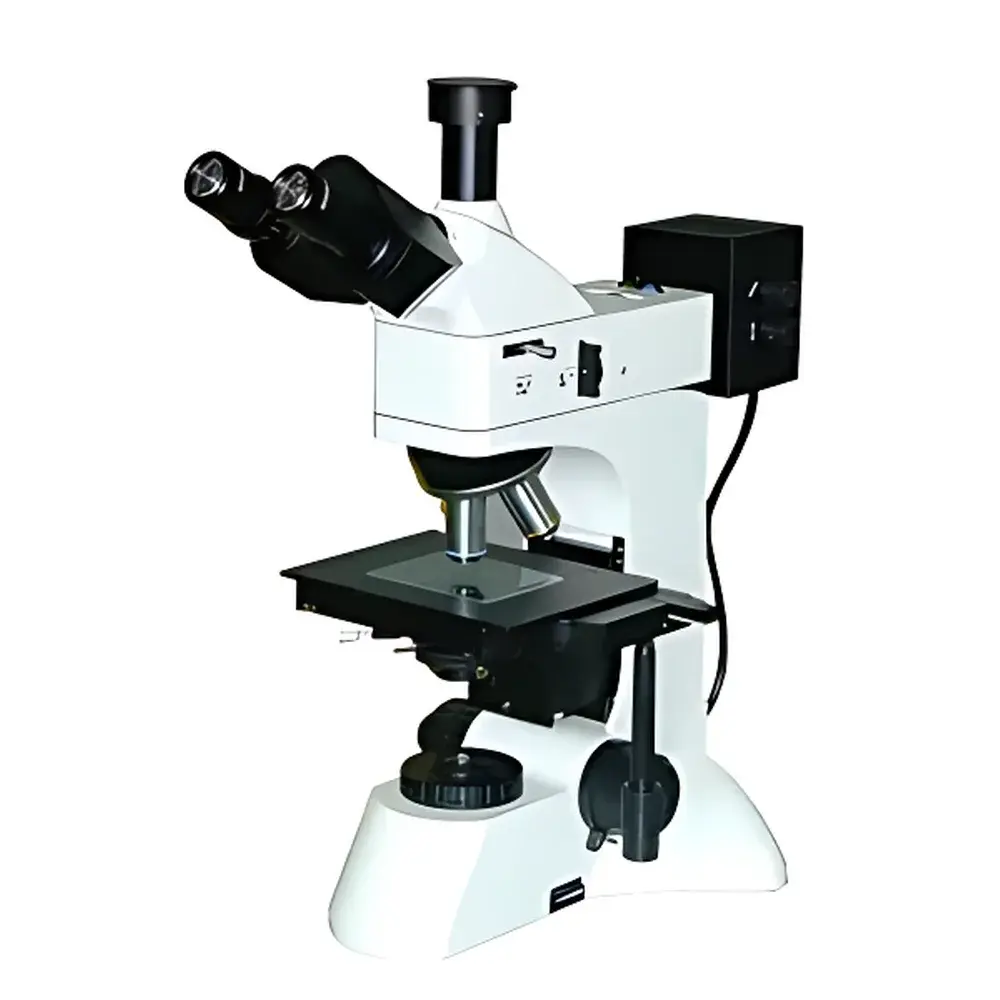
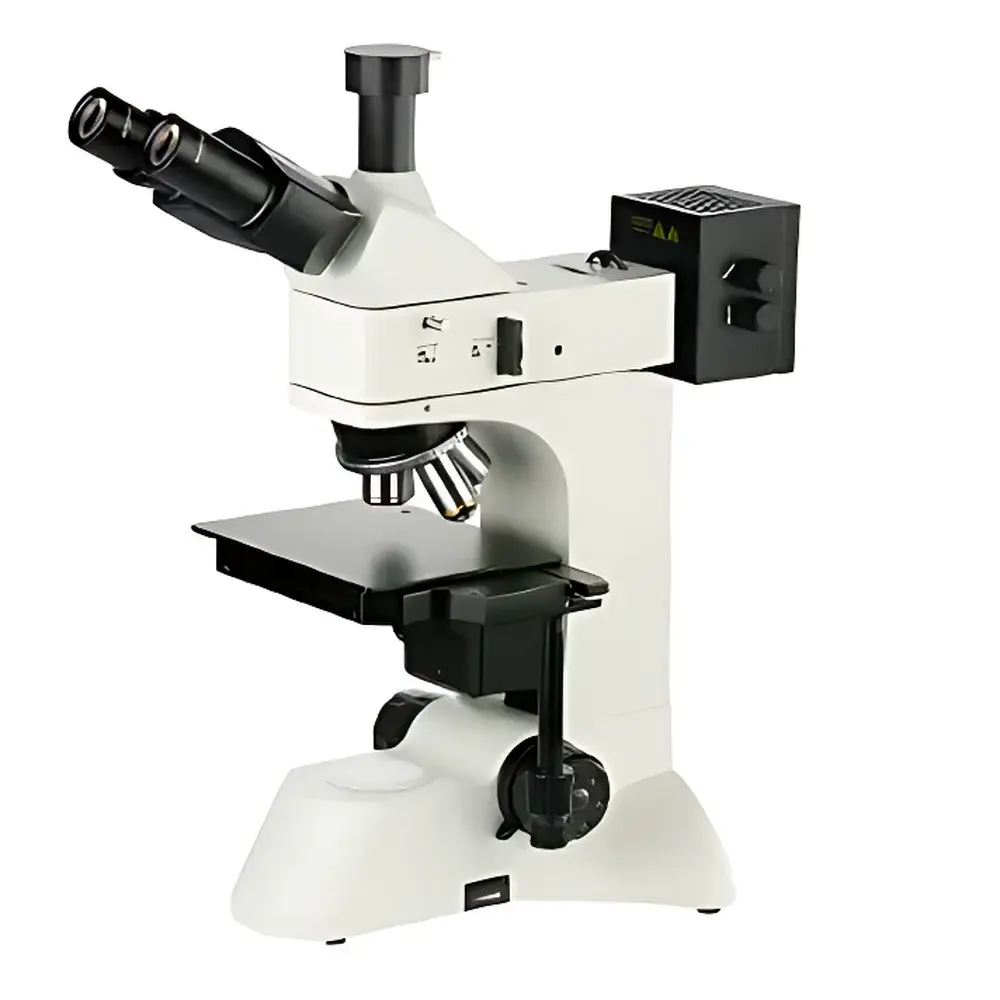
De尔斯 MST-R Upright Reflected & Transmitted Light Metallurgical Microscope
| Brand | De'ers / DS |
|---|---|
| Origin | Beijing, China |
| Manufacturer Type | Authorized Distributor |
| Product Origin | Domestic (China) |
| Model | MST-R |
| Price | USD 2,700 (approx.) |
| Configuration | Upright |
| Total Magnification Range | 50× to 1000× |
| Eyepieces | Wide-Field 10× (Φ22 mm) |
| Objectives | Infinity-Corrected Long Working Distance Achromatic Plan Objectives — 5×/0.12, 10×/0.25, 20×/0.40, 40×/0.60, 60×/0.70, 100×/0.85 (dry) |
| Focusing Mechanism | Coaxial coarse/fine adjustment with 2 µm fine-focus graduation, tension adjustment, and upper/lower limit locks |
| Stage Travel | 75 mm × 50 mm (mechanical), 30 mm vertical clearance |
| Illumination | Dual-path — reflected (epi-illumination) and transmitted (Köhler illumination via Abbe condenser NA 1.25) |
| Built-in Polarizing System | Rotatable polarizer and analyzer, push-pull configuration |
| Trinocular Tube | 30° inclination, 100% light path diversion for imaging |
| Certifications | Compliant with ISO 10934-1 (optical microscopy terminology), GB/T 22057–2008 (Chinese national standard for metallurgical microscopes) |
Overview
The De’ers MST-R Upright Reflected & Transmitted Light Metallurgical Microscope is engineered for high-fidelity microstructural analysis of both opaque and transparent specimens in industrial quality control, materials science research, and failure analysis laboratories. Its dual-illumination architecture—combining Köhler-optimized transmitted-light optics with adjustable epi-illumination—enables rigorous examination of polished metallographic sections, semiconductor wafers, coated substrates, mineral thin sections, and composite cross-sections without reconfiguration. The system employs infinity-corrected long-working-distance plan achromatic objectives (5× to 100×), eliminating cover-slip dependency and ensuring consistent aberration correction across magnifications. Optical path design conforms to ISO 8578 and ASTM E3–22 standards for metallographic specimen evaluation, supporting quantitative grain size measurement (ASTM E112), inclusion rating (ASTM E45), and phase distribution mapping under both brightfield and polarized contrast modes.
Key Features
- Infinity-corrected long working distance plan achromatic objectives (PL L5×/0.12, PL L10×/0.25, PL L20×/0.40, PL L40×/0.60, PL L60×/0.70, PL L100×/0.85 dry) with calibrated working distances from 26.1 mm down to 0.4 mm—enabling safe observation of tall or uneven samples including mounted metallographic specimens and PCB assemblies.
- Coaxial coarse/fine focusing mechanism with 2 µm fine-focus graduation, adjustable coaxial tension control, and mechanical upper/lower limit stops—ensuring repeatability during serial sectioning or multi-layer thickness profiling.
- Dual independent illumination pathways: (1) Reflected-light path with 6 V / 30 W halogen lamp, continuously variable intensity control, field and aperture diaphragms, and integrated filter turret (including green/yellow interference filters); (2) Transmitted-light path featuring an NA 1.25 Abbe condenser with centering adjustment, built-in blue filter and ground-glass diffuser, and matched 6 V / 30 W halogen source.
- Trinocular observation tube inclined at 30°, offering 100% beam-splitting capability for simultaneous visual observation and digital imaging—compatible with C-mount adapters (0.4×, 0.5×, 1×) and standardized CCD/CMOS cameras meeting USB 2.0 or analog video (NTSC/PAL) output specifications.
- Built-in polarizing optical train with rotatable linear polarizer (below condenser) and push-pull analyzer (above objective turret), enabling stress birefringence detection in polymers, crystal orientation analysis in alloys, and anisotropic phase identification in geological thin sections.
Sample Compatibility & Compliance
The MST-R accommodates standard 25 mm and 30 mm metallographic mounts, as well as glass slides up to 1.2 mm thickness. Its 210 mm × 140 mm double-layer mechanical stage provides 75 mm × 50 mm travel range with vernier-scale positioning—critical for systematic grid-based inspection per ISO 14644-1 cleanroom particulate protocols or MIL-STD-883H microsectioning workflows. All optical components comply with RoHS Directive 2011/65/EU and CE marking requirements for laboratory instrumentation. The microscope supports GLP-compliant documentation when paired with validated camera systems and timestamped image acquisition software—fully traceable metadata capture aligns with FDA 21 CFR Part 11 electronic record provisions when configured with audit-trail-enabled imaging platforms.
Software & Data Management
While the MST-R operates as a hardware platform without embedded firmware, it integrates seamlessly with third-party metrology and image analysis software suites—including Olympus cellSens, Media Cybernetics Image-Pro Premier, and open-source Fiji/ImageJ—via standard USB 2.0 or analog video interfaces. Optional CCD modules (e.g., DV-1, DV-2, DV-3 series) deliver calibrated pixel resolution (up to 3 MP), dynamic range ≥60 dB, and real-time frame rates compatible with time-lapse microstructural evolution studies. All digital outputs retain EXIF metadata (magnification, objective ID, exposure time, illumination mode), facilitating automated report generation aligned with ISO/IEC 17025 accredited testing laboratory requirements.
Applications
- Metallography: Grain boundary delineation, inclusion quantification (ASTM E45), heat-affected zone (HAZ) characterization, and coating thickness verification on ferrous/non-ferrous alloys.
- Electronics Failure Analysis: Solder joint integrity assessment, die attach void detection, and intermetallic compound (IMC) layer thickness measurement on BGA packages.
- Geological Petrography: Identification of birefringent mineral phases (e.g., quartz, feldspar, olivine) using conoscopic and orthoscopic polarized light modes.
- Quality Assurance in Additive Manufacturing: Porosity analysis, melt pool morphology evaluation, and residual stress-induced birefringence mapping in Ti-6Al-4V and Inconel 718 builds.
- Academic Teaching Labs: Structured pedagogy modules for optical principles (Abbe theory, numerical aperture, depth of field), diffraction-limited resolution validation, and comparative microscopy methodology training.
FAQ
What is the maximum usable magnification for the 100× objective?
The 100× dry objective (NA 0.85) achieves optimal resolution at 1000× total magnification when used with the standard 10× wide-field eyepiece; further digital zoom does not enhance resolvable detail and is discouraged for quantitative analysis.
Can the MST-R be used for differential interference contrast (DIC)?
No—the system lacks DIC prism slots and strain-free objectives required for Nomarski contrast; however, it supports brightfield, darkfield (with optional stop), and polarized light contrast modes.
Is the halogen illumination stable enough for photomicrography?
Yes—both reflected and transmitted halogen sources feature constant-voltage regulation and thermal stabilization circuitry, minimizing intensity drift (<±1.5% over 30 min), essential for multi-frame stacking and time-series documentation.
Does the microscope support motorized stage or autofocus upgrades?
Not natively—the MST-R uses manual mechanical translation and focus; however, third-party motorized XY stages with RS-232 or USB interface can be retrofitted using standard mounting threads (M4/M6), subject to payload compatibility verification.
What calibration standards are recommended for routine verification?
NIST-traceable stage micrometers (0.01 mm division) and resolution test targets (e.g., USAF 1951) are recommended for daily alignment checks; objective magnification verification should follow ISO 10934-2 procedures using certified reference slides.



