
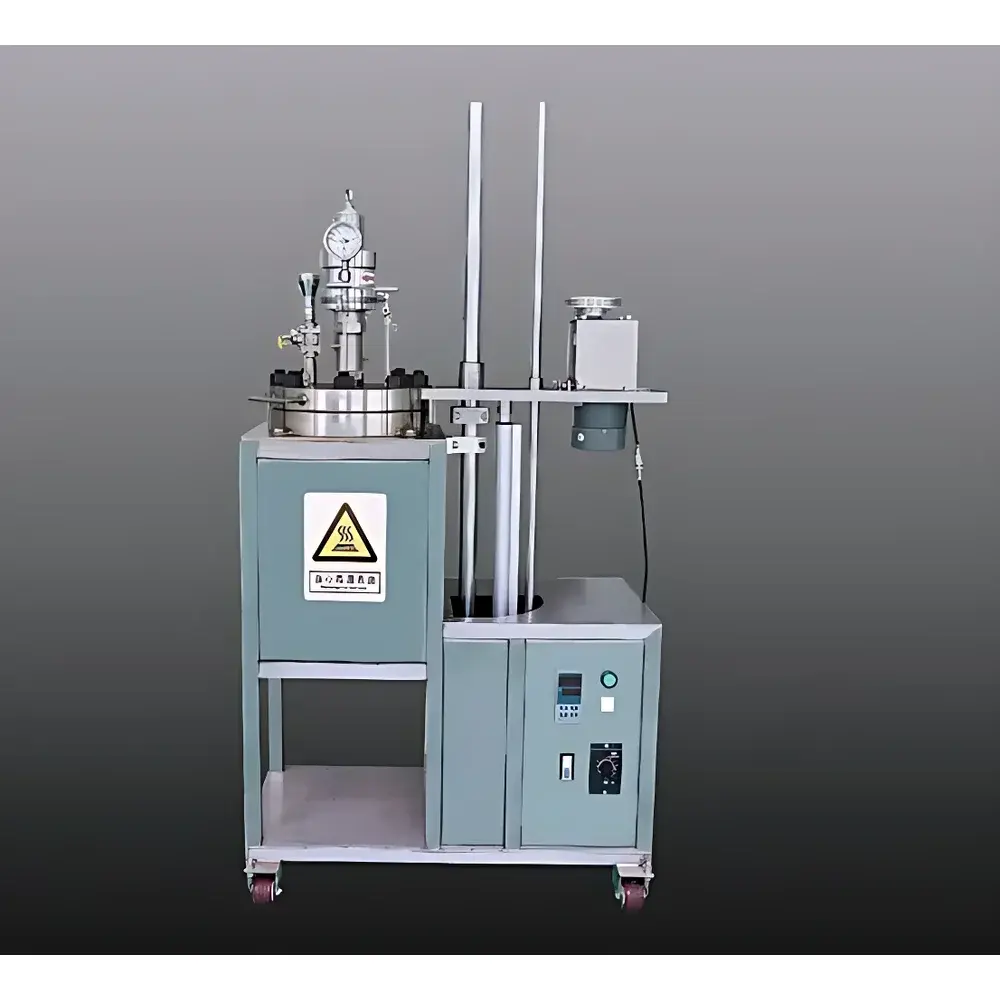
Kemi MSL Series Mechanical Stirring Reactor
| Origin | Anhui, China |
|---|---|
| Manufacturer Type | Distributor |
| Origin Category | Domestic |
| Model | MSL |
| Price Range | USD 2,800 – 7,000 (FOB) |
| Vessel Capacity | 5 L, 10 L, 20 L, 40 L, 50 L |
| Vessel Material | ASTM A240 316L Stainless Steel |
| Maximum Working Pressure | 30 bar (435 psi) up to 207 bar (3,000 psi), depending on configuration |
| Maximum Operating Temperature | 100 °C to 300 °C |
| Drive System | High-Torque Magnetic Coupling Stirrer |
| Sealing | Full Static Seal (No Dynamic Shaft Seal) |
| Frame Design | Integrated Benchtop/Free-Standing Monocoque Structure with Electric Linear Actuator or Hoist-Assisted Lid Handling |
| Bottom Discharge | Standard Ball Valve (DN25/DN40) |
| Control System | IPT Programmable Temperature Controller (Optional: Touchscreen Expert PID Controller) |
| Compliance | Designed per ASME BPVC Section VIII Div. 1 (when specified), ISO 9001–certified manufacturing process, compatible with GLP/GMP documentation workflows |
Overview
The Kemi MSL Series Mechanical Stirring Reactor is an engineered solution for mid-scale laboratory and pilot-plant synthesis under controlled temperature, pressure, and agitation conditions. Based on Couette-type fluid dynamics and torque-transmitted magnetic coupling, the MSL reactor enables reproducible heterogeneous and homogeneous reactions—including hydrogenation, polymerization, catalytic oxidation, and high-viscosity slurry processing—without compromising seal integrity. Its monocoque architecture integrates the vessel, heating mantle (electric resistance or oil-jacketed), and structural frame into a single rigid assembly, minimizing thermal drift and mechanical resonance during extended operation. The reactor supports batch-mode operation across five standard capacities (5 L to 50 L), with pressure ratings scalable from 30 bar (435 psi) up to 207 bar (3,000 psi), and temperature capability extending to 300 °C—enabling compliance with reaction protocols defined in ASTM D1565, ISO 11348, and USP for chemical process development.
Key Features
- Static-seal magnetic drive system delivering >15 N·m nominal torque, eliminating shaft seal wear, leakage risk, and maintenance downtime associated with conventional mechanical seals.
- Electric linear actuator–assisted lid lifting (standard on 5–20 L units); optional overhead hoist mechanism for 40 L and 50 L configurations to ensure safe, repeatable lid removal and repositioning.
- Full 316L stainless steel wetted parts (ASME SA-240 certified), including vessel body, lid, internal baffles, and agitator shaft—resistant to chloride-induced stress corrosion cracking and compatible with nitric acid passivation per ASTM A967.
- Modular interface design supporting simultaneous integration of sampling valves (standard or balanced reflux), bottom discharge ball valves (DN25/DN40), liquid/solid feed ports, pressure transducers (0–250 bar range), digital pressure indicators, rupture discs, and internal cooling coils.
- Pre-wired IPT programmable temperature controller (±0.5 °C accuracy, 0.1 °C resolution) with ramp-soak profiles, real-time data logging, and RS485 Modbus RTU output; optional touchscreen expert controller includes audit trail, user-level access control, and FDA 21 CFR Part 11–compliant electronic signatures.
Sample Compatibility & Compliance
The MSL reactor accommodates viscous liquids (up to 50,000 mPa·s), suspended catalysts (e.g., Pd/C, Raney Ni), particulate slurries, and corrosive reagents (e.g., HCl, H₂SO₄, HF at controlled concentrations). All wetted components meet material traceability requirements per EN 10204 3.1. Pressure-bearing assemblies are fabricated and tested per ISO 15848–2 for fugitive emission control. Optional configurations include ASME U-stamp certification, third-party hydrostatic test documentation (1.5× MAWP), and FAT/SAT reports aligned with ICH Q7 and EU GMP Annex 15 standards.
Software & Data Management
Data acquisition is supported via native Modbus RTU integration with SCADA platforms (e.g., Ignition, Siemens Desigo CC). The optional expert controller embeds embedded SQLite database logging (timestamped T, P, RPM, power draw) with configurable export to CSV or PDF. Audit trails record operator ID, parameter changes, alarm events, and calibration actions—fully compliant with ALCOA+ principles. Raw sensor outputs are timestamp-synchronized to within ±10 ms, enabling kinetic modeling in MATLAB or Python-based reaction engineering suites.
Applications
- Catalytic hydrogenation of unsaturated organic compounds under 10–50 bar H₂.
- High-temperature esterification and transesterification for biodiesel R&D.
- Batch crystallization studies with in situ FBRM or PVM integration (via flanged optical port).
- Electrochemical synthesis requiring inert atmosphere and precise potential control (compatible with external potentiostat interfacing).
- Thermal stability testing of energetic materials per UN Test Series 3 (with appropriate safety interlocks).
FAQ
What pressure and temperature combinations are validated for the 20 L MSL unit with 316L construction?
For 20 L vessels, maximum validated operating conditions are 103 bar / 300 °C (P3/T3 rating), verified by finite element analysis (FEA) and hydrostatic proof testing per ISO 9001 QA protocol.
Can the MSL reactor be configured for continuous feed while maintaining pressure integrity?
Yes—liquid addition via calibrated metering pump (LF option) and solid dosing through pressurized lock-hopper (SF option) maintain system pressure within ±0.5 bar during feeding cycles.
Is remote monitoring supported out-of-the-box?
Standard IPT controller supports local display only; Ethernet/WiFi gateway modules and cloud telemetry (MQTT/HTTPS) are available as add-on kits with TLS 1.2 encryption.
Are spare parts and calibration services available internationally?
All critical spares (magnetic couplers, pressure sensors, thermowells) are stocked in Hamburg and Singapore distribution hubs; NIST-traceable calibration certificates issued upon request.
Does the system comply with explosion protection directives for Zone 1 environments?
ATEX/IECEx-certified variants (II 2G Ex db IIB T4 Gb) are available with flameproof enclosures and intrinsically safe instrumentation loops—consult factory for hazardous area classification mapping.



