
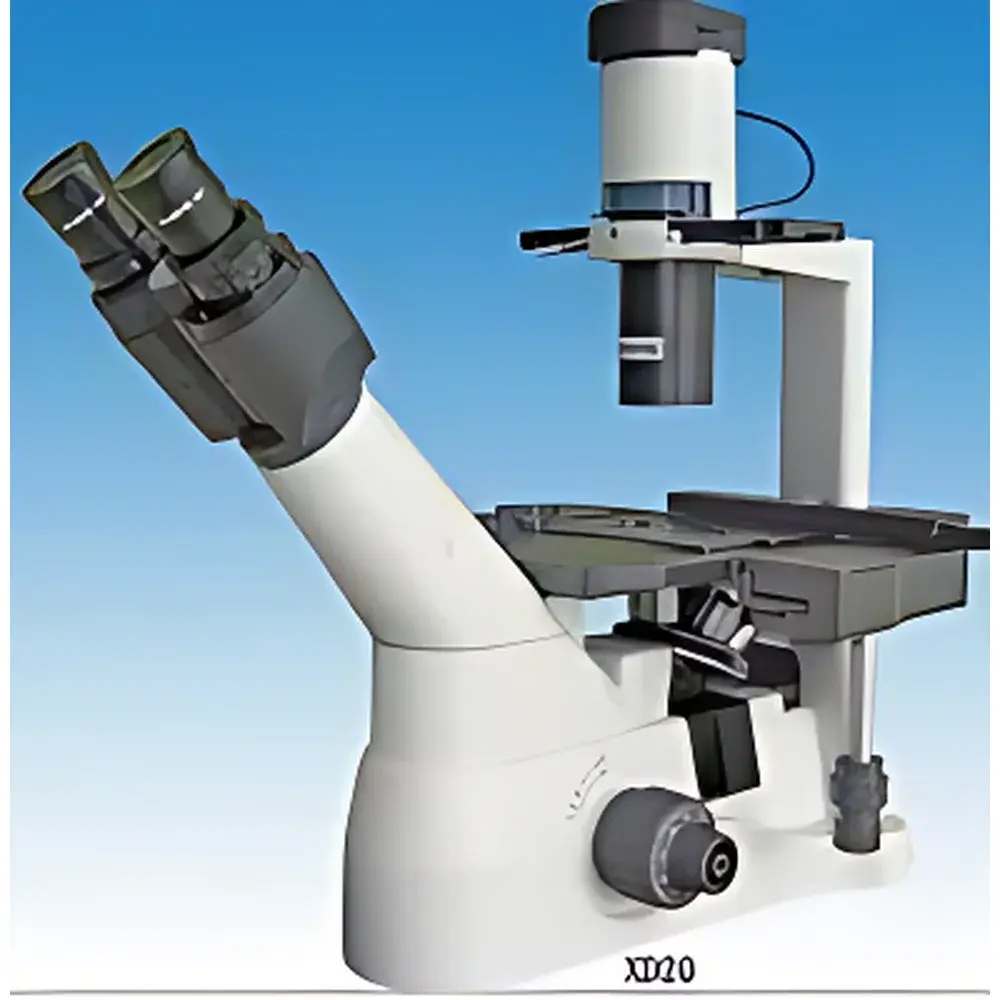
CSIS XD20 Inverted Fluorescence Microscope
| Origin | Beijing, China |
|---|---|
| Manufacturer Type | Authorized Distributor |
| Country of Origin | Domestic (PRC) |
| Model | XD20 |
| Instrument Type | Inverted Fluorescence Microscope |
| Optical System | CSIS Infinity-Corrected Achromatic Optics |
| Illumination | 6V30W Halogen Lamp (Pre-centered) |
| Objective Working Distance | Long Working Distance (LWD) |
| Phase Contrast Capability | Yes |
| Fluorescence Excitation | Standard Filter Cube Set (e.g., DAPI/FITC/TRITC) |
Overview
The CSIS XD20 Inverted Fluorescence Microscope is an engineered optical platform designed for live-cell imaging, long-term culture observation, and quantitative fluorescence analysis in biological laboratories. Built upon an inverted optical architecture, the system positions the objective lenses beneath the specimen stage—enabling direct visualization of adherent or suspended cells within standard tissue culture vessels (e.g., Petri dishes, flasks, and multi-well plates) without specimen removal or mounting. Its optical core integrates a CSIS infinity-corrected achromatic optical pathway, ensuring consistent image fidelity across magnifications and minimizing chromatic aberration in both brightfield and fluorescence modalities. The microscope employs epi-illumination fluorescence excitation with standardized filter cube configurations (including DAPI, FITC, and TRITC bands), supporting common fluorophores used in immunocytochemistry, GFP-tagged protein tracking, and nucleic acid staining protocols. Designed for stability under extended acquisition, the rigid mechanical chassis minimizes thermal drift and vibration-induced blur—critical for time-lapse microscopy and low-light fluorescence detection.
Key Features
- Long working distance (LWD) infinity-corrected objectives (4×, 10×, 20×, 40×) optimized for through-vessel imaging with minimal spherical distortion
- Dual-mode optical path: simultaneous brightfield, phase contrast, and epifluorescence observation via turret-mounted filter cubes
- Adjustable N.A. 0.3 condenser with 72 mm working distance—compatible with thick-bottomed cultureware and inverted-stage accessories
- Phase contrast slider with pre-aligned annuli for 10×, 20×, and 40× objectives; includes centering telescope for precise alignment verification
- Biocular or trinocular head options support real-time visual inspection and digital capture via C-mount interface (C-mount adapter included)
- Coaxial coarse/fine focusing mechanism with 2 µm fine-focus graduation and torque-limiting safety clutch
- Modular stage design accommodating multiple specimen holders: 35 mm Petri dish cradle, standard slide holder, Terasaki plate adapter, and custom-fit extensions
Sample Compatibility & Compliance
The XD20 accommodates a broad range of live and fixed biological specimens—including monolayer cultures, spheroids, organoids, zebrafish embryos, and primary neuronal explants—without requiring coverslip inversion or dehydration. Its LWD optics enable high-resolution imaging through up to 1.5 mm-thick vessel bottoms (e.g., polystyrene or glass-bottom dishes). The system complies with ISO 10934-1:2003 (Microscopes — Nomenclature of components) and conforms to IEC 61000-6-3:2019 (EMC emission standards) and IEC 61000-6-2:2016 (immunity requirements). All optical components meet RoHS Directive 2011/65/EU restrictions on hazardous substances. While not certified for clinical diagnostics under FDA 21 CFR Part 820, the XD20 supports GLP-compliant documentation workflows when paired with validated imaging software and audit-trail-enabled acquisition systems.
Software & Data Management
The XD20 operates as a hardware platform compatible with third-party imaging software suites (e.g., NIS-Elements, ZEN Blue, or open-source MicroManager v2.0+). When equipped with a scientific CMOS or CCD camera (sold separately), users can perform multi-channel fluorescence registration, Z-stack acquisition, and time-series export in TIFF or OME-TIFF formats—ensuring FAIR (Findable, Accessible, Interoperable, Reusable) data principles. Metadata embedding (objective ID, exposure time, filter set, stage coordinates) follows the OME-XML schema. For regulated environments, optional integration with electronic lab notebooks (ELNs) enables traceable experiment logging aligned with ALCOA+ (Attributable, Legible, Contemporaneous, Original, Accurate, Complete, Consistent, Enduring, Available) data integrity criteria.
Applications
- Real-time monitoring of cell proliferation, migration, and apoptosis in 2D/3D culture models
- Immunofluorescence localization of intracellular targets (e.g., cytoskeletal proteins, nuclear transcription factors)
- Transfection efficiency assessment using fluorescent reporter constructs (e.g., GFP, mCherry)
- Live/dead viability assays with dual-stain protocols (e.g., Calcein AM / EthD-1)
- Phase contrast–guided micromanipulation prior to patch-clamp or microinjection procedures
- Quality control of stem cell differentiation batches in academic and biomanufacturing settings
FAQ
Is the XD20 suitable for quantitative fluorescence intensity measurements?
Yes—when calibrated with NIST-traceable fluorescence reference standards and operated with a stabilized light source and linear-response camera, the XD20 supports semi-quantitative intensity comparisons across samples imaged under identical acquisition parameters.
Can the microscope be upgraded to support DIC or confocal compatibility?
The CSIS optical train does not natively support Nomarski DIC due to lack of prism slots; however, the trinocular port and infinity space allow integration with external spinning-disk confocal units (e.g., Yokogawa CSU-W1) via relay lens coupling.
What is the maximum recommended working distance for objective immersion?
All standard LWD objectives are dry-type; no oil or water immersion variants are offered. The longest working distance is 7.2 mm (4× LWD), enabling unobstructed access to culture vessels with lids in place.
Does the system include fluorescence filter cubes for DAPI, FITC, and TRITC?
A base set including DAPI (365 nm ex / 445 nm em), FITC (480 nm ex / 535 nm em), and TRITC (545 nm ex / 610 nm em) cubes is supplied standard. Additional cubes (e.g., Cy5, mCherry) are available as optional accessories.
Is service and technical support available outside mainland China?
CSIS provides remote diagnostic assistance and firmware updates globally. On-site service is coordinated through authorized distributors in APAC, EMEA, and LATAM regions; warranty coverage requires registration within 30 days of delivery.





