
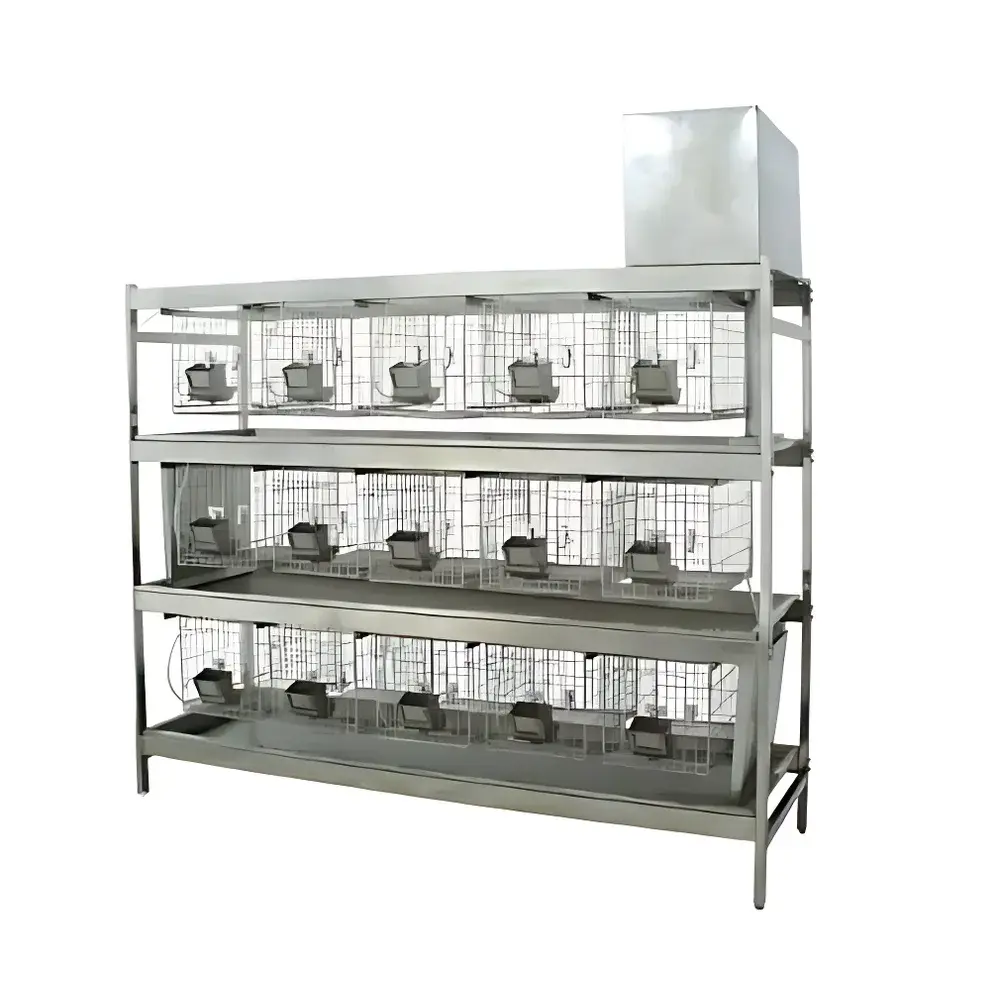
Jiayuan RS-15 Stainless Steel Flush-Type Laboratory Rabbit Cage System
| Brand | Jiayuan |
|---|---|
| Origin | Beijing, China |
| Manufacturer Type | Authorized Distributor |
| Country of Origin | China |
| Model | RS-15 |
| Unit Price | USD 1,280 (FOB Beijing) |
| Cage Configuration | 3 × 5 = 15 individual units |
| Overall Dimensions (Cage Rack) | 2000 × 650 × 1720 mm (H × W × D) |
| Individual Cage Dimensions | 500 × 300 × 350 mm (L × W × H) |
| Watering System | Automatic stainless steel sipper tube with 500 mL bent-neck bottle |
| Accessories Included | 15 cage trays, 15 feed pans, 15 stainless steel wire mesh tops, 3 large stainless steel collection trays (for floor-level waste capture), fully welded 304 stainless steel rack frame with four locking casters |
Overview
The Jiayuan RS-15 Stainless Steel Flush-Type Laboratory Rabbit Cage System is an engineered housing solution designed for controlled biomedical research environments requiring rigorous sanitation, regulatory traceability, and long-term animal welfare compliance. Unlike static dry-housing systems, the RS-15 integrates a gravity-fed flush mechanism—compatible with standard laboratory floor drainage infrastructure—that enables rapid, residue-free removal of urine and solid waste without manual cage disassembly. Constructed entirely from medical-grade 304 stainless steel (ASTM A240/A240M), the system resists corrosion from disinfectants (e.g., sodium hypochlorite, peracetic acid), enzymatic cleaners, and acidic metabolic byproducts. Its modular 3×5 configuration supports scalable colony management while maintaining ISO 14644-1 Class 8 (100,000) cleanroom-compatible surface finish (Ra ≤ 0.8 µm). The RS-15 complies with the minimum spatial requirements defined in the U.S. NIH Guide for the Care and Use of Laboratory Animals (2011) and the European Directive 2010/63/EU Annex III for rabbit housing—specifically addressing floor area (≥ 0.7 m² per adult New Zealand White rabbit), height clearance (≥ 0.45 m), and ventilation volume (≥ 50 L/min per kg body weight).
Key Features
- Full 304 stainless steel construction—including rack frame, cage trays, feed pans, sipper tube mounts, and casters—ensuring non-porous, non-shedding surfaces validated for autoclaving (121°C, 20 min) and repeated chemical sterilization.
- Integrated flush manifold design with sloped cage floors (2° gradient) and centralized drain channels directing effluent to floor-level collection trays; eliminates standing liquid and reduces ammonia volatilization (NH₃ < 10 ppm over 8-hr exposure).
- Adjustable stainless steel sipper tubes with precision-machined stainless steel ball valves and 500 mL borosilicate glass bottles equipped with PTFE-sealed bent nozzles—preventing drip contamination and ensuring consistent water delivery under IACUC-defined flow rates (≥ 50 mL/hr per animal).
- Locking dual-wheel casters (two fixed, two swivel with brake) enabling stable repositioning within vivarium corridors while meeting ANSI/AAMI ST79:2017 requirements for mobile equipment stability during transport.
- Modular rack architecture supporting interoperability with optional accessories: HEPA-filtered laminar airflow hoods (mounted above rack), RFID-enabled cage identification tags (ISO 15693 compliant), and integrated weight-sensing feed pan modules (±1 g resolution).
Sample Compatibility & Compliance
The RS-15 is validated for use with New Zealand White, Dutch Belted, and Californian rabbits (weight range: 2.5–5.5 kg) in acute toxicity studies, dermal sensitization assays (OECD TG 406), and chronic pharmacokinetic investigations. Its design conforms to GLP (21 CFR Part 58) facility requirements for documented cleaning validation—each cage unit carries engraved serial numbers for audit-trail linkage to maintenance logs. All materials meet USP Class VI biocompatibility standards, and weld seams undergo dye-penetrant inspection per ASTM E165. The system supports concurrent use with telemetry implants (e.g., Data Sciences International TA-F10), as cage geometry permits unobstructed RF signal transmission (402–405 MHz ISM band). It is not intended for use with immunocompromised or SPF-grade rabbits without supplemental barrier enclosure integration.
Software & Data Management
While the RS-15 is a hardware-only platform, its standardized dimensions and accessory interface points enable seamless integration with third-party vivarium management software (e.g., LabVantage LIMS, Provantis v9.5, or Cerner Enviza). Cage-specific metadata—including installation date, last sanitization cycle (recorded via barcode-scanned chemical lot numbers), and animal assignment history—can be ingested via CSV/API into institutional animal care databases. Optional IoT sensor kits (sold separately) provide real-time monitoring of ambient temperature (±0.3°C), relative humidity (±3% RH), and cage-level CO₂ (0–5,000 ppm, NDIR sensor), with data export compliant with FDA 21 CFR Part 11 electronic record requirements (audit trail, role-based access, digital signature support).
Applications
- Regulatory toxicology studies requiring daily waste quantification (e.g., OECD TG 412, 422) where flush efficiency directly impacts urinary biomarker integrity.
- Vaccine adjuvant evaluation in rabbits, where minimized environmental ammonia levels prevent respiratory confounding in serological response interpretation.
- Orthopedic device implantation models requiring postoperative wound assessment—flush design prevents bedding particulate migration onto surgical sites.
- Pharmacodynamic studies involving IV or subcutaneous dosing, where automated watering eliminates handling stress that alters corticosterone kinetics.
- Teaching laboratories conducting GLP-aligned animal handling certifications, leveraging the RS-15’s transparent maintenance protocol documentation for student competency assessment.
FAQ
What cleaning agents are validated for use with the RS-15 system?
Sodium hypochlorite (1:10 dilution), peracetic acid (0.2%), and ethanol (70%) have been verified for material compatibility and residual absence via GC-MS analysis per ASTM E2996. Avoid chloride-based acids (e.g., hydrochloric acid) and alkaline solutions > pH 12.5.
Can the RS-15 be retrofitted with automated feeding systems?
Yes—the feed pan mounting interface follows ISO 11783-12 mechanical specifications, permitting integration with commercial pellet dispensers (e.g., BioDAQ FeedMaster) using custom bracket kits (part #RS-15-FB-KIT, available on request).
Is the flush mechanism compatible with central vacuum waste evacuation?
No. The RS-15 utilizes passive gravity drainage only. For vacuum-assisted evacuation, a separate ASME B31.9-compliant piping retrofit must be commissioned by qualified vivarium engineering personnel.
What is the maximum recommended service life under daily use?
Based on accelerated corrosion testing (ASTM G56, 1,000-hr salt spray), structural integrity is maintained for ≥10 years when operated within ambient temperatures of 18–26°C and relative humidity ≤70%. Annual weld seam inspection is recommended.
Does the system include documentation for IACUC protocol submission?
Yes—factory-supplied documentation includes material certificates (EN 10204 3.1), dimensional QA reports, and a GLP-compliant cleaning validation template aligned with AAALAC International Standard 3.2.3.




