
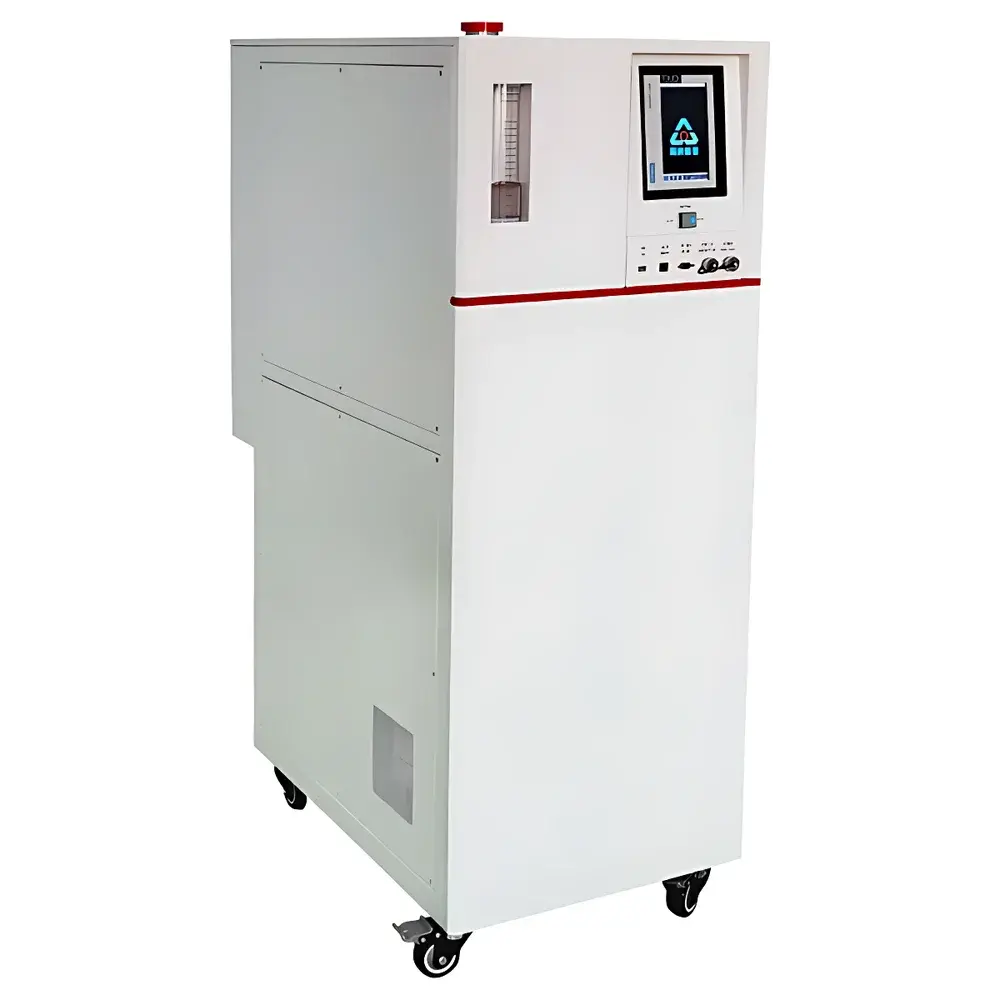
TC600 High-Low Temperature Dynamic Circulating Chiller
| [Origin | Tianjin, China |
|---|---|
| Manufacturer Type | Authorized Distributor |
| Product Origin | Domestic (China) |
| Model | TC600 |
| Price Range | USD 7,000–14,000 |
| Temperature Range | −60 °C to +250 °C |
| Max Flow Rate | 15 L/min |
| Max Pressure | 1.5 bar |
| Heating Power | 3.0 kW |
| Refrigeration Capacity | 3.5 kW @ −20 °C |
| Cooling Method | Water-Cooled (Air-Cooled Optional) |
| Control Algorithm | Multi-Dimensional Adaptive PID |
| System Type | Closed-Loop Oil Circulation] |
Overview
The TC600 High-Low Temperature Dynamic Circulating Chiller is an engineered thermal management system designed for precise, rapid, and stable temperature control across demanding laboratory and pilot-scale process applications. It operates on a closed-loop circulation principle, using thermally stable heat transfer fluid (typically silicone oil or synthetic bath fluid) to deliver controlled thermal energy to external equipment—including jacketed reactors, calorimeters, semiconductor test chambers, sterilizers, and material testing rigs. Unlike basic immersion circulators, the TC600 employs dynamic thermal response architecture: its dual-stage refrigeration system (cascade compressor design), high-efficiency heating elements, and low-volume internal loop minimize thermal inertia—enabling sub-1 °C stability and ramp rates up to 10 °C/min over its full operating span (−60 °C to +250 °C). This performance profile meets the stringent thermal fidelity requirements of kinetic reaction studies, accelerated aging tests, and qualification-grade environmental simulation.
Key Features
- Multi-Dimensional Adaptive PID Control: Real-time algorithmic adjustment of proportional, integral, and derivative gains based on load dynamics, setpoint deviation, and rate-of-change—ensuring minimal overshoot and fast settling time under variable thermal loads.
- Closed-Loop Fluid Management: Hermetically sealed circulation path prevents oxidation, moisture ingress, and volatile loss of heat transfer fluid—extending service life beyond 5,000 operational hours without degradation in viscosity or thermal conductivity.
- High-Low Temperature Isolation Pump Design: Dual-shaft magnetic drive pump with thermally segmented housing isolates cold and hot zones, eliminating seal failure risk and cross-contamination between temperature domains.
- Comprehensive Safety Architecture: Redundant hardware-level protections include high/low fluid level detection, overtemperature cutoff (±2 °C tolerance), high-pressure shutdown (>2.0 bar), dry-run prevention, and ground-fault circuit interruption (GFCI).
- Modular Thermal Interface: Standardized 1/2″–3/4″ NPT and ISO-KF flange options support seamless integration with reactor jackets, test chambers, and custom manifolds; optional flow metering and inline temperature sensors available.
Sample Compatibility & Compliance
The TC600 is compatible with a wide range of heat transfer media—including Dow Corning PMX series, Marlotherm SH, and Syltherm XLT—enabling operation across cryogenic, ambient, and high-temperature regimes without fluid replacement. Its mechanical and electrical design conforms to IEC 61010-1:2010 (Safety Requirements for Electrical Equipment for Measurement, Control, and Laboratory Use) and EMC Directive 2014/30/EU. While not certified for Class I Div 1 hazardous locations, it complies with ATEX Category 3G (Zone 2) when operated with non-flammable fluids and installed per manufacturer-specified ventilation guidelines. For regulated environments, the system supports audit-ready operation via optional data logging modules compliant with FDA 21 CFR Part 11 (electronic records/signatures) and GLP/GMP traceability protocols.
Software & Data Management
Standard operation is managed via a 7″ capacitive touchscreen HMI with intuitive graphical workflow navigation, real-time trend plotting, and multi-segment programmable ramp-soak profiles. An optional Ethernet-enabled controller (RS-485/Modbus TCP) enables remote monitoring and scripting through LabVIEW, MATLAB, or SCADA platforms. All temperature setpoints, actual readings, alarm events, and system status logs are timestamped and exportable as CSV or PDF reports. Firmware supports firmware-over-the-air (FOTA) updates and includes built-in diagnostics for compressor health, pump efficiency, and thermal sensor drift compensation—reducing scheduled maintenance intervals by up to 40% versus conventional chillers.
Applications
- Exothermic/endothermic reaction control in glass or stainless-steel jacketed reactors (e.g., Grignard synthesis, hydrogenation, polymerization)
- Thermal qualification of power electronics, battery cells, and MEMS devices under cycling stress (−40 °C ↔ +125 °C)
- Calorimetric calibration and heat capacity measurement using differential scanning (DSC) or adiabatic calorimeters
- Environmental stress screening (ESS) of aerospace composites and optical coatings per MIL-STD-810H methods
- In-process temperature stabilization during laser crystal growth, thin-film deposition, and wafer probing
FAQ
What is the minimum recommended heat transfer fluid volume for stable TC600 operation?
The system requires ≥12 L of fluid in the reservoir to ensure adequate head pressure, thermal buffer capacity, and accurate level sensing—verified during factory commissioning.
Can the TC600 operate continuously at −60 °C with full refrigeration load?
Yes—when supplied with cooling water at ≤20 °C and ambient air ≤25 °C, the TC600 maintains −60 °C at rated capacity (3.5 kW) with ≤±0.3 °C fluctuation over 24 h.
Is air-cooling available as a retrofit option for existing water-cooled units?
No—air-cooled variants (designated “A” suffix, e.g., TC600A) require distinct condenser geometry, fan arrays, and refrigerant charge optimization; conversion is not supported post-manufacture.
Does the TC600 support external temperature feedback from a user-provided probe?
Yes—the controller accepts 2-wire Pt100 or thermocouple inputs (Type K/J) for cascade control, enabling direct process-jacket or sample-core temperature regulation.
What maintenance intervals are recommended for optimal long-term performance?
Fluid analysis every 1,000 h; refrigerant leak check annually; filter replacement every 2,000 h; full system calibration biannually per ISO/IEC 17025-compliant procedures.



