
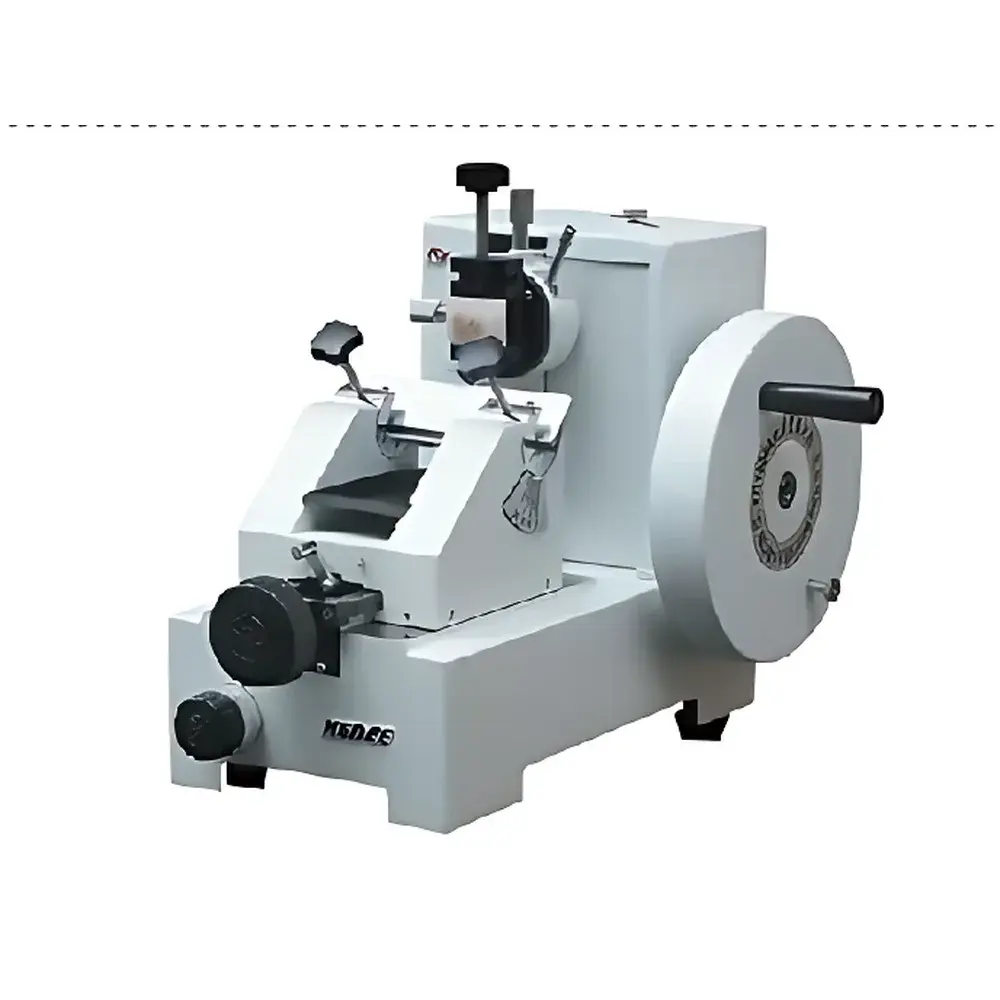
KD-1508R Rotary Microtome
| Origin | Beijing, China |
|---|---|
| Manufacturer Type | Authorized Distributor |
| Product Origin | Domestic (PRC) |
| Model | KD-1508R |
| Cutting Thickness Range | 1–35 µm (continuous) |
| Minimum Graduation | 1 µm |
| Cutting Accuracy | ±10% |
| Max Paraffin Section Area | 60 × 40 mm |
| Overall Dimensions | 470 × 320 × 320 mm |
| Net Weight | 22.5 kg |
Overview
The KD-1508R Rotary Microtome is a precision-engineered laboratory instrument designed for consistent, high-fidelity sectioning of biological, botanical, and hard-tissue specimens—including fibrous tissues, plant stems, calcified bone, keratinized structures (e.g., hair), rubber, and polymer samples. Based on the proven KD-1508A platform, the KD-1508R incorporates upgraded mechanical architecture: hardened alloy steel components, high-precision ground roller bearings for linear stage guidance, and optimized knife advance mechanics to minimize vibration and thermal drift during operation. Its rotary motion principle—where the specimen advances vertically while the knife remains stationary in a fixed horizontal plane—ensures stable shear geometry and reproducible section thickness across extended cutting sessions. This design conforms to internationally recognized microtomy standards for histological preparation, supporting both routine diagnostic workflows and advanced research applications requiring morphological integrity at the cellular and subcellular level.
Key Features
- Continuous section thickness adjustment from 1 to 35 µm with 1 µm minimum graduation, enabling fine control for delicate or dense tissue types.
- Robust roller-bearing-guided specimen advancement mechanism ensures minimal lateral deviation (<±2 µm runout) and long-term dimensional stability.
- Optimized knife holder geometry accommodates standard disposable blades (e.g., Feather S35, Leica 819) and reusable steel knives; optional B-series models include dedicated disposable-blade clamping fixtures.
- Ergonomic handwheel with dual-density grip and calibrated torque feedback provides tactile consistency during manual sectioning.
- Integrated specimen orientation system with dual-axis tilt (±10° vertical, ±5° horizontal) and precise rotational alignment (0.5° increments) for oblique or serial sectioning protocols.
- Tool-free blade exchange mechanism reduces downtime and minimizes risk of accidental injury during maintenance.
Sample Compatibility & Compliance
The KD-1508R supports a broad spectrum of embedding media and specimen types: paraffin-embedded tissues (standard and low-melting-point waxes), celloidin, methacrylate (e.g., Technovit 7100), and epoxy resins. It is routinely employed in academic histology labs, clinical pathology departments, and industrial R&D facilities handling non-biological materials such as thermoplastics, elastomers, and composite laminates. The instrument complies with ISO 13805:2017 (Microtomy — Requirements for performance verification), and its mechanical repeatability meets internal QC thresholds aligned with CAP and CLIA pre-analytical validation guidelines. When used in conjunction with validated embedding and staining SOPs, sections produced on the KD-1508R satisfy morphology assessment criteria defined in WHO Classification of Tumours and College of American Pathologists (CAP) checklists.
Software & Data Management
While the base KD-1508R operates as a fully manual microtome, it is compatible with optional digital add-ons—including external USB-connected section counters and third-party microscope-integrated image capture systems (e.g., Zeiss ZEN, Olympus cellSens). For laboratories operating under regulated environments (e.g., GLP, GMP, or FDA 21 CFR Part 11), traceability is maintained through lab notebook documentation of section parameters (thickness, block ID, date/time, operator), which can be imported into LIMS platforms via CSV export from companion software modules. No embedded firmware or proprietary cloud connectivity is present; all operational settings remain locally configurable without network dependency—ensuring data sovereignty and audit readiness.
Applications
- Routine histopathology: Hematoxylin & eosin (H&E), special stains (Masson’s trichrome, PAS), and immunohistochemistry (IHC) on formalin-fixed paraffin-embedded (FFPE) human and animal tissues.
- Botanical anatomy: Transverse and longitudinal sections of woody stems, root nodules, and seed embryos without compression artifacts.
- Materials science: Cross-sectional analysis of polymer blends, fiber-reinforced composites, and sintered ceramics for porosity and interfacial characterization.
- Forensic anthropology: Sectioning of decalcified bone fragments and dental tissues for age estimation and trauma analysis.
- Preclinical toxicology: High-throughput sectioning of rodent organ blocks for dose-response histomorphometric evaluation.
FAQ
What embedding media are compatible with the KD-1508R?
Paraffin wax (56–62 °C melting point), low-viscosity paraffin substitutes (e.g., Paraplast X-tra), celloidin, methyl methacrylate (MMA), and epoxy resins (e.g., Epon 812) — provided appropriate block trimming and knife sharpening protocols are followed.
Can the KD-1508R be upgraded to a cryo-capable system?
Yes — the KD-1508R serves as the core module of the KD-1508R-VI cryo-rotary platform, which integrates a semiconductor-based rapid-cooling unit (–55 °C operating range) with independent cold knife and cold stage temperature control, meeting ASTM F2622-21 requirements for frozen section reproducibility.
Is calibration documentation provided with shipment?
Each unit ships with a factory-verified mechanical calibration certificate covering stage linearity, thickness dial accuracy (±1 µm tolerance), and knife alignment symmetry — traceable to NIM (National Institute of Metrology, China) reference standards.
What maintenance intervals are recommended for optimal performance?
Lubrication of roller guides every 200 hours of operation; annual inspection of gear backlash and handwheel clutch engagement; biannual verification of micrometer dial zero point using certified gauge blocks.
Does the KD-1508R support serial sectioning for 3D reconstruction?
Yes — its sub-micron thickness repeatability and minimal chatter enable reliable collection of consecutive ribbons (up to 100 sections per ribbon) suitable for TEM tomography, confocal volume rendering, and digital spatial profiling workflows.



