
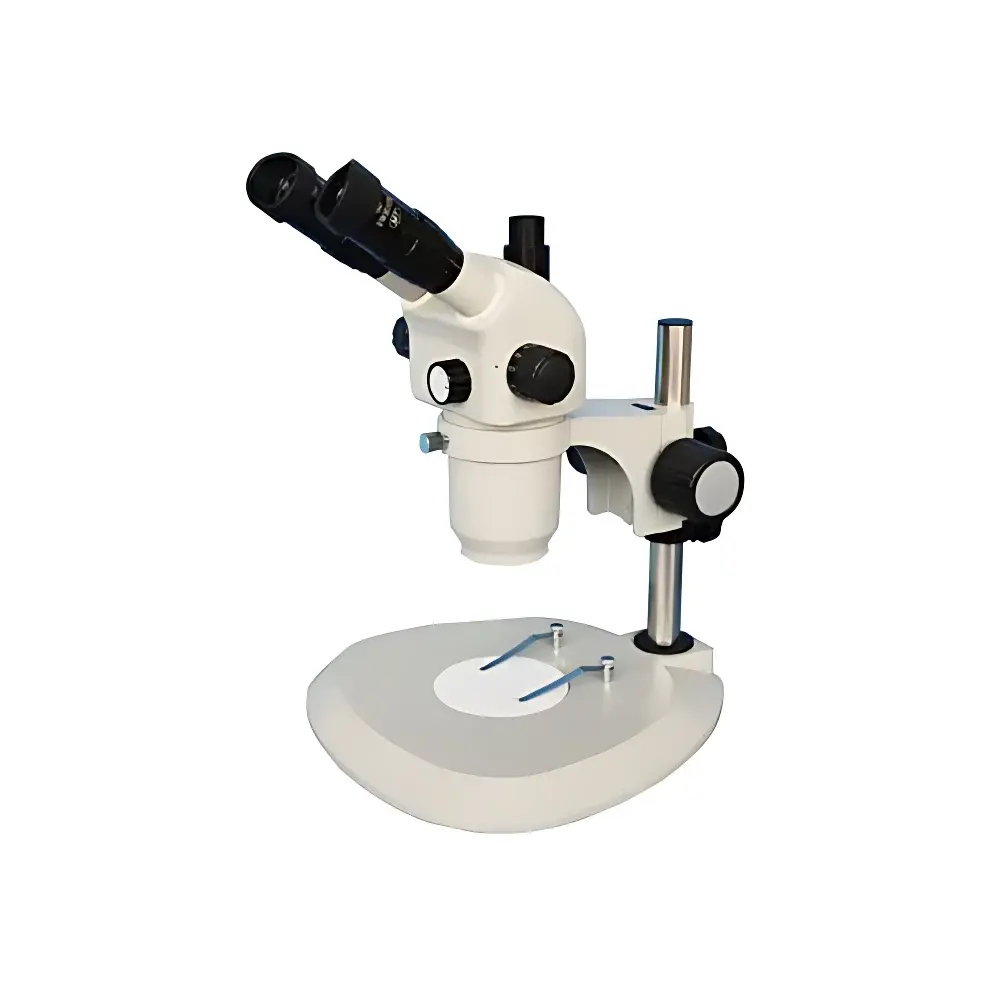
SZ700TR Triple-Port Continuous-Zoom Stereo Microscope
| Origin | Beijing, China |
|---|---|
| Manufacturer Type | Authorized Distributor |
| Regional Origin | Domestic (PRC) |
| Model | SZ700TR |
| Price | USD 2,200 (FOB Beijing) |
| Zoom Ratio | 8.8:1 (0.8×–7.0× Objective Zoom) |
| Standard Total Magnification Range | 8×–70× (with 10× Eyepieces) |
| Working Distance | 108 mm (standard), down to 35 mm with 2.0× Auxiliary Objective |
| Eyepiece | SWH10× (23 mm Field Number, High-Eye-Point, Widefield) |
| Interpupillary Adjustment | 52–76 mm (linked) |
| Diopter Compensation | ±6 D per eyepiece |
| Inclination | 35° Tilting Binocular/Triocular Tube |
| Rotation | 360° Swivel Head |
| Focusing Travel | 100 mm (vertical column) |
| Stage Diameter | Ø95 mm |
| Pillar Diameter | Ø25 mm |
| Center-to-Center Distance (Pillar to Bracket) | 140 mm |
| Bracket Mounting Diameter | Ø76 mm |
| Illumination Options | Adjustable 6 V / 10 W Halogen Reflector Lamp |
Overview
The SZ700TR is a precision-engineered triple-port continuous-zoom stereo microscope designed for industrial inspection, quality control, electronics assembly, biological dissection, and materials science applications requiring high-resolution depth perception and ergonomic long-term operation. It operates on the Greenough optical principle—employing two separate, parallel optical paths with inclined objectives—to deliver true stereoscopic imaging with natural depth cues and minimal parallax. The core zoom system features a mechanically coupled 0.8×–7.0× objective lens assembly (zoom ratio 8.8:1), enabling seamless magnification adjustment without refocusing or image shift. When combined with widefield SWH10× eyepieces (23 mm field number), the standard total magnification spans 8×–70×. With optional auxiliary objectives (0.5×, 0.7×, 1.5×, 2.0×) and high-magnification eyepieces (15×, 20×), the system supports calibrated magnifications up to 420× while maintaining optical coherence and edge-to-edge sharpness across the entire field of view.
Key Features
- Continuous zoom optics with 8.8:1 zoom ratio and parfocal design—ensures stable focus throughout the zoom range and eliminates need for re-focusing during magnification changes
- Triple-port head configuration: dual eyepiece viewing path + vertical C-mount port (standard 1× photo adapter included) for simultaneous visual observation and digital documentation
- Ergonomic 35° inclined binocular/trocular tube with 360° rotational freedom—reduces cervical strain during extended use and enables flexible positioning relative to workstations or light sources
- High-eye-point SWH10× widefield eyepieces (23 mm FN) compatible with corrective lenses and spectacles—ensures full field visibility without vignetting
- Precision interpupillary adjustment (52–76 mm, linked mechanism) and independent ±6 D diopter compensation per eyepiece—supports operator-specific visual acuity requirements
- Extended working distance of 108 mm at lowest zoom (0.8×), scalable down to 35 mm with 2.0× auxiliary objective—accommodates bulky samples, manipulators, and integrated tooling
- Modular illumination architecture: standardized 6 V / 10 W halogen reflector lamp with continuous intensity control; optional 5 W fluorescent transmitted-light base for low-heat, uniform background illumination
Sample Compatibility & Compliance
The SZ700TR accommodates specimens ranging from printed circuit boards (PCBs) and solder joints to botanical sections, entomological specimens, and metallurgical fracture surfaces. Its large stage (Ø95 mm), generous working distance, and 360° rotatable head allow integration with micromanipulators, probe stations, and custom fixturing. The optical train is optimized for Köhler illumination compatibility when used with transmitted-light bases, supporting ISO 10934-1 (microscopy — nomenclature and terminology) and ASTM E2917 (standard guide for selection and use of stereo microscopes in failure analysis). While not certified as medical device under FDA 21 CFR Part 820, the instrument meets general laboratory equipment requirements per IEC 61010-1 for electrical safety and electromagnetic compatibility (EMC). Documentation includes factory calibration records traceable to NIM (National Institute of Metrology, China).
Software & Data Management
The integrated C-mount port (1× coupling) supports industry-standard CMOS/CCD cameras (e.g., Sony IMX series, ON Semiconductor PYTHON sensors) and USB 3.0 or GigE vision interfaces. Compatible acquisition software—including ToupView, Ocular, and third-party SDKs (HALCON, OpenCV)—enables real-time measurement (distance, angle, area), annotation, time-lapse capture, and multi-focus extended-depth-of-field (EDF) stacking. All image metadata (magnification, illumination mode, timestamp, objective ID) are embedded in EXIF headers. Audit trails and user access logs can be enabled via enterprise-grade lab informatics platforms compliant with GLP/GMP data integrity principles (ALCOA+). No proprietary firmware lock-in: raw sensor output remains accessible for custom algorithm development.
Applications
- Electronics manufacturing: solder joint inspection (IPC-A-610 Class 2/3), component placement verification, counterfeit IC detection
- Academic research: insect morphology, plant tissue sectioning, small-animal dissection, mineral grain analysis
- Materials engineering: coating thickness assessment, corrosion evaluation, weld bead profiling, composite fiber orientation mapping
- Forensic science: toolmark comparison, fiber identification, gunshot residue (GSR) particle localization
- Quality assurance labs: dimensional verification per ISO 1101 (geometrical tolerancing), surface defect classification (scratches, pits, delamination)
FAQ
What is the maximum usable magnification before resolution degradation occurs?
Optical resolution is governed by the Abbe limit and effective NA. At 70× total magnification (10× eyepiece × 7.0× objective), the system resolves ≥3.5 µm details under optimal Köhler illumination. Pushing beyond 140× requires auxiliary optics and introduces diminishing returns—practical upper limit for routine metrology is 105×.
Can the SZ700TR be integrated into an automated production line?
Yes—the C-mount port, standardized mechanical interfaces (Ø76 mm bracket mount), and programmable halogen dimmer support PLC-triggered illumination sequencing and camera synchronization via TTL or RS-232. Custom brackets and motorized Z-focus modules are available through OEM partners.
Is the microscope compliant with ISO/IEC 17025 calibration requirements?
The base instrument includes a factory verification report covering magnification accuracy (±2%), field flatness (≤5% distortion at edges), and coaxiality of optical axes. Full ISO/IEC 17025 accreditation requires third-party calibration using traceable step gauges and resolution test targets (e.g., US Air Force 1951).
Does the system support fluorescence observation?
Not natively—the standard halogen and fluorescent bases emit broad-spectrum visible light only. Fluorescence capability requires retrofitting with LED excitation modules (e.g., 395 nm, 470 nm, 530 nm), barrier filters, and high-quantum-efficiency monochrome cameras. Such configurations are validated per ISO 10934-2 for fluorescence microscopy nomenclature.
What maintenance intervals are recommended for long-term optical stability?
Annual cleaning of external optics and verification of zoom track lubrication are advised. Internal alignment checks (collimation, pupil conjugation) should be performed every 24 months by authorized service centers using autocollimators and interferometric tools.





