
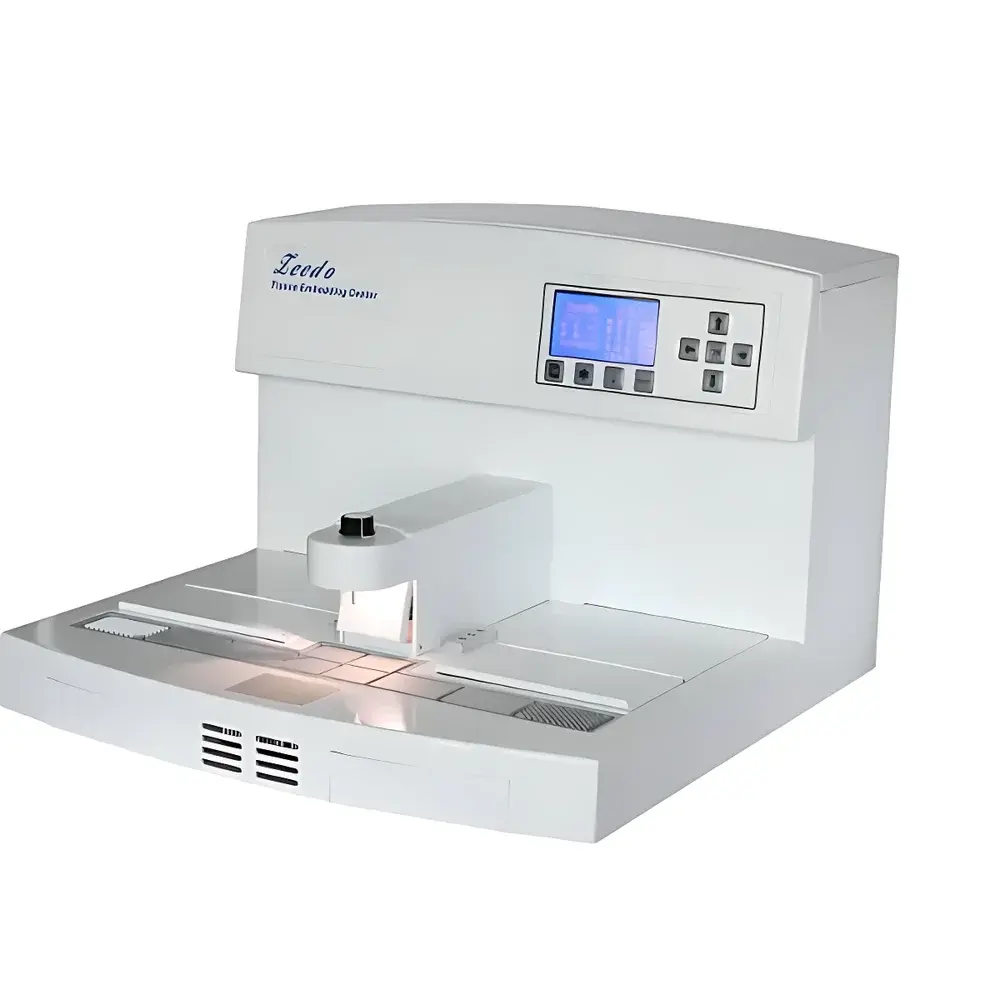
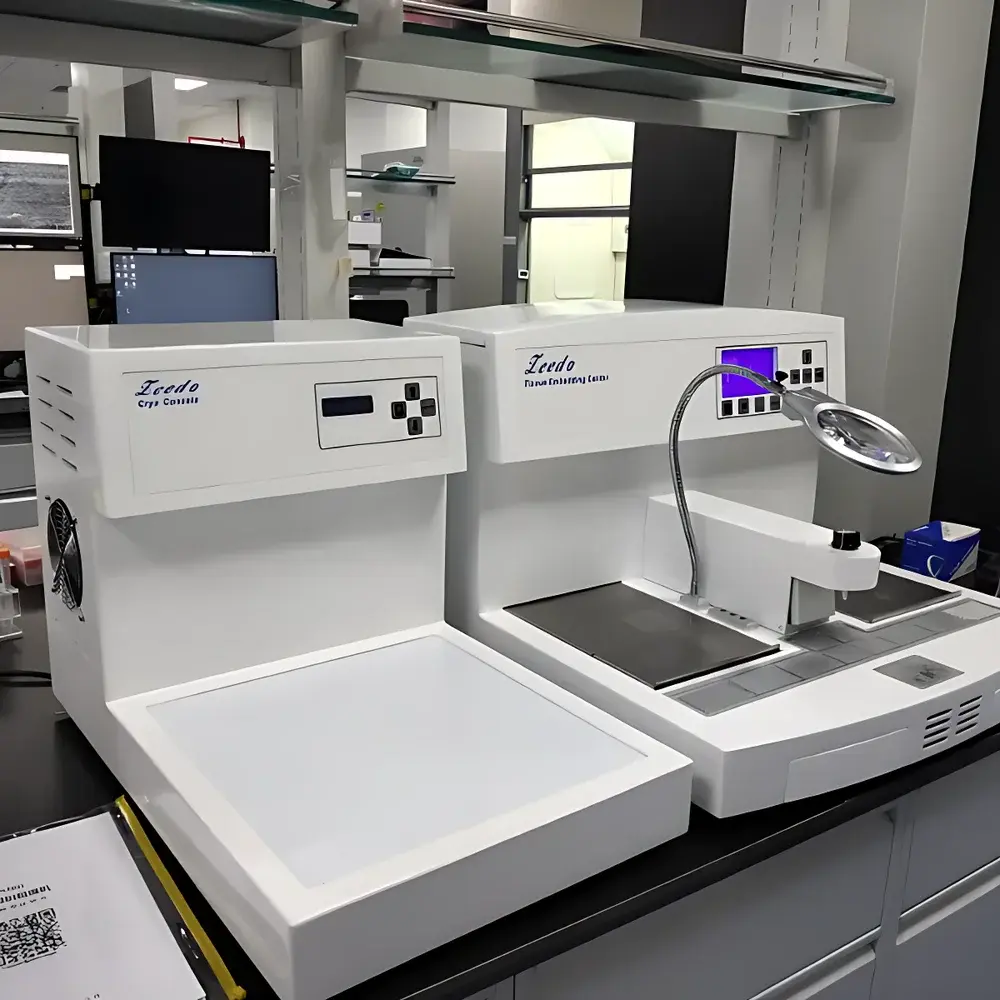
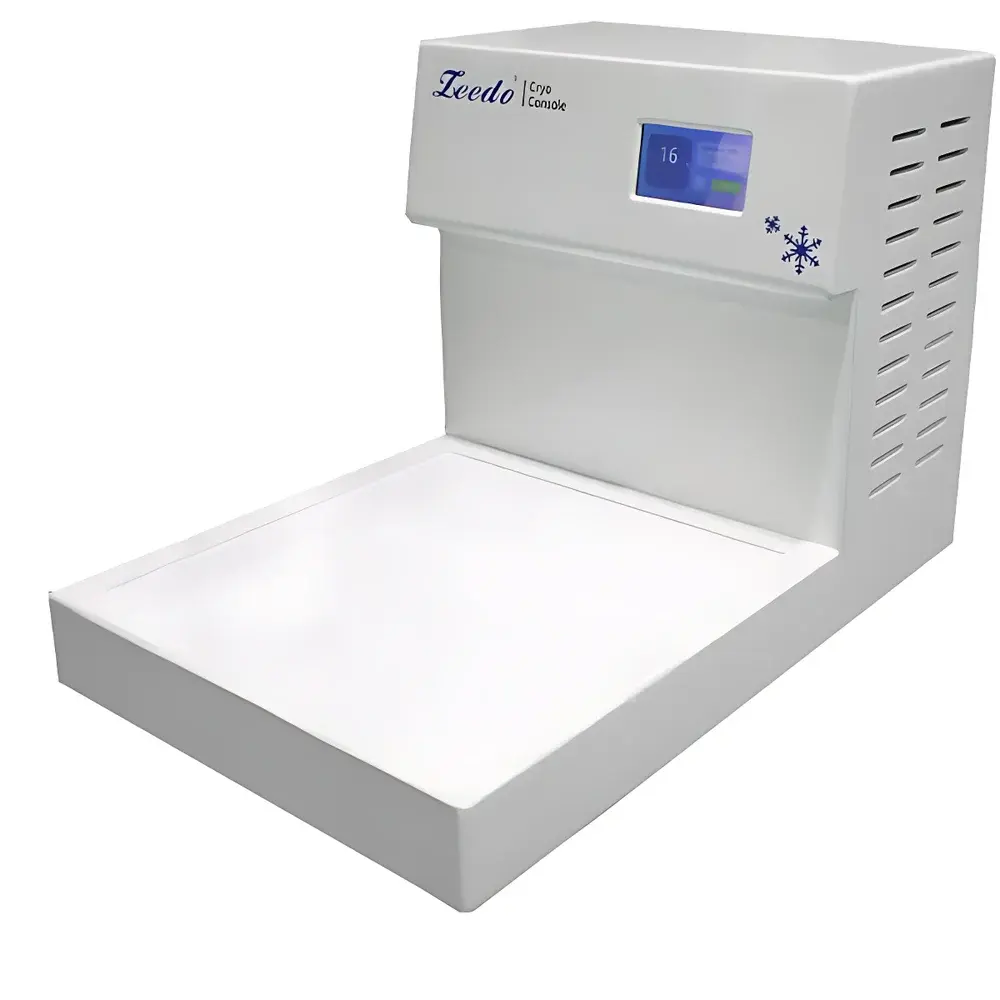
ZEEDO ES-500-2C Paraffin Tissue Embedding Station with Integrated Cryo Cold Plate
| Brand | ZEEDO |
|---|---|
| Model | ES-500-2C |
| Origin | Zhejiang, China |
| Type | Paraffin Embedding Station |
| Cold Plate Temperature Range | Ambient to –20 °C |
| Hot Plate Temperature Range | 30–99 °C |
| Wax Bath Capacity | 400 wax blocks per melt |
| Cold Plate Power | 100 VA |
| Hot Plate Power | 400 VA |
| Total System Power | 1500 VA |
| Dimensions (Embedding Unit) | 600 × 650 × 450 mm (W × D × H) |
| Dimensions (Cold Plate) | 410 × 660 × 450 mm (W × D × H) |
| Weight (Embedding Unit) | 40 kg |
| Weight (Cold Plate) | 14 kg |
| Voltage | 220 V, 50 Hz |
| Operating Ambient | 5–45 °C, ≤85% RH |
Overview
The ZEEDO ES-500-2C Paraffin Tissue Embedding Station with Integrated Cryo Cold Plate is a dual-function histopathology workstation engineered for precision, reproducibility, and workflow integration in clinical and research laboratories. It combines a fully programmable paraffin embedding console—featuring five independently controlled thermal zones—with a dedicated cryogenic cold plate operating down to –20 °C. This architecture supports both standard paraffin embedding protocols and rapid frozen tissue orientation prior to embedding, eliminating the need for separate cold benches or manual ice-based cooling. The system operates on the principle of controlled thermal phase transition: molten paraffin (typically 56–62 °C) is dispensed via a thermostatically regulated nozzle onto chilled tissue specimens placed on the cold plate, enabling immediate solidification and optimal spatial fixation. Its design adheres to core histotechnical requirements for tissue integrity, orientation fidelity, and operator ergonomics—critical factors influencing downstream sectioning quality and diagnostic accuracy.
Key Features
- Five independent PID-controlled temperature zones: wax bath (30–99 °C), dispensing nozzle (30–99 °C), embedding work surface (30–99 °C), warm holding tray (30–99 °C), and forceps storage block (30–99 °C)—each adjustable in 1 °C increments for protocol-specific thermal management.
- Dedicated cryo cold plate with precise ambient-to–20 °C range, thermoelectric cooling, and stable temperature uniformity (< ±1.5 °C across surface) for consistent tissue hardening without ice crystal formation.
- High-capacity wax reservoir (≥400 standard wax blocks per melt) with dual overheat protection (bimetallic + electronic cut-off) meeting IEC 61010-1 safety standards for laboratory equipment.
- Ergonomic LED top illumination system (5000 K CCT, >300 lux at working surface) integrated into the embedding hood—enabling accurate visualization of small biopsies, needle cores, and fragmented specimens during orientation.
- Dual-mode operation: foot-switch activation for hands-free wax dispensing and micro-switch tactile control for fine manual adjustment—designed to reduce repetitive strain and support GLP-compliant documentation workflows.
- 7-day programmable auto-start scheduler for unattended pre-heating and cold plate preconditioning—optimized for high-throughput labs operating under fixed shift schedules.
Sample Compatibility & Compliance
The ES-500-2C accommodates standard histological specimen formats including biopsy cassettes (25 × 35 mm), tissue fragments (0.5–20 mm), needle cores, and whole-organ slices up to 30 mm thickness. It supports conventional paraffin formulations (melting point 56–62 °C) and low-melting-point waxes (e.g., 48–52 °C) used in delicate tissue processing. The system’s thermal stability and zone isolation ensure compliance with key histopathology standards, including CAP (College of American Pathologists) checklist ANP.31100 (embedding equipment validation), ISO 15189:2022 clause 5.3.2 (equipment suitability), and CLSI document H26-A3 (tissue processing quality assurance). All temperature zones log real-time values internally for audit-ready traceability, supporting GLP/GMP-aligned record retention practices.
Software & Data Management
While the ES-500-2C operates via embedded microcontroller firmware (no external PC dependency), it features non-volatile memory storing up to 100 user-defined thermal profiles—including ramp rates, hold times, and cold plate setpoints. Temperature logs are timestamped and exportable via USB port in CSV format for integration with LIMS or QC dashboards. The interface includes password-protected administrator mode for calibration verification and parameter lockout—supporting FDA 21 CFR Part 11 principles through electronic signature-capable access control and audit trail generation (system events, temperature deviations >±2 °C, power interruptions). Firmware updates are delivered via encrypted USB firmware package to maintain cybersecurity integrity.
Applications
- Routine diagnostic histopathology: embedding of surgical resections, biopsies, and cytology cell blocks in clinical pathology labs.
- Research tissue banking: standardized embedding of human and animal tissues under controlled thermal gradients to preserve antigenicity and nucleic acid integrity.
- Quality control in pharmaceutical toxicology studies: reproducible embedding of rodent organ sections for blinded histomorphometric analysis.
- Education and training: intuitive dual-control interface and visual feedback support competency-based instruction in histotechnician certification programs.
- Multi-instrument integration: modular cold plate design allows co-location with microtomes (e.g., Leica RM2255, Thermo Fisher HM360) and automated tissue processors (e.g., Sakura Tissue-Tek VIP) within shared benchtop spaces.
FAQ
What is the minimum tissue size this station can accurately orient?
Tissues as small as 0.5 mm (e.g., endoscopic biopsies, lymph node fragments) can be reliably positioned using the LED-lit work surface and cold plate stabilization.
Does the system support validation documentation for ISO 15189 accreditation?
Yes—the five-zone temperature logging, profile history, and calibration lockout functionality meet ISO 15189:2022 requirements for equipment suitability and ongoing performance verification.
Can the cold plate operate independently of the hot station?
Yes—the cryo module has a standalone power input and control interface; it may be used with third-party embedding consoles or as a dedicated freezing station.
Is the wax dispensing nozzle resistant to carbon buildup during extended use?
The nozzle features a stainless-steel internal bore with anti-adhesion surface treatment and self-cleaning thermal cycling—validated for >10,000 dispense cycles without manual descaling.
What ambient conditions are required for stable –20 °C cold plate operation?
Ambient temperature must remain ≤25 °C and relative humidity ≤70% for sustained sub-zero performance; operation above 30 °C ambient may limit minimum achievable temperature to –12 °C.




