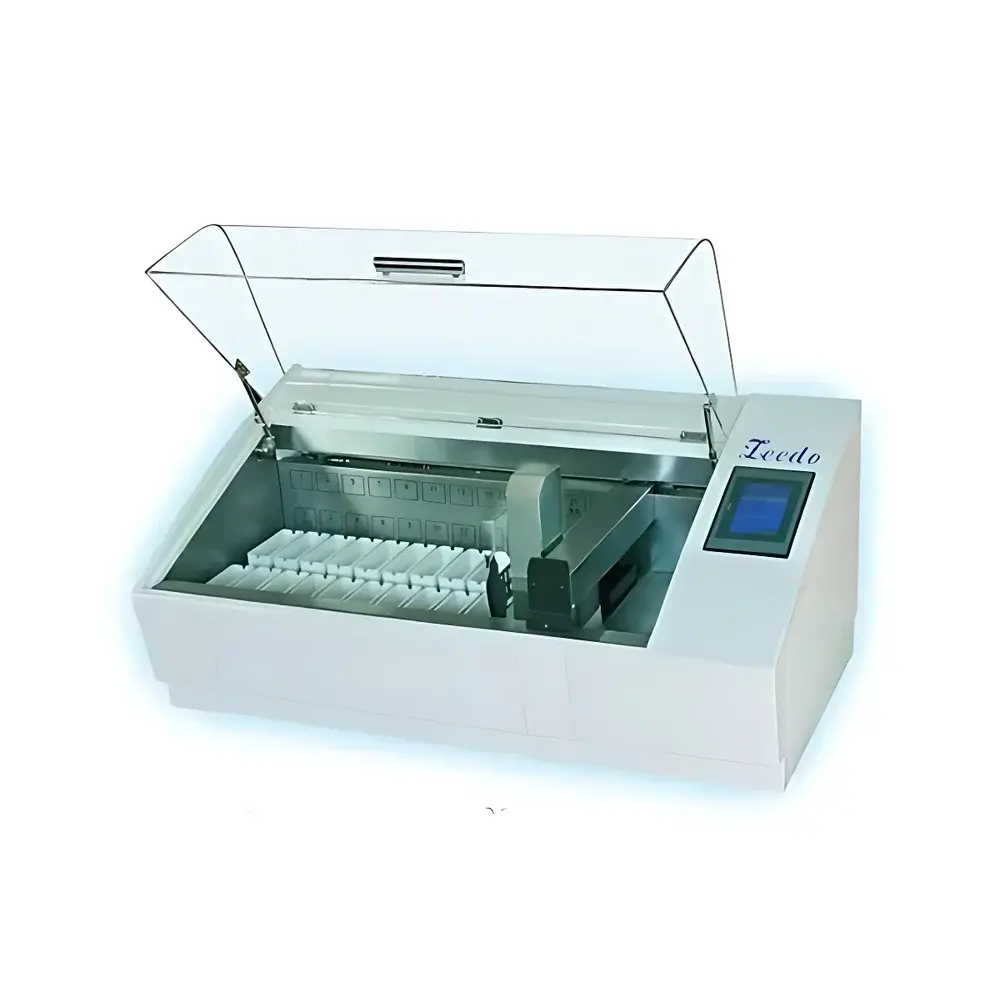
ZEEDO LSS800 Fully Automated Tissue Staining System
| Brand | ZEEDO |
|---|---|
| Origin | Zhejiang, China |
| Model | LSS800 |
| Automation Level | Fully Automatic |
| Instrument Type | Non-rotary Staining System |
| Dimensions (W×D×H) | 1200 × 500 × 600 mm |
| Weight | 80 kg |
| Power Supply | 220 V, 50 Hz |
| Power Consumption | 200 W |
| Staining Capacity | 30 slides per basket, up to 1200 slides/day (routine H&E) |
| Total Stations | 26 tanks (including 3 dedicated rinse tanks) |
| Temperature Control Range | Ambient to 85 °C |
| Staining Time Resolution | 1–9999 s (1 s increments) |
| Control Interface | Touchscreen + PLC, English UI |
| Positioning | Photoelectric sensor-based auto-alignment |
| Programmability | 5 preloaded protocols, 3 baskets operable simultaneously |
| Water Supply | Pressure-regulated, demand-activated |
| Loading/Unloading | Independent upper and lower drawers (non-interruptive operation) |
Overview
The ZEEDO LSS800 Fully Automated Tissue Staining System is an integrated, non-rotary platform engineered for high-throughput, reproducible histological staining of formalin-fixed, paraffin-embedded (FFPE) tissue sections—primarily optimized for routine hematoxylin and eosin (H&E) processing in clinical pathology and research laboratories. Unlike rotary or carousel-based systems, the LSS800 employs a linear, dual-rack transport architecture with three independently controllable slide baskets, enabling parallel processing without cross-contamination risk. Its core mechanism relies on precise gravimetric immersion timing, programmable reagent dwell durations, and thermally stabilized staining baths—ensuring consistent dye penetration, nuclear contrast, and cytoplasmic differentiation across batches. Designed to replace manual staining workflows, the system reduces inter-operator variability, eliminates repetitive manual handling, and supports compliance with standardized histopathology workflow requirements under ISO 15189 and CAP-accredited laboratory frameworks.
Key Features
- Fully automated linear transport system with photoelectric auto-positioning—ensures repeatable basket alignment at each station with ≤±0.5 mm positional tolerance.
- 26-station tank configuration including three dedicated rinse tanks and separate wait/hold stations, minimizing carryover and optimizing fluid dynamics during dehydration, clearing, and staining transitions.
- Touchscreen HMI with English-language interface and PLC-based control logic—supports real-time protocol modification during active runs and audible end-of-cycle alerts.
- Temperature-regulated staining baths (ambient to 85 °C) with PID-controlled heating elements—critical for temperature-sensitive steps such as hematoxylin differentiation and eosin counterstaining.
- Independent upper and lower drawer loading design—allows unloading completed slides or loading new cassettes without interrupting ongoing staining cycles.
- Programmable time resolution down to 1-second increments across all 26 stations—enabling fine-tuned optimization for specialized stains (e.g., Masson’s trichrome, PAS) beyond standard H&E.
- Pressure-regulated, demand-activated water supply system—reduces waste, prevents overflow, and maintains consistent rinse efficacy across variable batch sizes.
Sample Compatibility & Compliance
The LSS800 accommodates standard 1″ × 3″ glass microscope slides (up to 30 per basket), compatible with both conventional and charged/adhesive-coated substrates. It supports routine processing of FFPE tissue sections ranging from 3–5 µm thickness and is validated for use with commercially available reagents from Leica Biosystems, Thermo Fisher Scientific, and Sakura Finetek. The system adheres to electrical safety standards IEC 61010-1 and electromagnetic compatibility requirements per EN 61326-1. While not FDA 510(k)-cleared, its operational parameters align with CLIA-waived workflow expectations for non-diagnostic preparatory instrumentation. Audit trails are not natively embedded; however, external logging via USB export of run logs (date/time stamp, protocol ID, basket status, temperature readings) supports GLP documentation practices.
Software & Data Management
Control firmware resides on an industrial-grade PLC with non-volatile memory retaining up to 5 user-defined staining protocols. Each protocol stores station-specific dwell times, temperature setpoints, agitation modes (if applicable), and rinse cycle counts. Run history—including start/stop timestamps, operator ID (manually entered), and error codes—is recorded locally on the touchscreen controller and exportable via USB flash drive in CSV format. No cloud connectivity or remote monitoring is supported. The system does not comply with FDA 21 CFR Part 11 electronic signature requirements; validation documentation (IQ/OQ templates) is provided upon request for internal lab qualification.
Applications
- Routine diagnostic H&E staining for surgical pathology and cytology specimen preparation.
- High-volume academic and core facility workflows requiring >1000 slides/day throughput with minimal staffing overhead.
- Standardized staining for immunohistochemistry (IHC) pretreatment—particularly antigen retrieval steps requiring controlled temperature and timing.
- Special stain development and protocol refinement where precise, repeatable immersion kinetics are essential (e.g., reticulin, silver stains, mucin detection).
- Training environments where consistent, hands-off operation supports competency assessment and SOP adherence.
FAQ
What types of tissue sections is the LSS800 optimized for?
The system is validated for formalin-fixed, paraffin-embedded (FFPE) sections between 3–5 µm thickness on standard glass slides. Frozen section staining is not supported due to lack of cryo-compatible bath temperature ranges.
Can the LSS800 be integrated into a total lab automation (TLA) line?
No—the LSS800 operates as a standalone unit with no robotic interface, LIS/HIS connectivity, or barcode scanning capability.
Is validation support available for GMP or CAP accreditation?
Yes—manufacturer-provided IQ/OQ documentation templates and calibration certificates for temperature sensors and timer modules are included with purchase.
How often does the water filtration system require maintenance?
The pressure-regulated supply has no internal filter; users must ensure incoming tap water meets local laboratory grade specifications (≤5 ppm total dissolved solids recommended).
Does the system support multi-tier staining protocols with conditional branching?
No—it executes linear, fixed-sequence protocols only. Conditional logic (e.g., “if staining intensity low, extend eosin time”) is not implemented.