
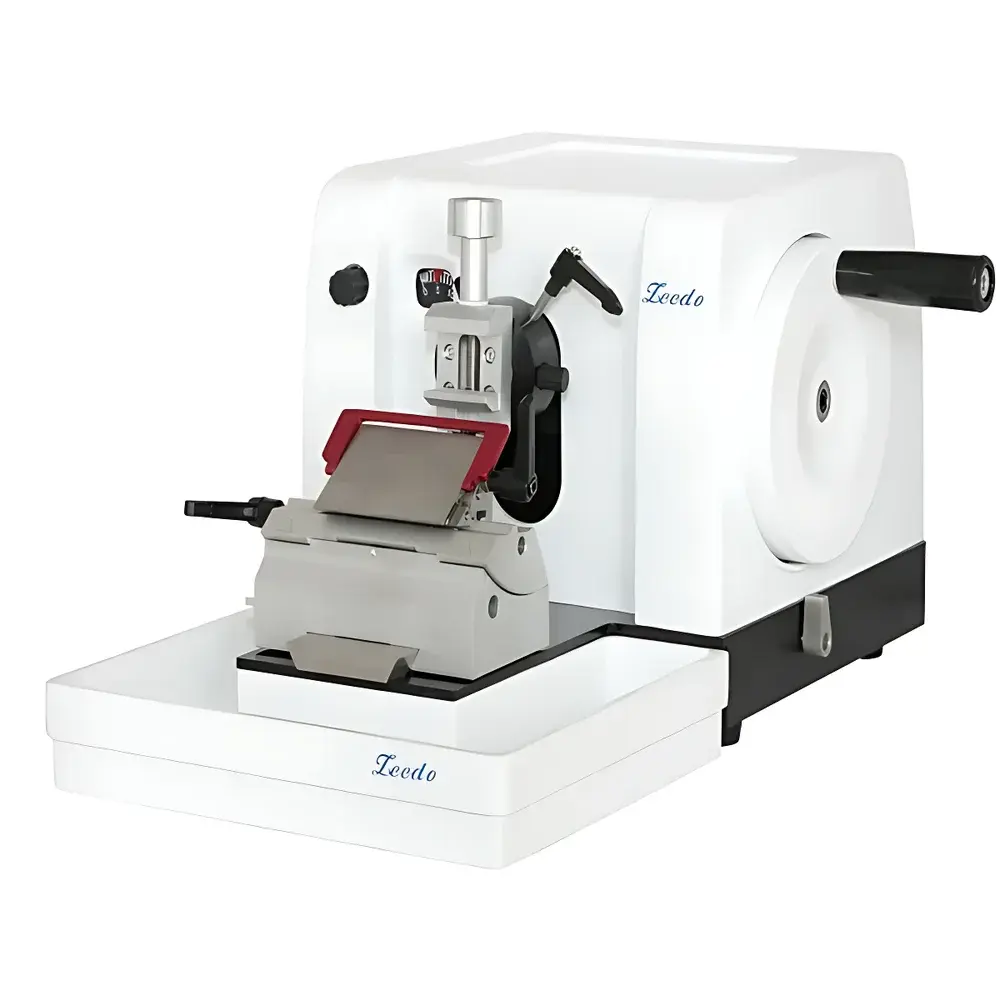
ZEEDO HS-2205 Rotary Microtome
| Origin | Zhejiang, China |
|---|---|
| Manufacturer Type | Authorized Distributor |
| Origin Category | Domestic (China) |
| Model | HS-2205 |
| Price Range | USD 1,400–7,200 |
| Max Specimen Size | 58 × 25 mm |
| Section Thickness Range | 0–60 µm (with incremental steps: 0.5 µm from 0–2 µm |
| Vertical Specimen Travel | 58 mm |
| Horizontal Specimen Travel | 25 mm |
| Specimen Orientation Adjustment | ±8° horizontal tilt, ±8° vertical tilt, ±90° rotation |
| Knife Base Translation Range | ±25 mm (front/back), ±20 mm (left/right) |
| Net Weight | 35 kg |
Overview
The ZEEDO HS-2205 Rotary Microtome is a precision-engineered laboratory instrument designed for consistent, high-fidelity sectioning of paraffin-embedded biological and plant tissue specimens. Operating on the fundamental principle of rotary motion—where the specimen advances linearly toward a stationary cutting edge during each revolution of the handwheel—the HS-2205 delivers reproducible sections across the full 0–60 µm thickness range. Its mechanical architecture prioritizes dimensional stability, thermal inertia minimization, and vibration damping to ensure minimal chatter, knife marks, or compression artifacts—critical prerequisites for histopathological diagnosis, immunohistochemistry (IHC), and routine H&E staining workflows. Built for daily use in clinical pathology labs, academic research facilities, and botanical laboratories, the HS-2205 meets foundational operational expectations aligned with ISO 13485-informed quality systems and supports GLP-compliant documentation when integrated with validated software environments.
Key Features
- Precision micrometric feed mechanism with multi-step incremental resolution: 0.5 µm (0–2 µm), 1 µm (2–10 µm), 2 µm (10–20 µm), and 5 µm (20–60 µm), enabling granular control over section thickness for both ultra-thin diagnostic sections and thicker preparatory cuts.
- Three-axis specimen orientation system: ±8° horizontal and vertical tilt adjustment plus ±90° rotational capability, facilitating optimal tissue plane alignment relative to the knife edge—particularly advantageous for irregular or fibrous samples such as cardiac muscle or woody plant stems.
- Dual-mode rapid block trimming: A dedicated coarse advance lever allows fast removal of excess paraffin prior to fine sectioning, reducing manual repositioning time without compromising positional repeatability.
- Ergonomic handwheel with dual-lock functionality: The right-side handwheel locks at any angular position, while an auxiliary high-point lock enables secure wax block exchange—enhancing operator safety and workflow continuity.
- Cross-roller linear guide rails and self-lubricating micro-feed assembly eliminate routine oil maintenance and sustain long-term mechanical accuracy under repeated loading cycles.
- Integrated specimen stage with ±25 mm front-to-back and ±20 mm lateral translation ensures precise knife-to-specimen clearance and facilitates serial sectioning across heterogeneous tissue blocks.
Sample Compatibility & Compliance
The HS-2205 accommodates standard paraffin-embedded tissue cassettes and custom molds up to 58 mm (vertical) × 25 mm (horizontal). It is routinely employed for human biopsy specimens (e.g., breast, prostate, colon), rodent organ sections, and plant anatomical samples including root cross-sections and leaf mesophyll layers. While the instrument itself does not carry CE marking or FDA 510(k) clearance as a standalone device, its mechanical performance aligns with ASTM E2132-22 (Standard Guide for Microtomy Procedures) and supports compliance with CAP (College of American Pathologists) checklist requirements for microtome verification and preventive maintenance logging. When used in conjunction with traceable calibration standards and documented SOPs, the HS-2205 contributes to audit-ready histology workflows under CLIA and ISO/IEC 17025 frameworks.
Software & Data Management
The HS-2205 operates as a fully manual, non-digital microtome and does not incorporate onboard electronics, touchscreen interfaces, or data export capabilities. All operational parameters—including section count, thickness setting, and specimen orientation—are recorded manually by the user in lab notebooks or LIMS-integrated electronic records. For laboratories requiring digital traceability, integration with third-party microscope imaging platforms (e.g., Leica DM6 B, Zeiss Axio Imager) or automated slide scanners (e.g., Hamamatsu NanoZoomer) is achieved via standardized slide labeling protocols and barcode-based sample tracking—not through direct instrument connectivity.
Applications
- Routine histopathology: Serial sectioning of formalin-fixed, paraffin-embedded (FFPE) tissue blocks for diagnostic evaluation in hospital and reference laboratories.
- Research histology: Generation of consecutive sections for multiplex IHC, in situ hybridization (ISH), and spatial transcriptomics library preparation.
- Botanical morphology: Sectioning of dehydrated and infiltrated plant tissues—including vascular bundles, epidermal layers, and meristematic zones—for light microscopy analysis.
- Quality control in biobanking: Verification of tissue integrity and embedding orientation prior to cryosectioning or nucleic acid extraction.
- Teaching laboratories: Robust mechanical design and intuitive controls support hands-on training in microtomy fundamentals for undergraduate and graduate students.
FAQ
Is the HS-2205 compatible with disposable steel blades and reusable tungsten-carbide knives?
Yes—it accepts standard 25-mm-wide disposable blades (e.g., Feather S35, Leica 819) via its universal blade holder, and accommodates reusable tungsten-carbide knives using optional adapter mounts.
Does the instrument include calibration certification or traceable metrology documentation?
No factory-issued calibration certificate is provided; however, users may perform in-house verification using NIST-traceable micrometer gauges and certified step-height standards per ASTM E2132-22 Annex A2.
Can the HS-2205 be adapted for frozen sectioning?
No—it is engineered exclusively for room-temperature paraffin sectioning and lacks cryogenic cooling capacity or anti-static features required for frozen tissue workflows.
What maintenance schedule is recommended for sustained accuracy?
Visual inspection and cleaning of the knife edge, specimen chuck, and waste trough after each use; annual verification of feed mechanism backlash and stage parallelism using optical alignment tools.
Is technical support available outside mainland China?
Yes—authorized regional distributors provide multilingual application support, spare parts logistics, and on-site service contracts in North America, EMEA, and APAC regions.



