
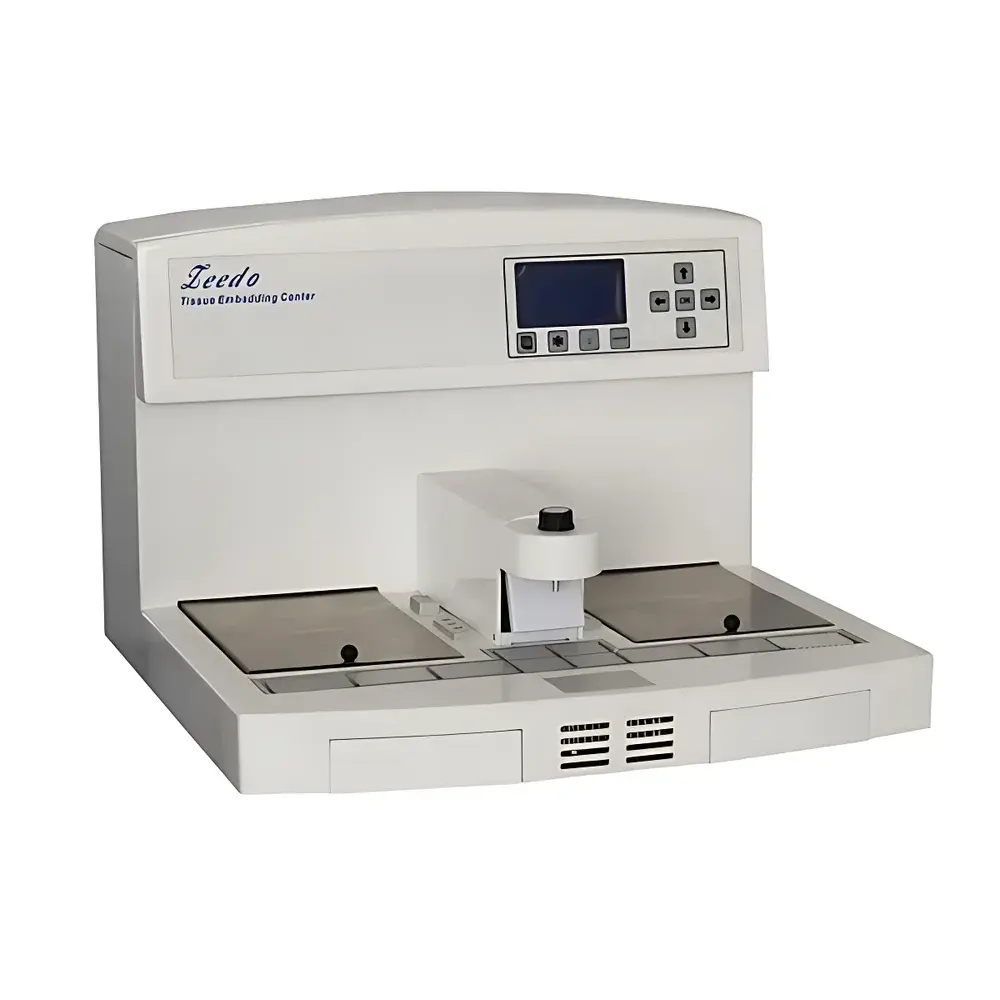
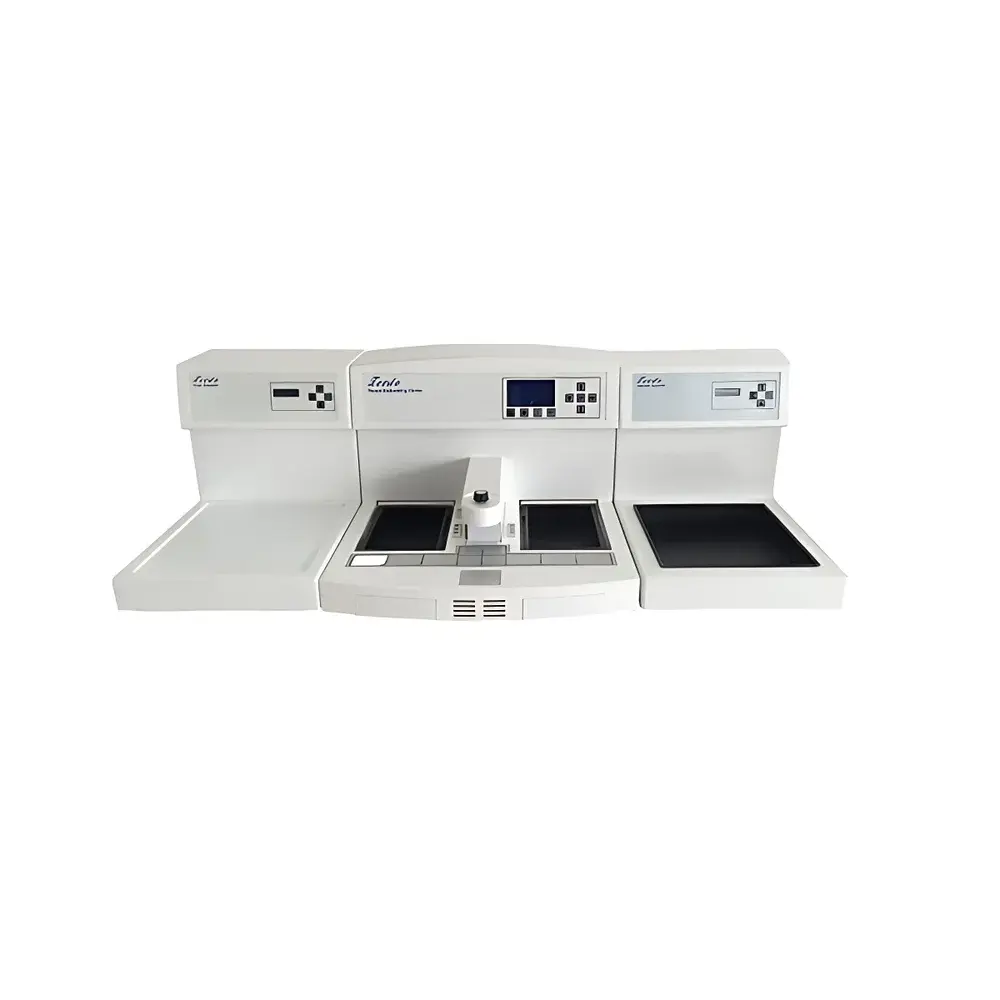
ZEEDO ES-500 Automated Paraffin Tissue Embedding Station
| Origin | Zhejiang, China |
|---|---|
| Manufacturer Type | Authorized Distributor |
| Country of Origin | China |
| Model | ES-500 |
| Pricing | Available Upon Request |
| Wax Bath Capacity | 6 L |
| Temperature Range (Wax Bath, Wax Dispensing Nozzle, Work Surface, Holding Tray, Forceps Storage Block) | Ambient to 99 °C |
| Cold Plate Temperature Range | 0 to –20 °C |
| Ambient Operating Temperature | 0–45 °C |
| Dimensions (W×D×H) | 600 × 650 × 450 mm |
| Weight | 40 kg |
| Voltage/Power | 220 V, 50 Hz / 1500 W |
| Control System | 7-day programmable auto-start |
| Safety | Dual overheat protection for wax bath |
| Illumination | Integrated LED top-mounted positioning light |
| Actuation Options | Manual micro-switch + foot pedal (dual-mode operation) |
| Compliance | Designed for ISO 13485-aligned laboratory environments and GLP-compliant histopathology workflows |
Overview
The ZEEDO ES-500 Automated Paraffin Tissue Embedding Station is a precision-engineered instrument designed for high-throughput, reproducible embedding of biological specimens in paraffin wax within clinical pathology and research histology laboratories. It operates on the principle of controlled thermal phase transition—melting, dispensing, and solidification of molten paraffin under precisely regulated temperature gradients—to ensure optimal tissue orientation, minimal artifact formation, and consistent block integrity. Unlike manual or semi-automated systems, the ES-500 integrates five independent thermal zones (wax bath, dispensing nozzle, work surface, holding tray, and forceps storage block), each adjustable from ambient to 99 °C, enabling simultaneous optimization of wax viscosity, tissue handling temperature, and block cooling kinetics. Its integrated cold plate (0 to –20 °C) facilitates rapid solidification without thermal shock, preserving cellular morphology and minimizing edge curling or cracking—critical for downstream sectioning on rotary microtomes.
Key Features
- Five-zone independent temperature control system with digital PID regulation ensures thermal stability ±0.5 °C across all critical surfaces—essential for reproducible wax flow dynamics and tissue positioning.
- 6-liter high-capacity wax reservoir supports continuous operation for up to 400 embedding cycles per fill, reducing downtime and operator intervention in high-volume diagnostic labs.
- Dual-mode actuation: ergonomically positioned micro-switch for fingertip control and optional foot pedal—designed to minimize repetitive strain and accommodate varied workflow preferences.
- Top-mounted LED illumination system provides uniform, shadow-free lighting directly above the embedding surface (≥3000 lux), enabling accurate visual confirmation of small or translucent tissue fragments during orientation.
- Programmable 7-day auto-start scheduler allows pre-heating and system readiness before staff arrival—supporting standardized startup protocols and energy-efficient operation.
- Dual redundant overheat protection circuitry in the wax bath prevents thermal runaway and complies with IEC 61010-1 safety requirements for laboratory equipment.
Sample Compatibility & Compliance
The ES-500 accommodates standard histological cassettes (e.g., 30 × 40 mm), gelatin-coated molds, and custom aluminum or plastic embedding molds. It supports routine human and veterinary tissue types—including soft tissues (liver, kidney), fibrous specimens (muscle, tendon), and calcified samples when pre-decalcified. The system is engineered for compatibility with common paraffin formulations (melting point 56–60 °C) and low-viscosity infiltration waxes. From a regulatory standpoint, its construction adheres to ISO 13485 design controls for in vitro diagnostic support equipment. While not an IVD device itself, it is validated for use in GLP- and CAP-accredited pathology laboratories where traceability, temperature logging, and procedural consistency are required per CLIA and ISO 15189 Annex A.5.3.
Software & Data Management
The ES-500 operates via an embedded microcontroller interface with non-volatile memory for storing up to 20 user-defined temperature profiles and scheduling presets. Although it does not feature network connectivity or cloud integration, all thermal setpoints, runtime logs, and auto-start events are timestamped and retained internally for audit purposes. Optional external data loggers (e.g., compliant with FDA 21 CFR Part 11) may be interfaced via analog voltage outputs (0–10 V) for wax bath and cold plate temperatures. This architecture supports retrospective verification of embedding conditions—critical for root-cause analysis in QA/QC investigations or accreditation audits.
Applications
- Routine diagnostic histopathology: embedding of biopsy specimens, surgical resections, and cytology cell blocks in clinical laboratories.
- Preclinical research: standardized embedding of rodent and large-animal tissues for longitudinal studies requiring inter-laboratory comparability.
- Teaching laboratories: intuitive interface and dual actuation modes facilitate hands-on training in embedding technique fundamentals.
- Core facilities: high-duty-cycle operation enabled by large wax capacity and programmable scheduling reduces technician workload during peak processing windows.
- Specialized applications: compatible with rapid-embedding protocols using low-melting-point waxes and cryo-assisted orientation techniques.
FAQ
What temperature accuracy does the five-zone control system maintain?
Each zone maintains setpoint stability within ±0.5 °C under steady-state conditions, verified via calibrated NIST-traceable thermistors.
Can the ES-500 be used with low-temperature embedding media such as OCT compound?
No—the system is engineered exclusively for paraffin-based embedding media; OCT and other water-soluble compounds require dedicated cryostat-compatible embedding stations.
Is the cold plate temperature independently adjustable from the ambient environment?
Yes—the Peltier-cooled plate operates independently and achieves stable setpoints between 0 °C and –20 °C regardless of room temperature (within 0–45 °C operating range).
Does the unit include validation documentation for GMP environments?
Factory calibration certificates and IQ/OQ templates are provided; full PQ must be performed onsite per user SOPs and local regulatory expectations.
How is maintenance access designed for wax residue removal?
The wax bath features a removable stainless-steel liner and drain valve; the dispensing nozzle includes a quick-release mechanism for ultrasonic cleaning without disassembly of thermal sensors.
Related Products



