
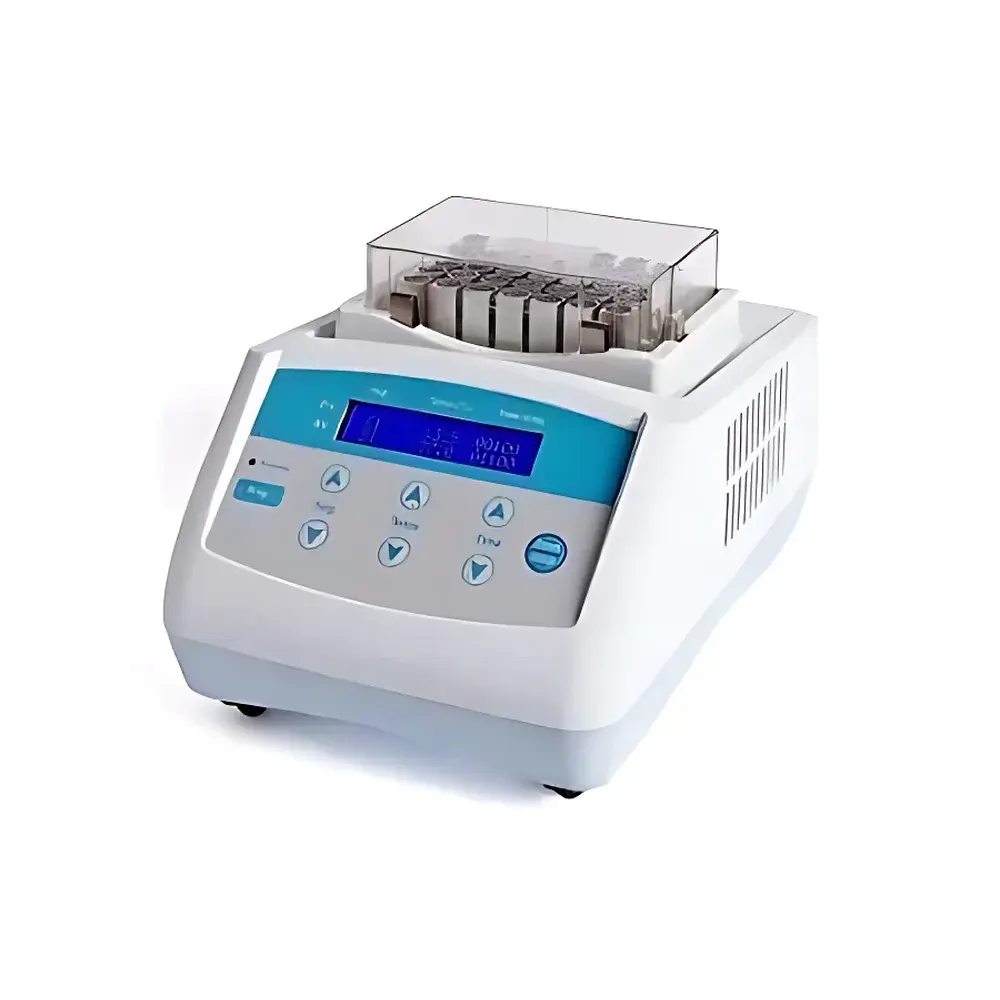
Jiayuan MK-10 Heated Dry Block Incubator
| Brand | Jiayuan |
|---|---|
| Model | MK-10 Heated |
| Origin | Beijing, China |
| Heating Range | Room Temperature +5°C to 100°C |
| Temperature Stability @100°C | ≤±0.5°C |
| Block Uniformity | ≤±0.3°C |
| Display Resolution | 0.1°C |
| Ramp Time | ≤15 min (20°C → 100°C) |
| Max Timer Setting | 99 h 59 min |
| Power Consumption | 150 W |
| Net Weight | 2.2 kg |
| Dimensions (W×D×H) | 270 × 190 × 170 mm |
| Interchangeable Block Options | A–N (including 0.2 mL PCR plates, 0.5/1.5/2.0 mL tubes, 5/15/50 mL tubes, square wells, and custom configurations) |
Overview
The Jiayuan MK-10 Heated Dry Block Incubator is a microprocessor-controlled dry bath system engineered for precise, uniform, and repeatable thermal management of biological and chemical samples in laboratory environments. Unlike traditional water baths—prone to contamination, evaporation, and inconsistent heat transfer—the MK-10 employs solid aluminum heating blocks with optimized thermal mass and conductive geometry to deliver rapid, stable, and gradient-free temperature control across all well positions. Its operational principle relies on resistive heating elements embedded beneath high-purity aluminum blocks, coupled with PID feedback loops that continuously monitor and adjust power delivery based on real-time sensor input from multiple thermistor locations. Designed specifically for applications requiring strict thermal consistency without liquid media, the MK-10 serves as a robust alternative for enzyme reactions, serum coagulation assays, DNA denaturation prior to PCR or electrophoresis, sample thawing, and reagent pre-warming in clinical, research, and quality control laboratories.
Key Features
- High-resolution blue LCD display with intuitive dual-parameter interface: simultaneous independent setting of temperature and timer duration, plus real-time readouts of current block temperature and remaining time.
- Rapid thermal response: achieves full setpoint (e.g., 100°C) from ambient (20°C) in ≤15 minutes, minimizing workflow delays during high-throughput protocols.
- Exceptional thermal uniformity: ≤±0.3°C across the entire block surface at 40°C, verified per ISO/IEC 17025 traceable calibration practices; critical for reproducible coagulation kinetics and enzymatic activity profiling.
- Integrated safety architecture: includes over-temperature cut-off (hardware-limited to 105°C), automatic self-diagnostic routines, audible alarm activation upon fault detection, and user-accessible temperature offset calibration for long-term drift compensation.
- Modular design supporting 14 standardized and customizable interchangeable blocks (A–N), enabling seamless adaptation between 0.2 mL PCR strips, 96-well microplates, 1.5 mL centrifuge tubes, 50 mL conical tubes, and specialized square-well formats—all compatible with autoclaving and routine lab disinfection protocols.
- Compact footprint (270 × 190 × 170 mm) and low acoustic emission (<35 dB(A)) ensure integration into laminar flow hoods, biosafety cabinets, and benchtop workflows without spatial or noise constraints.
Sample Compatibility & Compliance
The MK-10 accommodates a broad spectrum of tube and plate geometries through its field-replaceable block system. All standard modules are machined from anodized aluminum alloy (6061-T6), ensuring corrosion resistance, mechanical durability, and compatibility with common laboratory solvents and sterilization methods including steam autoclaving (121°C, 20 min) and ethanol wipe-downs. The device meets general electrical safety requirements per IEC 61010-1:2010 for laboratory equipment and conforms to electromagnetic compatibility standards EN 61326-1:2013. While not certified for GMP or FDA 21 CFR Part 11 out-of-the-box, its programmable timer, non-volatile parameter storage, and hardware-based thermal cutoff support audit-ready operation in GLP-compliant environments when paired with documented SOPs and periodic verification using NIST-traceable reference thermometers.
Software & Data Management
The MK-10 operates as a standalone instrument with no external software dependency. All operational parameters—including temperature setpoint, dwell time, and calibration offsets—are stored in non-volatile memory and retained after power cycling. The front-panel interface supports immediate recall of last-used settings and allows manual override during active runs. For laboratories implementing electronic lab notebooks (ELNs) or LIMS integration, the unit’s consistent thermal performance enables reliable protocol mapping without proprietary drivers or USB/RS-232 connectivity. Users may document validation data—including block uniformity maps, ramp rate verification, and stability profiles—at defined intervals per internal QA schedules or ISO 15189/CLIA requirements.
Applications
- Serum and plasma coagulation testing (e.g., PT, aPTT, fibrinogen assays) requiring strict 37°C incubation per CLSI H21-A5 guidelines.
- Pre-heating of restriction enzymes, ligases, and reverse transcriptases prior to reaction setup to minimize cold-start inhibition.
- DNA denaturation at 95–100°C for PCR master mix preparation and hot-start polymerase activation.
- Controlled thawing of cryopreserved cell suspensions, antibodies, and recombinant proteins to prevent thermal shock.
- Standardization of ELISA plate incubation steps where water bath immersion poses cross-contamination risks.
- Quality assurance testing of temperature-sensitive reagents, including lyophilized standards and calibration kits.
FAQ
Is the MK-10 suitable for use in regulated clinical laboratories?
Yes—when operated within validated temperature ranges and maintained per manufacturer-recommended calibration intervals, the MK-10 supports compliance with CLIA, CAP, and ISO 15189 requirements for incubation-critical assays.
Can the heating block be cleaned with alcohol or bleach solutions?
Yes—aluminum blocks are resistant to 70% ethanol, isopropanol, and diluted sodium hypochlorite (≤0.5%); avoid prolonged exposure to strong acids or alkaline cleaners.
Does the MK-10 support external temperature probes for independent verification?
No—the unit does not feature analog/digital probe inputs; however, it is fully compatible with handheld calibrated thermistors or RTDs placed directly into sample wells for routine performance qualification.
What is the expected service life under continuous daily use?
With proper maintenance and adherence to operating limits, the MK-10 demonstrates >5 years of reliable operation in high-volume academic and diagnostic labs, supported by replaceable heating elements and modular electronics.
Are replacement blocks available separately, and do they require recalibration?
All A–N blocks are sold individually; no recalibration is needed—each block is factory-matched to the MK-10’s thermal profile and retains accuracy without user intervention.



