
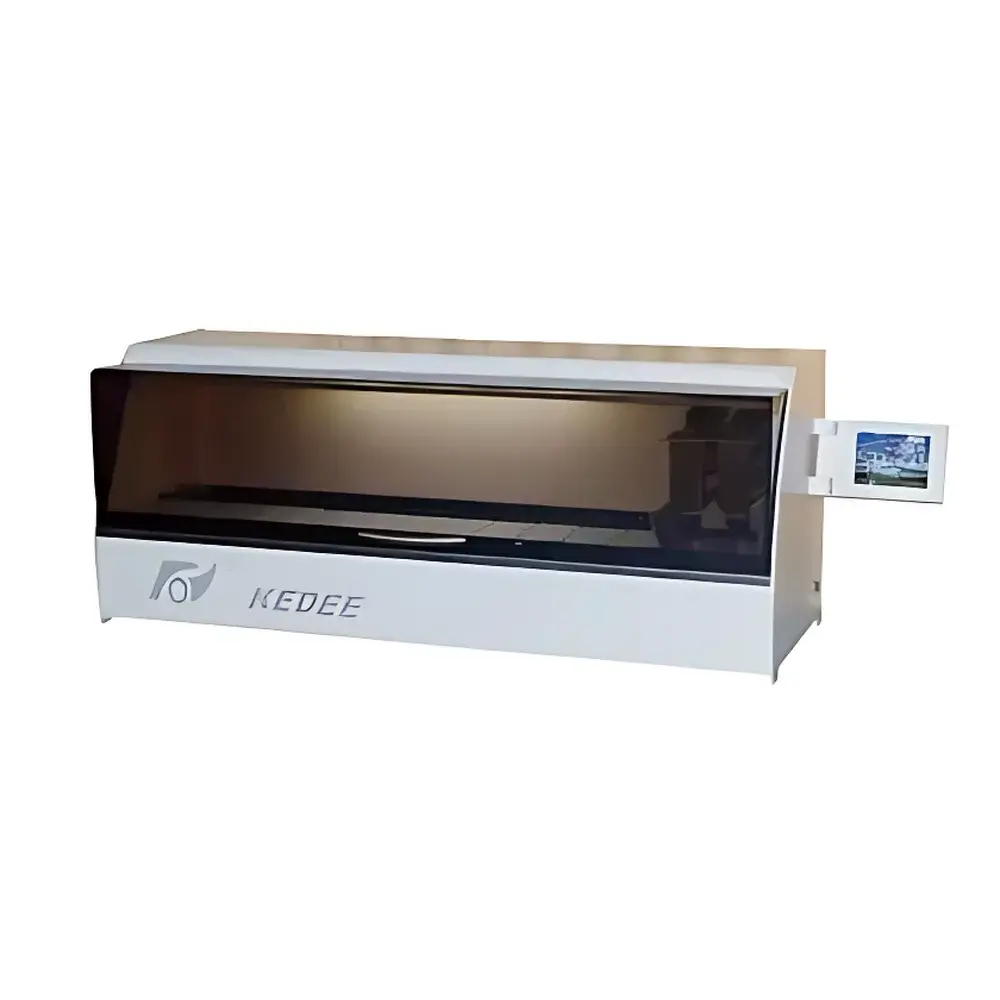
Kedi KD-TS3S Automatic Tissue Processor
| Origin | Beijing, China |
|---|---|
| Manufacturer Type | Authorized Distributor |
| Product Origin | Domestic (China) |
| Model | KD-TS3S |
| Price | USD 12,500 (FOB) |
| Cylinder Count | 14 (10 reagent + 4 paraffin wax cylinders) |
| Single-Cylinder Capacity | 1500 mL |
| Temperature Range | Ambient to 80 °C |
| Temperature Accuracy | ±1 °C |
| Processing Time per Cylinder | Cylinders 1–2: up to 99 h 59 min |
| Cylinders 3–14 | 0–24 h |
| Drain/Blot Time | 10–60 s (adjustable, with surface draining & shaking) |
| Agitation Frequency | 0–6 cycles/min |
| Power Supply | AC 220 V ±10%, 50 Hz / AC 110 V ±10%, 60 Hz |
| Power Consumption | 550 VA |
| Dimensions (W×D×H) | 1250 × 430 × 490 mm |
| Weight | 85 kg |
Overview
The Kedi KD-TS3S Automatic Tissue Processor is a high-throughput, dual-basket benchtop instrument engineered for standardized, reproducible dehydration, clearing, and paraffin infiltration of biological tissue specimens in histopathology laboratories. It operates on a programmable timed fluid exchange principle—sequentially immersing tissue cassettes in graded ethanol series, xylene (or xylene substitutes), and molten paraffin across 14 precisely controlled processing stations. Its dual independent lifting mechanisms enable parallel processing of heterogeneous tissue types (e.g., dense fibrous vs. soft parenchymal samples) without cross-contamination or differential processing artifacts. Designed for compliance with routine histology workflows, the KD-TS3S supports both routine diagnostic throughput and research-grade consistency—meeting foundational requirements for CLIA, CAP, and ISO 15189-accredited pathology labs where traceability and process stability are critical.
Key Features
- Dual-basket architecture with independent motion control—enables simultaneous yet segregated processing of up to 200+ tissue cassettes per cycle, minimizing inter-sample variability caused by size, density, or anatomical origin.
- Fully sealed, low-noise flexible drive system with imported photoelectric positioning sensors—ensures repeatable basket positioning accuracy within ±0.5 mm and eliminates mechanical wear or audible disturbance during overnight operation.
- Intelligent touchscreen HMI with bilingual (English/Chinese) interface—supports scrolling navigation, real-time animated process visualization, context-sensitive on-screen help, and step-by-step operational prompts for first-time users.
- Integrated environmental safety subsystem—comprising activated carbon filtration, catalytic decomposition, and optional external exhaust ducting—to continuously neutralize formalin, xylene, and alcohol vapors within the chamber and maintain operator exposure below OSHA PEL thresholds.
- Triple-redundant thermal management: dry-heating cast-aluminum blocks, PID-controlled gradient heating, and overtemperature cutoffs—deliver stable ±1 °C temperature regulation across all 14 cylinders, even under ambient fluctuations.
- Configurable agitation (0–6 rpm) and programmable drain/blot cycles (10–60 s)—optimize reagent penetration while minimizing carryover between stations and extending solvent service life by up to 35% versus non-agitated systems.
- Uninterruptible operation logic: battery-backed memory retains active programs and position data during power loss; automatic recovery resumes from last completed station after >30 hours of standby runtime.
Sample Compatibility & Compliance
The KD-TS3S accommodates standard histology cassettes (e.g., Leica, Sakura, Thermo Fisher formats) in both baskets simultaneously. Its 1500 mL cylinder volume supports full immersion of up to 40 cassettes per basket without crowding—critical for uniform reagent access and avoidance of edge effects. The system complies with ASTM E2917-22 (Standard Practice for Validation of Automated Tissue Processors) and supports audit-ready documentation when paired with optional LIMS integration. All temperature, timing, and agitation parameters are logged with timestamped metadata—enabling alignment with GLP/GMP documentation standards and FDA 21 CFR Part 11 electronic record requirements when configured with user authentication and audit trail software modules.
Software & Data Management
The embedded controller stores up to 40 customizable protocols (20 per basket), each with independent time/temperature/agitation profiles per station. Protocols may be duplicated, edited, or exported via USB port for lab-wide standardization. Real-time status logging includes cylinder temperature history, basket position timestamps, agitation actuation logs, and alarm event records (e.g., door open, low fluid, thermal deviation). Optional Ethernet connectivity enables remote monitoring through secure HTTPS web interface—supporting centralized fleet management in multi-instrument core facilities. Data export formats include CSV and XML, compatible with LIS/HIS platforms and internal QA dashboards.
Applications
The KD-TS3S serves as a primary tissue processor in clinical pathology departments, academic research cores, and contract research organizations (CROs) performing solid tumor biobanking, toxicologic pathology, and preclinical efficacy studies. Its dual-basket design is particularly advantageous for labs handling mixed specimen loads—such as simultaneous processing of surgical resections (large, dense tissues requiring extended dehydration) and biopsy cores (small, delicate samples needing gentler protocols). It is routinely deployed in studies requiring high-fidelity morphology preservation prior to IHC, IF, or spatial transcriptomics—where inconsistent dehydration directly impacts antigen retrieval efficiency and section integrity.
FAQ
What is the maximum number of tissue cassettes the KD-TS3S can process per run?
Up to 200 standard-sized cassettes (e.g., 25 × 25 × 5 mm) across both baskets—assuming optimal loading density and use of recommended cassette racks.
Does the KD-TS3S support xylene-free processing protocols?
Yes—the system accepts any miscible organic solvent (e.g., limonene, d-limonene, or isopropanol-based clearing agents) provided viscosity and vapor pressure fall within its fluid handling specifications (1–15 cSt, boiling point < 200 °C).
Can processing protocols be validated for regulatory submissions?
Absolutely—the device supports full parameter logging, user access controls, and electronic signature capability when upgraded with compliant firmware and connected to a validated network infrastructure.
Is maintenance training available for biomedical engineers?
Kedi provides certified on-site technician training covering preventive maintenance schedules, sensor calibration procedures, fluid path sanitation, and error code diagnostics—all documented in English-language service manuals.
What safety certifications does the KD-TS3S hold?
CE-marked per IEC 61010-1:2010 (Safety Requirements for Electrical Equipment for Measurement, Control, and Laboratory Use) and RoHS 2011/65/EU compliant; meets UL 61010-1 equivalency for North American installation.



