
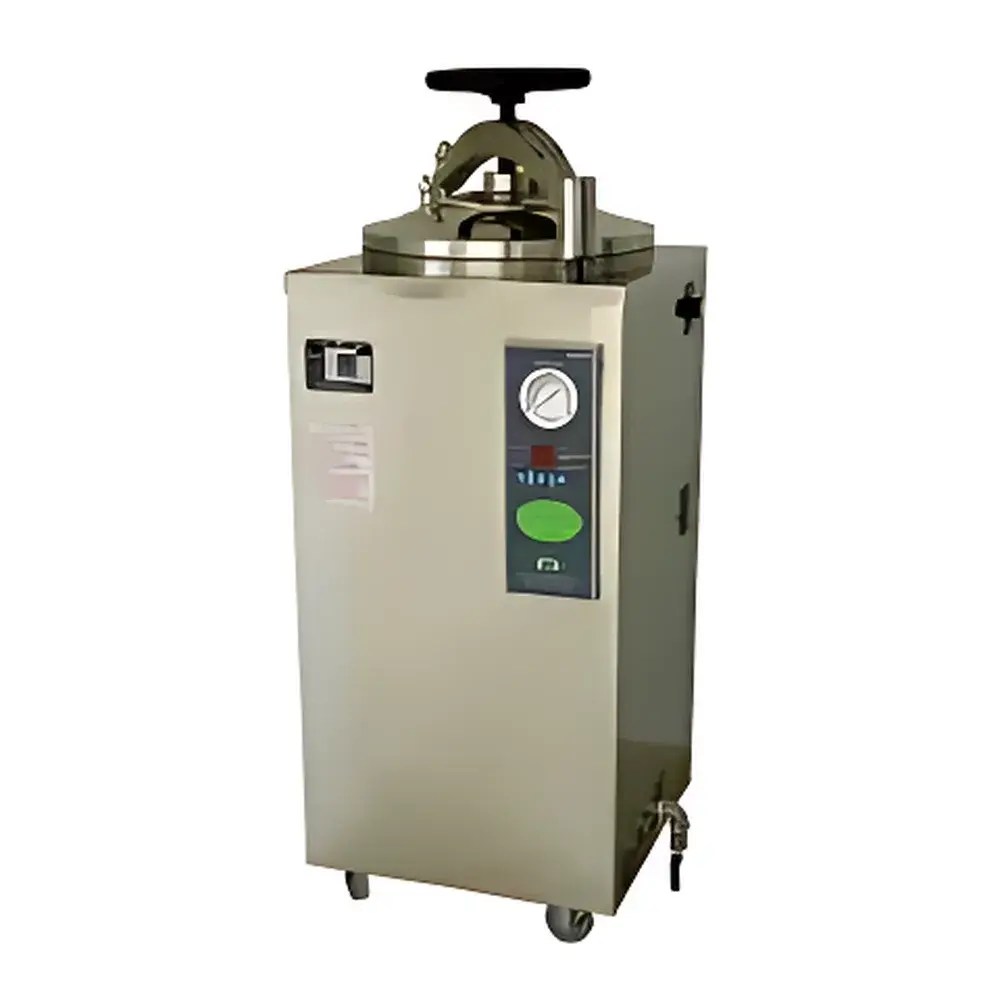
YXQ-LS-75SII Vertical Steam Autoclave
| Origin | Shanghai, China |
|---|---|
| Manufacturer Type | Authorized Distributor |
| Origin Category | Domestic (PRC) |
| Model | YXQ-LS-75SII |
| Price | USD 1,620 (FOB Shanghai) |
| Chamber Volume | 75 L |
| Max Operating Temperature | 135 °C |
| Max Operating Pressure | 0.22 MPa |
| Heating Power | 3.5 kW |
| Voltage/Frequency | 220 V ±10%, 50 Hz ±2% |
| External Dimensions (W×D×H) | 500 × 500 × 1100 mm |
| Internal Chamber Diameter × Height | Ø400 × 600 mm |
| Basket Dimensions (Ø × H × Qty) | Ø360 × 280 mm × 2 pcs |
| Temperature Range | 0–135 °C |
| Time Setting Range | 0–999 min |
| Safety Compliance | Meets TSG 21–2016 (China Special Equipment Safety Technical Supervision Regulation, Art. 49) |
Overview
The YXQ-LS-75SII Vertical Steam Autoclave is a CE-compliant, microprocessor-controlled sterilization system engineered for routine and validation-grade steam sterilization in academic laboratories, clinical diagnostic centers, pharmaceutical QC labs, and biomedical research facilities. It operates on the principle of saturated steam under pressure—leveraging the thermodynamic properties of moist heat to achieve microbial inactivation through irreversible protein denaturation and nucleic acid disruption. Designed in accordance with TSG 21–2016 (China’s Special Equipment Safety Technical Supervision Regulation), this autoclave integrates dual-pressure safety architecture, including mechanical pressure interlock and electronic overpressure relief, ensuring compliance with ISO 17665-1:2017 (Sterilization of health care products — Moist heat — Part 1: Requirements for the development, validation and routine control of a sterilization process for medical devices). Its vertical orientation optimizes floor space utilization while maintaining full accessibility for loading/unloading standard laboratory glassware, stainless steel instrument trays, and wrapped surgical packs.
Key Features
- Interlocked handwheel-type quick-opening door mechanism compliant with TSG 21–2016 Article 49—prevents accidental opening during pressurized operation via mechanical linkage and real-time pressure verification.
- Double-walled chamber construction: inner chamber and outer casing fabricated from SUS304 austenitic stainless steel (EN 10088-1, ASTM A240), providing long-term resistance to chloride-induced pitting, alkaline cleaning agents, and repeated thermal cycling.
- Self-sealing silicone gasket with auto-expansion design ensures leak-tight integrity across the full operating temperature range (0–135 °C); cold air purge cycle initiates automatically prior to sterilization phase to eliminate non-condensable gases.
- Dual independent safety systems: temperature-limited cut-off (140 °C mechanical override) and pressure-actuated safety valve (set at 0.25 MPa design limit, releasing at ≥0.225 MPa).
- Intelligent water-level management: ultrasonic low-water detection triggers audible/visual alarm and halts heating if water volume falls below minimum operational threshold; integrated dry-run prevention logic disables heater activation when sensor signal is invalid.
- Programmable sterilization cycles with adjustable time (0–999 min) and temperature (0–135 °C), plus post-cycle drying option (user-selectable duration).
Sample Compatibility & Compliance
The YXQ-LS-75SII accommodates standard laboratory loads including but not limited to: borosilicate glassware (e.g., flasks, Petri dishes), stainless steel surgical instruments, cotton gauze packs, liquid media in sealed bottles (with vented caps), and polymer-based lab consumables rated for autoclaving (e.g., polypropylene centrifuge tubes, autoclavable pipette tip boxes). All sterilization cycles conform to ISO 11134:2014 (Validation and routine control of sterilization by moist heat) and support GLP/GMP documentation requirements. While not FDA 510(k)-cleared as a medical device, its performance parameters meet the minimum functional criteria outlined in ANSI/AAMI ST79:2017 for steam sterilizers used in healthcare settings. Traceable calibration records for temperature and pressure sensors can be generated upon request for internal audit or regulatory review.
Software & Data Management
This model features an embedded 8-bit microcontroller with non-volatile EEPROM for cycle parameter storage and event logging. Each completed cycle automatically records timestamp, setpoint temperature, actual chamber temperature profile (sampled every 10 s), pressure curve, and fault codes—retained for up to 1,000 cycles. Data export is supported via RS232 serial interface (optional USB-to-serial adapter required) for integration with LIMS or local CSV archiving. Audit trail functionality includes operator ID input (via numeric keypad), cycle start/stop confirmation, and tamper-evident log entries—all aligned with ALCOA+ principles (Attributable, Legible, Contemporaneous, Original, Accurate, Complete, Consistent, Enduring, Available) for quality system alignment.
Applications
- Routine sterilization of reusable labware in university teaching and research laboratories.
- Preparation of sterile culture media and reagents for microbiology, cell culture, and molecular biology workflows.
- Decontamination of biohazardous waste prior to disposal in BSL-2 and BSL-3 containment environments.
- Validation support for sterilization SOPs under ISO 13485 or ICH Q5A frameworks.
- QC release testing of terminally sterilized devices in small-scale medical device manufacturing.
FAQ
What is the maximum load capacity for liquid sterilization?
The chamber supports up to 50 L of aqueous solution per cycle when using validated slow-cool protocols to prevent boil-over; total mass must remain within 75 kg to maintain thermal uniformity.
Does the unit include a built-in printer or data logger?
No—data logging is internal only; external printing requires optional RS232-to-thermal-printer interface (sold separately).
Can this autoclave be validated per HTM 2030 or EN 285?
While designed to meet core physical performance criteria (temperature uniformity ±1 °C, pressure accuracy ±0.01 MPa), formal validation per EN 285 requires third-party IQ/OQ/PQ execution and cannot be claimed without documented evidence.
Is the control system compliant with FDA 21 CFR Part 11?
The current firmware does not support electronic signatures or role-based access control; however, raw cycle logs are exportable and retain immutable timestamps for manual review and signature.
What maintenance intervals are recommended?
Daily: chamber wipe-down and gasket inspection; quarterly: safety valve function test and pressure transducer calibration; annually: full preventive maintenance including door seal replacement and control board diagnostics.



