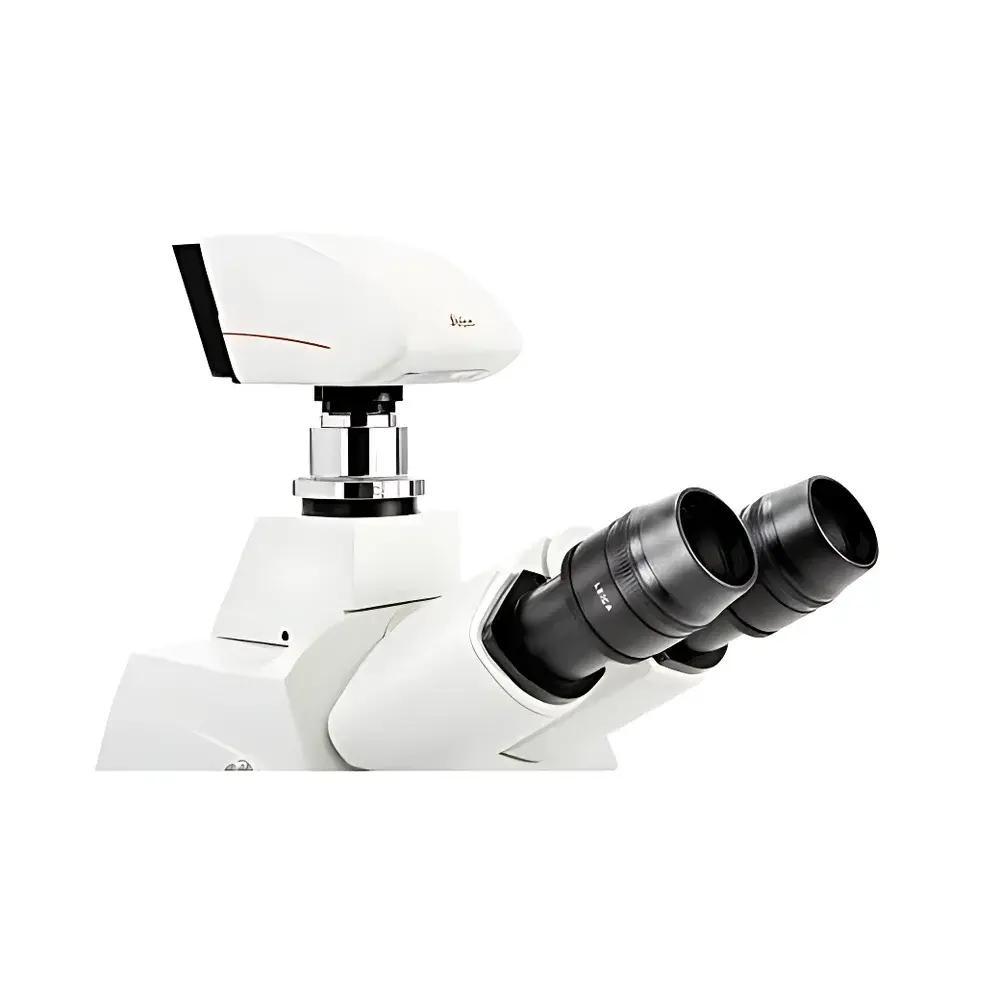
Leica DFC310 FX Microscope Camera System
| Brand | Leica |
|---|---|
| Origin | Germany |
| Model | DFC310 FX |
| Sensor Type | 1.4 MP CCD with Bayer RGB filter array |
| Color Depth | 36-bit |
| Cooling | Peltier-cooled sensor |
| Frame Rate | up to 71 fps (in partial scan mode) |
| Exposure Time Range | 4 µs to 10 min |
| Interface | IEEE 1394b (FireWire) |
| Compliance | CE, RoHS, ISO 13485–compatible manufacturing environment |
Overview
The Leica DFC310 FX Microscope Camera System is a high-performance, Peltier-cooled scientific imaging solution engineered for demanding transmitted-light and fluorescence microscopy applications. Built around a 1.4-megapixel progressive-scan CCD sensor with integrated Bayer RGB color filter array, the DFC310 FX delivers exceptional color fidelity and low-noise performance—critical for quantitative analysis in cell biology, developmental biology, and translational medical research. Its thermoelectric cooling architecture suppresses dark current noise, enabling reliable image acquisition under ultra-low illumination conditions typical of live-cell GFP expression studies or weakly fluorescent tissue sections. Unlike consumer-grade sensors, the DFC310 FX employs a true scientific-grade CCD architecture with global shutter operation, eliminating motion artifacts during rapid dynamic processes. The system operates natively within Leica’s LAS X platform and maintains full hardware synchronization with Leica upright, inverted, and stereomicroscope platforms—including DM series, DMI series, and M-series systems—ensuring precise timing control for multi-channel fluorescence capture and time-lapse experiments.
Key Features
- Peltier-cooled CCD sensor for thermal noise suppression and stable baseline performance across extended acquisition sessions
- 36-bit color depth (12 bits per channel) supporting accurate spectral representation and post-acquisition linear scaling without clipping
- Configurable exposure times from 4 microseconds to 10 minutes—enabling both high-speed kinetic imaging and long-integration low-signal detection
- Partial scan mode for region-of-interest (ROI) readout, accelerating frame rates up to 71 fps while maintaining full spatial resolution within user-defined sub-areas
- IEEE 1394b (FireWire) interface providing deterministic data transfer latency, plug-and-play compatibility, and robust bandwidth for sustained high-throughput imaging
- Hardware-level white balance calibration with multiple preset illumination profiles (e.g., halogen, LED, mercury, xenon) ensuring consistent color reproduction across diverse staining protocols and microscope light sources
Sample Compatibility & Compliance
The DFC310 FX supports a broad range of specimen types including fixed and live cultured cells, histological sections (H&E, DAB, immunofluorescence), whole-mount embryos, zebrafish larvae, and botanical preparations. It is routinely deployed in GLP-compliant laboratories performing routine QC in pharmaceutical development and academic core facilities conducting NIH-funded morphometric studies. While not certified as a Class I medical device under FDA 21 CFR Part 820, the camera is manufactured in accordance with ISO 13485-aligned quality management systems and bears CE marking for conformity with EU Medical Device Directive (MDD) Annex II requirements for ancillary diagnostic equipment. Its FireWire interface meets IEC 61000-4-2/3/4/6 immunity standards, ensuring electromagnetic compatibility in shared lab environments with motorized stages, environmental chambers, and electrophysiology rigs.
Software & Data Management
The DFC310 FX integrates seamlessly with Leica Application Suite (LAS) X v3.7+, offering native support for multi-dimensional acquisition (XYZTλ), hardware-triggered time-lapse, and synchronized multi-camera workflows. All acquired images embed EXIF metadata including exposure parameters, objective magnification, filter cube ID, and stage coordinates—facilitating traceability in regulated environments. Raw image data are stored in Leica’s proprietary LIF format (compatible with open-standard TIFF export), preserving full bit-depth and metadata integrity. Audit trail functionality within LAS X complies with ALCOA+ principles and supports 21 CFR Part 11 compliance when deployed with validated electronic signature modules and network-based user authentication. Export pipelines include batch conversion to OME-TIFF for interoperability with ImageJ/Fiji, QuPath, and commercial AI-based segmentation tools.
Applications
- Quantitative fluorescence intensity profiling of GFP/RFP-tagged proteins in live-cell assays
- Time-resolved documentation of mitotic progression, cytokinesis, and organelle dynamics at ≤150 ms temporal resolution
- High-fidelity color documentation of H&E-stained pathology slides with minimal post-processing
- Multi-channel epifluorescence imaging of co-localization experiments using DAPI/FITC/TRITC filter sets
- Documentation and measurement of morphological parameters in developmental biology models (e.g., Drosophila wing discs, C. elegans neuronal outgrowth)
- Integration into automated slide scanning workflows via Leica DM6000/DM8000 microscope platforms with motorized focus and XY stage control
FAQ
Is the DFC310 FX compatible with non-Leica microscopes?
Yes—when used with third-party C-mount adapters and supported by generic FireWire drivers, it functions as a standard DCAM-compliant device; however, advanced features such as hardware synchronization and objective-linked magnification scaling require Leica microscope integration.
Does the camera support binning modes?
No—the DFC310 FX does not implement pixel binning. Instead, it achieves signal-to-noise improvement through Peltier cooling and extended exposure control, preserving native 1.4 MP spatial sampling.
What is the maximum sustained frame rate at full resolution?
At full 1360 × 1024 resolution, the maximum frame rate is 12 fps; ROI-based partial scan enables up to 71 fps within user-defined sub-regions.
Can the DFC310 FX be used for brightfield DIC or phase contrast quantification?
Yes—its wide dynamic range (≥64 dB) and linear response curve make it suitable for grayscale intensity measurements in label-free contrast techniques, provided appropriate neutral density filtration is applied to avoid saturation.
Is firmware update capability available remotely?
Firmware updates must be performed locally via Leica’s authorized service portal and require physical connection to a Windows host running LAS X; no over-the-air or cloud-based update mechanism is implemented.