
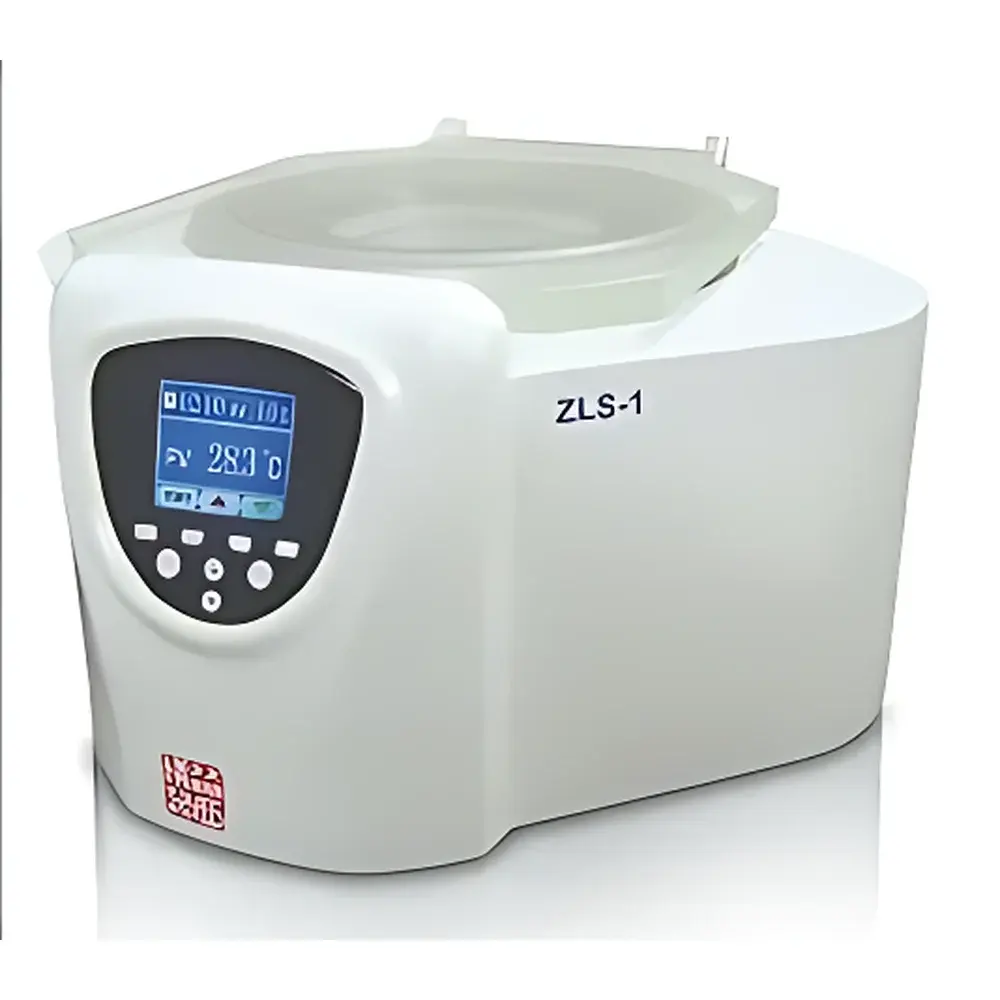
ZLS-2 Vacuum Centrifugal Concentrator
| Origin | Hunan, China |
|---|---|
| Manufacturer Type | Distributor |
| Product Origin | Domestic (China) |
| Model | ZLS-2 |
| Instrument Category | Vacuum Centrifugal Concentrator |
| Price | USD 1,500 (approx.) |
| Rotor Capacity | 10 mL × 12 |
| Max. Speed | 1500 rpm |
| Temperature Range | Ambient to 60 °C |
| Timer Range | 0–99 h 59 min |
| Chamber Material | Anodized Aluminum with Corrosion-Resistant Coating |
| Drive System | Maintenance-Free Contactless Magnetic Drive |
| Display | TFT True-Color Touchscreen Interface |
| Dimensions (L×W×H) | 500 × 490 × 280 mm |
| Vacuum Pump | External (Optional) |
| Compatibility | Interchangeable Rotors & Adapters (e.g., 1.5 mL × 62, 20 mL × 6/5, 50 mL × 6 or ×2) |
Overview
The ZLS-2 Vacuum Centrifugal Concentrator is an engineered solution for gentle, efficient solvent removal from heat-sensitive biological and analytical samples under reduced pressure. It integrates three orthogonal physical principles—centrifugal force, vacuum-assisted evaporation, and controlled conductive heating—to minimize sample degradation while maximizing recovery yield. Unlike conventional rotary evaporators or nitrogen blow-down systems, the ZLS-2 maintains sample integrity by preventing foaming, bumping, or oxidation through simultaneous rotation (up to 1500 rpm), vacuum application (typically 0.1–10 mbar, dependent on external pump performance), and precise temperature regulation (ambient to 60 °C). Its design adheres to fundamental mass-transfer theory: lowering vapor pressure via vacuum accelerates solvent evaporation, while centrifugal force counteracts boiling-induced splashing and ensures uniform sample distribution across tube walls. This architecture supports reproducible concentration of nucleic acids, proteins, metabolites, small-molecule pharmaceuticals, and environmental extracts—particularly where volatile organic solvents (e.g., ethanol, acetonitrile, chloroform) are employed.
Key Features
- True-color TFT touchscreen interface with intuitive icon-driven navigation and real-time parameter monitoring (speed, temperature, time, vacuum status)
- Anodized aluminum drying chamber with electrophoretic epoxy coating for long-term resistance to acid/base vapors and organic solvent corrosion
- Contactless magnetic drive system eliminates mechanical seals and bearings—zero maintenance, no lubricant contamination risk, and silent operation
- Transparent polycarbonate lid with safety interlock: automatic rotor stop upon lid opening and vacuum release
- Modular rotor ecosystem supporting multiple configurations: 10 mL × 12 standard, 1.5 mL × 62 microplate-compatible, 20 mL × 6/5 conical, and 50 mL × 6 or ×2 adapters for scalable throughput
- Precise PID-controlled heating plate with ±1 °C accuracy across 0–60 °C range; optional ambient-only mode for ultra-thermolabile samples
- Programmable timer (0–99 h 59 min) with auto-shutdown and hold function for unattended overnight runs
Sample Compatibility & Compliance
The ZLS-2 accommodates a broad spectrum of sample formats—including PCR tubes, microcentrifuge tubes (0.2–50 mL), deep-well plates, and custom vials—without requiring tube-specific accessories beyond standardized adapters. Its chamber geometry and airflow dynamics ensure uniform heat transfer and consistent vacuum distribution across all positions. While not certified to ISO/IEC 17025 or FDA 21 CFR Part 11 out-of-the-box, the instrument’s operational parameters (temperature logging, speed verification, time-stamped run records via optional USB export) support GLP/GMP-aligned documentation practices. Users routinely validate method performance per ICH Q5C (stability testing) and USP (analytical instrument qualification), particularly in QC labs handling biologics purification or residual solvent analysis per ICH Q3C.
Software & Data Management
The ZLS-2 operates via embedded firmware with no PC dependency. All protocols—including multi-step programs (e.g., ramp-to-45 °C → hold 30 min → cool to 25 °C) —are stored locally in non-volatile memory (≥100 user-defined methods). Run data (start/stop timestamps, actual vs. setpoint profiles, error logs) can be exported as CSV via USB-A port for traceability and audit readiness. Though lacking network connectivity or remote control, its deterministic behavior and hardware-based safety interlocks (overtemperature cutoff, overspeed shutdown, vacuum loss detection) meet essential requirements for regulated environments where deterministic repeatability outweighs cloud integration.
Applications
- Concentration of DNA/RNA eluates post-column purification (e.g., silica-membrane kits) without shearing or salt carryover
- Desalting and buffer exchange of peptide digests prior to LC-MS analysis
- Removal of trifluoroacetic acid (TFA) from HPLC fractions during synthetic peptide refinement
- Pre-concentration of environmental water extracts (e.g., PAHs, PCBs) prior to GC-ECD quantification
- Drying of lyophilization-prep samples where residual moisture must be minimized before freeze-drying
- Routine solvent exchange in medicinal chemistry workflows (e.g., DMSO → PBS for cell-based assays)
FAQ
Is a vacuum pump included with the ZLS-2?
No. The ZLS-2 requires an external vacuum pump (recommended ultimate vacuum ≤0.1 mbar; oil-free diaphragm pumps are preferred for solvent compatibility).
Can the ZLS-2 be used with corrosive solvents such as hydrochloric acid or nitric acid?
Not directly. While the chamber coating resists mild organic vapors, strong mineral acids require dedicated fume hood integration and optional acid-trap cold traps to prevent pump and instrument damage.
What is the maximum recommended volume per tube when using the 10 mL rotor?
For optimal centrifugal force distribution and minimal splashing, fill tubes to no more than 70% capacity (i.e., ≤7 mL for 10 mL tubes).
Does the ZLS-2 support validation documentation for regulated laboratories?
Yes—its stable thermal and rotational performance, combined with timestamped run logs and configurable alarm thresholds, enables IQ/OQ execution per ASTM E2500 and internal SOPs.
How frequently does the chamber coating require reapplication?
Under normal use with common organics (methanol, acetone, ethyl acetate), the electrophoretic epoxy layer remains effective for ≥5 years; visual inspection for pitting or discoloration is recommended annually.



