
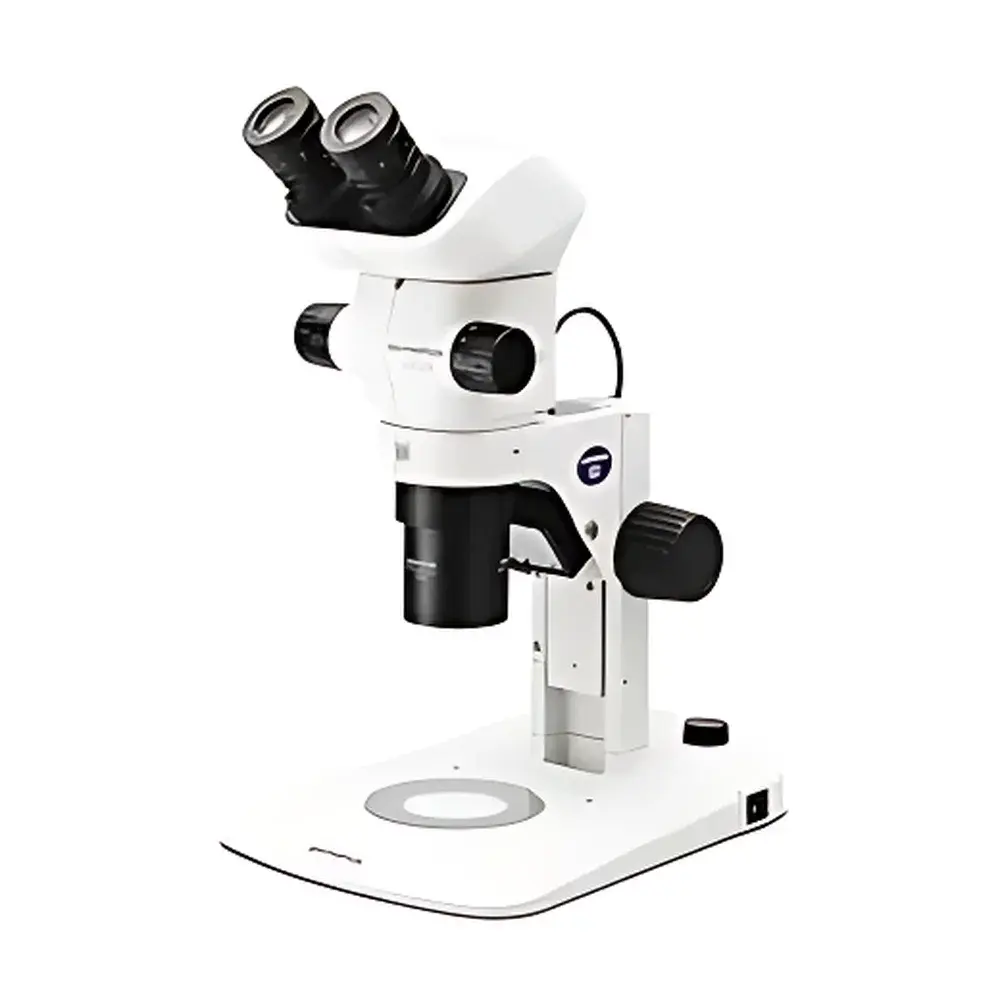
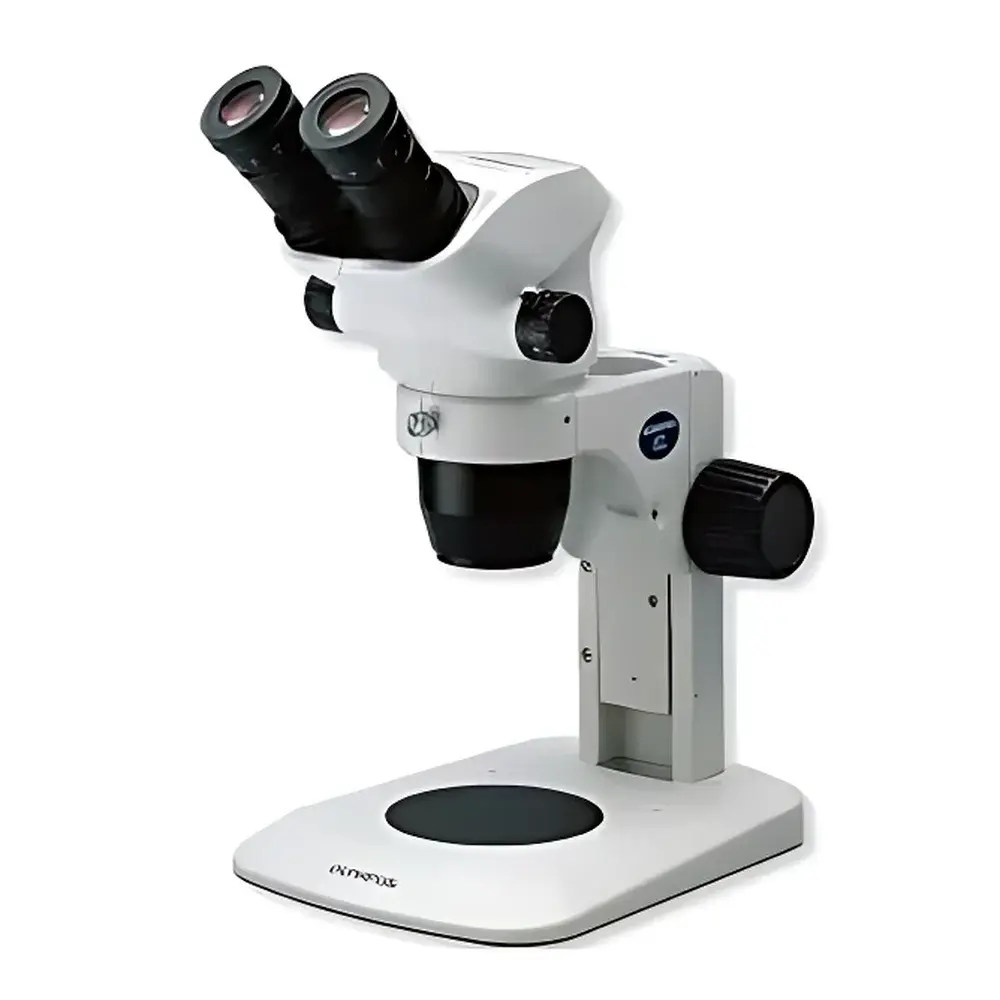
Olympus SZ51 Stereo Microscope
| Brand | Olympus |
|---|---|
| Origin | Japan |
| Model | SZ51 |
| Total Magnification | 40× |
| Zoom Ratio | 5:1 |
| Working Distance | 110 mm |
| Objective Type | 1× |
| Illumination | LED |
| Depth of Field | Compatible with C-mount camera systems |
| Eyepiece Angle | 45° |
| Interpupillary Adjustment Range | 52–76 mm (with WHSZ10× eyepieces) |
| LED Lifespan | 6,000 hours |
| Power Input | 100–120 V / 200–240 V AC, 50/60 Hz |
| Weight (Zoom Body) | 1.3 kg |
| Optical System | Greenough design |
| Environmental Compliance | Lead-free optical components |
Overview
The Olympus SZ51 Stereo Microscope is a high-performance, entry-level stereoscopic instrument engineered for routine inspection, educational demonstration, and foundational life science applications. Built upon the time-proven Greenough optical architecture—characterized by dual, laterally separated objective paths and a 10° convergence angle—the SZ51 delivers exceptional depth of field, flatness of field, and minimal geometric distortion across its entire zoom range. Unlike parallel-optical (Common Main Objective) systems, the Greenough design inherently supports wide working distances and natural three-dimensional perception without requiring complex beam-splitting optics. With a 5:1 zoom ratio (0.8× to 4.0× objective magnification) and standard 10× widefield eyepieces, the system achieves a total magnification range of 8× to 40×—optimized for manual dissection, PCB inspection, botanical specimen evaluation, and quality control workflows where ergonomic accessibility and optical fidelity are prioritized over ultra-high resolution.
Key Features
- Greenough Optical Design: Ensures consistent image flatness, high stereo acuity, and extended depth of field—critical for accurate spatial interpretation during manual manipulation tasks.
- Ergonomic Human-Centered Engineering: 45° inclined binocular tube with synchronized interpupillary adjustment (52–76 mm), low-profile compact chassis, and front-mounted zoom and focus controls reduce operator fatigue during prolonged use.
- Lead-Free Optical Construction: All lenses and prisms comply with RoHS directives, reflecting Olympus’ commitment to environmentally responsible manufacturing without compromising optical transmission or chromatic fidelity.
- Dual-Mode LED Illumination Base (SZ2-ILST): Integrated transmittance and incident illumination in a slim-profile base; provides stable color temperature (≈5,500 K) across intensity settings, eliminating thermal drift and bulb replacement cycles.
- C-Mount Compatibility: Built-in 0.5× photo port enables direct coupling to industrial cameras, scientific CMOS sensors, or digital imaging systems without additional adapters—supporting documentation, measurement, and GLP-compliant recordkeeping.
- Modular Mechanical Architecture: Standard 76 mm mounting diameter and M48×0.75 auxiliary lens thread allow seamless integration with third-party stands, motorized Z-drives, micromanipulators, and environmental chambers.
Sample Compatibility & Compliance
The SZ51 accommodates a broad spectrum of macro-to-mesoscale specimens—from intact insect specimens and plant tissues to electronic assemblies, metallurgical cross-sections, and polymer components—without requiring sectioning or vacuum preparation. Its 110 mm working distance permits unobstructed tool access beneath the objective, supporting tweezers, soldering irons, or pipettes. The system conforms to ISO 10934-1 (stereomicroscope nomenclature), JIS B 7151 (optical performance testing), and IEC 61000-6-3 (EMC emissions). While not certified for GMP production environments, its mechanical stability, repeatable zoom calibration, and traceable optical path make it suitable for QC laboratories operating under ISO/IEC 17025 quality management frameworks. Optional accessories—including darkfield transillumination (SZX-ILLD2), polarized incident light (SZ2-ILLC), and fiber-optic ring illuminators (SZ2-LGR)—extend compliance with ASTM E2015 (microscopy terminology) and USP (instrument qualification guidelines).
Software & Data Management
The SZ51 functions as a hardware platform compatible with industry-standard imaging software suites including Olympus cellSens™ Entry, ImageJ/Fiji (via TWAIN or DirectShow drivers), and HALCON-based machine vision pipelines. When paired with optional DP12 digital camera modules or third-party C-mount sensors, the microscope supports timestamped image capture, region-of-interest annotation, scale bar embedding (calibrated via stage micrometer), and export in TIFF, JPEG2000, or lossless PNG formats. Audit trail functionality—including user ID logging, acquisition metadata (magnification, illumination mode, exposure time), and folder-level version control—is achievable through compliant LIMS or ELN integrations. For regulated environments, optional firmware upgrades enable 21 CFR Part 11-compliant electronic signatures and role-based access control when deployed with validated software stacks.
Applications
- Academic Teaching: Demonstrating anatomical structures, embryonic development stages, and material fracture surfaces in undergraduate biology and materials science laboratories.
- Electronics Manufacturing: Visual inspection of solder joints, component placement accuracy, and conformal coating uniformity on PCBs at 8–40× magnification.
- Botanical & Entomological Research: Non-destructive morphological documentation of whole organisms, pollen grains, and leaf epidermal features.
- Forensic Evidence Examination: Toolmark analysis, fiber identification, and latent print enhancement using oblique LED illumination modes.
- Industrial Quality Assurance: Dimensional verification of machined parts, surface defect mapping, and assembly validation prior to functional testing.
FAQ
What is the maximum usable magnification with the SZ51?
The nominal total magnification reaches 40× using 10× eyepieces and the 4.0× end of the zoom range. Higher effective magnifications (e.g., 60×) may be achieved with auxiliary 1.5× or 2.0× objectives—but these reduce working distance and depth of field, and are not recommended for routine use.
Can the SZ51 be adapted for fluorescence observation?
No—the Greenough optical path lacks a dichroic beam splitter and excitation/emission filter cube holder. Fluorescence-capable alternatives include the Olympus SZX series with modular epi-illumination turrets.
Is the LED illumination intensity adjustable?
Yes—continuous analog dimming is provided via a rotary control on the base housing, enabling precise contrast optimization without spectral shift.
Does the SZ51 support motorized zoom or focus?
Not natively. However, third-party stepper motor kits (e.g., Prior Scientific LumenScope) can be retrofitted using the standard M48 accessory thread and external mounting rails.
What calibration standards are recommended for measurement applications?
A NIST-traceable stage micrometer (e.g., Edmund Optics #58-772) calibrated at 10×, 20×, and 40× magnifications is required for quantitative dimensional analysis per ISO 5725 repeatability protocols.





