
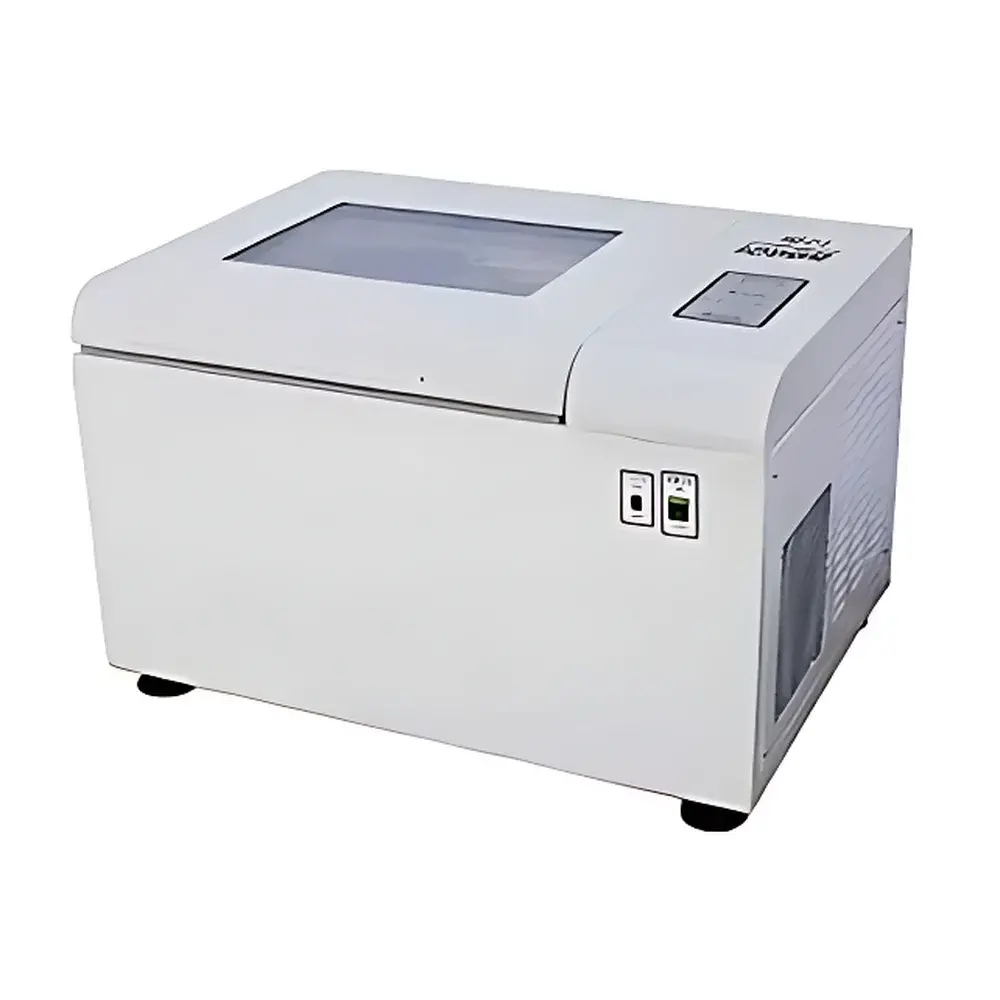
Taicang THZ-C-1 Refrigerated Orbital Shaker
| Origin | China |
|---|---|
| Manufacturer Type | Authorized Distributor |
| Instrument Category | Domestic |
| Model | THZ-C-1 |
| Quotation | USD 2,150 (FOB China) |
| Instrument Type | Refrigerated Orbital Shaker |
| Timer Range | 0–999 min |
| Oscillation Frequency | 20–350 rpm |
| Orbit Diameter | 26 mm |
| Temperature Range | 5°C to 60°C (ambient 25°C) |
| Temperature Accuracy | ±0.1°C |
| Temperature Uniformity | ±0.5°C |
| Platform Dimensions | 540 × 340 mm |
| Platform Capacity | 1000 mL × 6 or 500 mL × 10 or 250 mL × 19 (Erlenmeyer flasks) |
| Power Input | 600 W |
| Dimensions (W×D×H) | 790 × 565 × 490 mm |
| Net Weight | 56 kg |
| Voltage/Frequency | 220 V, 50 Hz |
| Illumination | 8 W LED |
| Display | LED digital |
Overview
The Taicang THZ-C-1 Refrigerated Orbital Shaker is an engineered platform for precise, temperature-controlled liquid mixing in microbiological cultivation, cell suspension, biochemical assays, and molecular biology workflows. It operates on the principle of orbital shaking—generating a consistent circular motion with a fixed 26 mm orbit diameter—to ensure homogeneous aeration and suspension without vortex formation or excessive shear stress. Integrated refrigeration enables stable sub-ambient operation down to 5°C, making it suitable for thermosensitive applications such as enzyme kinetics, cold-adapted microbial growth, and protein expression studies requiring low-temperature induction. Its robust steel chassis, brushless DC motor drive, and PID-controlled cooling/heating system deliver high reproducibility across extended incubation cycles.
Key Features
- Refrigerated temperature control from 5°C to 60°C with ±0.1°C setpoint accuracy and ±0.5°C chamber uniformity (measured at 5 points per ISO 17025-compliant validation protocol)
- Adjustable orbital speed from 20 to 350 rpm with digital feedback regulation ensuring <±1 rpm stability under load
- Single large-format platform (540 × 340 mm) accommodating diverse vessel configurations—including up to six 1000 mL Erlenmeyer flasks or nineteen 250 mL flasks—optimized for scalability in lab-scale fermentation and culture expansion
- Microprocessor-based LED interface with real-time display of temperature, speed, and remaining time; programmable timer supports continuous or timed operation up to 999 minutes
- Energy-efficient 600 W refrigeration system using environmentally compliant R134a refrigerant; integrated overheat and compressor protection circuits
- Stainless-steel chamber interior and powder-coated exterior for corrosion resistance and ease of decontamination; optional spring-loaded clamps and universal flask holders available
Sample Compatibility & Compliance
The THZ-C-1 accommodates standard laboratory glassware and plastic vessels including conical flasks (100–1000 mL), test tubes, deep-well plates, and custom bioreactor sleeves. Its mechanical design conforms to IEC 61000-6-3 (EMC emissions) and IEC 61010-1 (safety requirements for electrical equipment). While not certified for GMP manufacturing environments, the unit supports GLP-aligned workflows through traceable parameter logging (via optional RS-232/USB output) and meets common institutional requirements for temperature mapping validation per ASTM E2879-22. It is routinely deployed in academic core facilities, QC labs for media preparation, and preclinical research settings where controlled agitation and thermal stability are critical.
Software & Data Management
The THZ-C-1 operates autonomously via its onboard controller but supports external data capture through serial communication (RS-232) or USB-to-serial adapters. When interfaced with validated third-party lab management software (e.g., LabArchives, Benchling, or custom Python-based acquisition tools), users can export timestamped logs of setpoints, actual temperatures, rotational speeds, and runtime duration. Though the device does not natively support FDA 21 CFR Part 11 electronic signature functionality, audit trail generation and user access control can be implemented at the host system level—enabling compliance-ready documentation for ISO 13485 or ISO 9001 quality systems.
Applications
- Microbial and mammalian cell culture maintenance during exponential-phase growth
- Induction of recombinant protein expression in E. coli at low temperatures (e.g., 16°C overnight protocols)
- Preparation of agarose gels and antibody dilution series requiring uniform mixing without bubble entrapment
- Extraction of intracellular metabolites under chilled conditions to minimize enzymatic degradation
- Media sterilization validation studies involving thermal cycling with simultaneous agitation
- Environmental microbiology sampling—shaking of water or soil extracts for heterotrophic plate count (HPC) analysis per APHA Standard Methods 9215B
FAQ
What is the minimum operating temperature and how is sub-ambient cooling achieved?
The THZ-C-1 achieves a minimum setpoint of 5°C using a hermetically sealed R134a vapor-compression refrigeration system integrated into the base housing. Cooling capacity is rated at 200 W at 25°C ambient.
Can the shaker maintain temperature stability while running at maximum speed (350 rpm)?
Yes—thermal performance testing per ISO 17025 demonstrates ≤±0.3°C deviation from setpoint at 350 rpm across the full platform when loaded with nine 500 mL flasks filled to 70% capacity.
Is the platform compatible with non-standard or custom-sized vessels?
The flat, unclamped surface allows use of universal silicone mat inserts, magnetic flask holders, and third-party rack adapters. Custom mounting solutions can be designed using M4 threaded holes spaced at 50 mm intervals along the platform perimeter.
Does the unit include validation documentation or factory calibration certificates?
Standard delivery includes a factory-installed temperature sensor calibration certificate traceable to NIM (National Institute of Metrology, China). IQ/OQ documentation templates and temperature mapping SOPs are available upon request for qualification support.
What maintenance is required to sustain long-term reliability?
Recommended preventive maintenance includes quarterly cleaning of condenser coils, annual inspection of refrigerant pressure, and biannual verification of speed and temperature accuracy using NIST-traceable reference standards.






