
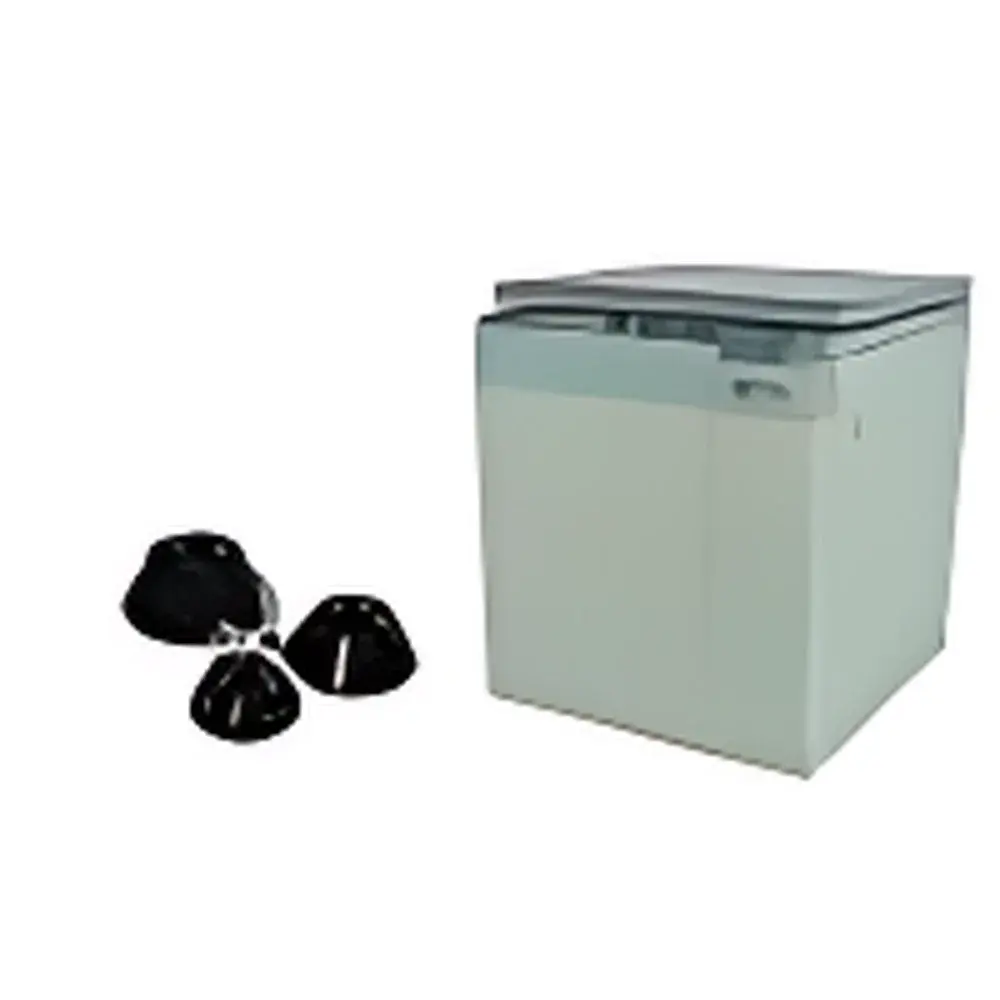
AnTing GL-20G-II High-Speed Refrigerated Centrifuge
| Origin | Shanghai, China |
|---|---|
| Manufacturer Type | Authorized Distributor |
| Origin Category | Domestic (PRC) |
| Model | GL-20G-II |
| Max Speed | 20,000 rpm |
| Max RCF | 25,480 ×g |
| Temperature Range | −5 °C to 30 °C |
| Temp. Accuracy | ±2 °C |
| Timer Range | 0–60 min |
| Noise Level | <75 dB(A) |
| Power Supply | 220 V, 50 Hz, 3 kW |
| Dimensions (L×W×H) | 460 × 480 × 720 mm |
| Weight | 72 kg |
| Rotor Options | Angle rotor 5 mL × 12 (20,000 rpm), 10 mL × 12 (16,000 rpm), 50 mL × 6 (14,000 rpm) |
Overview
The AnTing GL-20G-II High-Speed Refrigerated Centrifuge is an engineered laboratory workhorse designed for precise, temperature-sensitive separation of biological and biochemical samples under high gravitational forces. Utilizing the principle of sedimentation centrifugation—where differential particle migration occurs in a rotating field based on mass, density, shape, and medium viscosity—the GL-20G-II delivers reproducible pelleting, layering, and clarification across diverse sample types. Its refrigerated operation enables thermal stabilization during prolonged or high-speed runs, critical for preserving labile macromolecules (e.g., nucleic acids, membrane proteins, organelles), viral particles, and primary cell fractions. The system integrates a high-efficiency French Tecumseh (now part of Emerson) hermetic compressor, variable-frequency drive (VFD) motor control, and microprocessor-based regulation—ensuring stable rotational dynamics, minimal mechanical drift, and consistent thermal performance across the full operating range (−5 °C to 30 °C). With a maximum speed of 20,000 rpm and peak relative centrifugal force (RCF) of 25,480 ×g, it meets routine and advanced separation requirements in academic, clinical, and industrial laboratories.
Key Features
- Microprocessor-controlled operation with intuitive 4-button touch interface and wide-angle LCD display for real-time monitoring of speed, RCF, temperature, time remaining, and fault codes.
- Electronic lid interlock system automatically engages during rotation, preventing accidental opening and complying with IEC 61010-2-020 safety standards for centrifuges.
- High-strength polymer front housing reduces structural resonance and acoustic emission—operating noise maintained below 75 dB(A) at maximum speed.
- Optimized airflow path and insulated refrigeration chamber ensure uniform temperature distribution and rapid cool-down (<15 min from ambient to −5 °C).
- VFD motor enables smooth acceleration/deceleration profiles, minimizing sample disturbance and extending rotor service life.
- Robust cast-aluminum rotor chamber and precision-balanced rotor mounting reduce vibration transmission and enhance long-term mechanical stability.
Sample Compatibility & Compliance
The GL-20G-II accommodates standard conical-bottom polypropylene and polycarbonate tubes (5–50 mL), including common formats used in molecular biology (e.g., Eppendorf Safe-Lock, Corning Costar), clinical diagnostics (e.g., BD Vacutainer), and bioprocessing workflows. It supports ISO-certified angle rotors rated for repeated sterilization (autoclave up to 121 °C, 20 min) and validated for GMP-aligned environments. While not certified to FDA 21 CFR Part 11 out-of-the-box, its parameter logging capability—including timestamped run records with setpoints and actual values—supports ALCOA+ data integrity principles when integrated into validated laboratory information management systems (LIMS). The instrument conforms to EN 61010-1 (safety) and EN 61000-6-3 (EMC) standards. Temperature accuracy (±2 °C) and RCF repeatability (±1.5%) are verified per ISO 21501-4 for analytical centrifuge performance validation.
Software & Data Management
The embedded firmware stores up to 100 user-defined protocols with password-protected access levels (operator, supervisor, administrator). Each protocol retains rotor ID, speed/RCF, temperature setpoint, ramp/deceleration profile, and hold time. Run logs—including start/end timestamps, final rotor temperature, total runtime, and error flags—are exportable via USB port in CSV format for audit trail generation. Optional PC-based software (AnTing CentriLink v3.2) enables remote scheduling, multi-instrument fleet monitoring, and automated report generation compliant with GLP documentation templates. All electronic records support manual annotation and digital signature fields to align with internal QA procedures.
Applications
- Isolation of subcellular organelles (mitochondria, lysosomes, nuclei) from tissue homogenates using differential centrifugation protocols.
- Purification of plasmid DNA, genomic DNA, and RNA from bacterial or mammalian lysates under chilled conditions to inhibit nuclease activity.
- Clarification and concentration of viral vectors (AAV, lentivirus) and exosomes in biopharmaceutical development.
- Separation of blood components—including platelet-poor plasma (PPP), cryoprecipitate, and buffy coat—for transfusion medicine and immunoassay preparation.
- Downstream processing of monoclonal antibodies and recombinant proteins following harvest and initial depth filtration.
- Routine quality control testing of vaccine suspensions, diagnostic reagents, and sterile pharmaceutical intermediates where particulate removal and thermal control are mandated.
FAQ
What is the maximum allowable imbalance tolerance for the GL-20G-II?
The system permits ≤1.0 g imbalance per rotor position when loaded symmetrically; automatic imbalance detection halts acceleration if vibration exceeds ISO 1940 G2.5 threshold.
Can this centrifuge be used for continuous operation over multiple cycles without cooldown intervals?
Yes—its dual-stage refrigeration circuit and thermally shielded motor allow uninterrupted back-to-back runs within the −5 °C to 15 °C range, provided ambient room temperature remains ≤25 °C and humidity <60% RH.
Are rotor calibration certificates included with purchase?
Each rotor ships with a factory-verified balancing certificate and nominal RCF/speed curve; optional NIST-traceable calibration reports are available upon request.
Does the GL-20G-II support rotor recognition?
No—rotor identification is manual via operator input; however, firmware enforces speed limits based on selected rotor type to prevent overspeed events.
What maintenance intervals are recommended for the refrigeration system?
Compressor oil and refrigerant charge require inspection every 24 months by authorized service personnel; condenser coil cleaning is advised quarterly in non-laminar airflow environments.



