
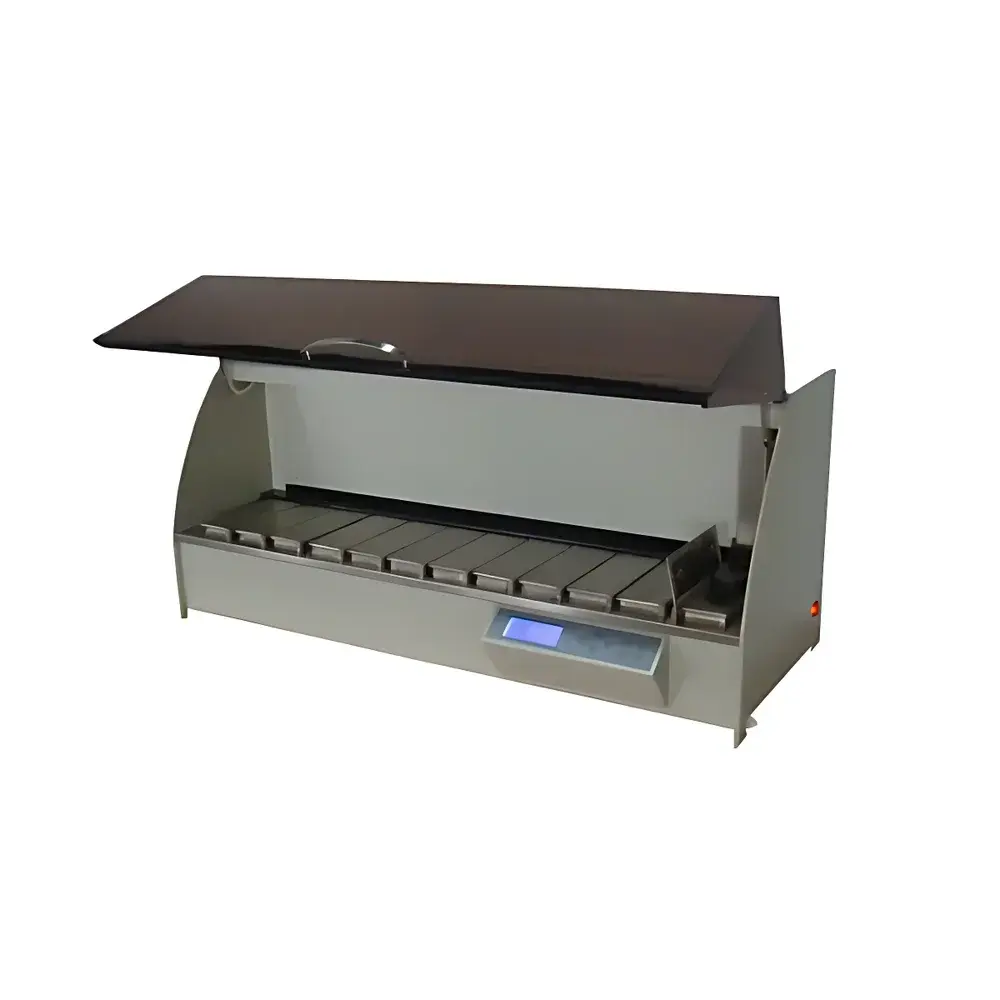
ZEEDO HS-1500 Fully Automated Tissue Dehydrator
| Cylinders | 9 reagent + 3 paraffin tanks (12 total) |
|---|---|
| Single tank capacity | 1500 mL |
| Processing time per station | 0–99 h (1st station), 0–24 h (others) |
| Temperature range | ambient to 99°C |
| Drain/hold time | 10–60 s |
| Stirring frequency | 0–6 rpm |
| Power supply | AC 220 V / 50 Hz or AC 110 V / 60 Hz |
| Power consumption | 800 VA |
| Dimensions | 1010 × 550 × 420 mm |
| Weight | 80 kg |
| Throughput | ≥75 tissue specimens per cycle |
| Safety | Sealed chamber, internal air purification, external exhaust port, dry-type internal heating, power-failure retention (>30 h) |
Overview
The ZEEDO HS-1500 Fully Automated Tissue Dehydrator is an integrated, programmable platform engineered for consistent, reproducible dehydration and infiltration of biological tissue specimens in histopathology laboratories. It operates on a sequential fluid exchange principle—replacing water in fixed tissues with graded alcohols, xylene (or xylene substitutes), and finally molten paraffin wax—enabling optimal embedding for microtome sectioning. Designed for high-throughput clinical and research pathology workflows, the HS-1500 features a 12-station carousel architecture (9 reagent stations + 3 paraffin tanks), precise temperature regulation up to 99°C, and closed-loop environmental control to minimize operator exposure to volatile organic solvents. Its fully sealed chamber design complies with occupational safety requirements for handling flammable and hazardous reagents, while its modular tank configuration supports flexible protocol development aligned with standard histotechnological practices (e.g., CAP-accredited laboratory protocols and ISO 15189 pre-analytical requirements).
Key Features
- 12-Station Programmable Carousel: Nine dedicated reagent tanks (for ethanol, isopropanol, xylene, etc.) and three independent paraffin tanks enable full dehydration-infiltration cycles without manual intervention.
- Precision Thermal Control: Dry-type internal heating system maintains stable temperature from ambient to 99°C across all stations; automatic activation begins upon entry into Station 2, reducing standby energy consumption.
- Intelligent Drain & Agitation Logic: Adjustable drain/hold time (10–60 s) at each station—including surface draining and mechanical shaking—minimizes cross-contamination between reagents and extends solvent service life.
- Configurable Stirring Mechanism: 0–6 rpm agitation frequency ensures uniform reagent penetration across heterogeneous tissue types (e.g., dense fibrous or fatty specimens) without mechanical damage.
- Power-Failure Resilience: Built-in non-volatile memory retains active protocols and real-time status during outages; system remains operational for >30 hours on backup power with continuous display feedback.
- Ergonomic Human-Machine Interface: Large backlit LCD panel with bilingual (English/Chinese) menu navigation, animated process visualization, context-sensitive prompts, and real-time progress tracking.
- Integrated Environmental Safety: Activated carbon filtration and optional external exhaust ducting mitigate VOC emissions; chamber seal integrity meets IEC 61010-1 Class II safety standards for laboratory equipment.
Sample Compatibility & Compliance
The HS-1500 accommodates standard histology cassettes (e.g., Leica, Sakura, Thermo Fisher formats) and supports simultaneous processing of ≥75 specimens per cycle. It is compatible with conventional dehydrating agents (ethanol series, isopropanol), clearing agents (xylene, limonene-based substitutes), and paraffin waxes (melting point 56–62°C). The instrument’s operational parameters align with widely adopted histotechnique guidelines, including those referenced in CLSI H25-A3 (Clinical Laboratory Standards Institute) and the College of American Pathologists (CAP) checklist ANP.40700 (specimen processing controls). While not FDA-cleared as a medical device, it is intended for use in GLP-compliant research environments and diagnostic labs adhering to ISO/IEC 17025 quality management systems.
Software & Data Management
The HS-1500 supports ten user-defined protocols stored in non-volatile memory, each configurable with individual dwell times, temperature setpoints, agitation profiles, and drain sequences. All program edits are timestamped and logged internally. Though the system does not feature network connectivity or remote monitoring, its onboard audit trail records start/stop timestamps, parameter changes, error events, and power interruption history—facilitating internal QA reviews and compliance documentation. For laboratories requiring electronic record integrity, the unit can be operated within a validated environment where procedural logs are manually transcribed into LIMS or ELN platforms compliant with 21 CFR Part 11 (when paired with appropriate administrative controls).
Applications
- Routine surgical pathology specimen processing in hospital and reference laboratories
- High-volume autopsy and biopsy tissue preparation in academic medical centers
- Preclinical toxicology studies requiring standardized tissue fixation and embedding
- Biobanking operations where batch consistency and traceability are critical
- Veterinary diagnostic labs processing diverse species-specific tissue morphologies
- Core facilities supporting multi-user access with protocol segregation and user-level password protection
FAQ
What is the maximum number of tissue cassettes the HS-1500 can process simultaneously?
The system accommodates ≥75 standard-sized cassettes per run, depending on basket configuration and cassette dimensions.
Does the HS-1500 support integration with LIS or LIMS systems?
No native digital interface (e.g., RS-232, Ethernet, or USB host) is provided; data export requires manual logging or third-party hardware bridging.
Can the paraffin tanks be used for both infiltration and embedding?
Yes—the three paraffin stations allow staged infiltration (low-melt → high-melt) or dual-phase wax immersion, though final embedding is performed externally using a separate embedding center.
Is validation documentation (IQ/OQ/PQ) available from the manufacturer?
ZEEDO provides basic operation manuals and electrical safety certifications; full qualification support must be developed in-house or via qualified third-party vendors.
How often should the activated carbon filter be replaced?
Under typical usage (8-hour shifts, 5 days/week), replacement is recommended every 6–12 months—or sooner if solvent odor becomes detectable in the lab environment.




