
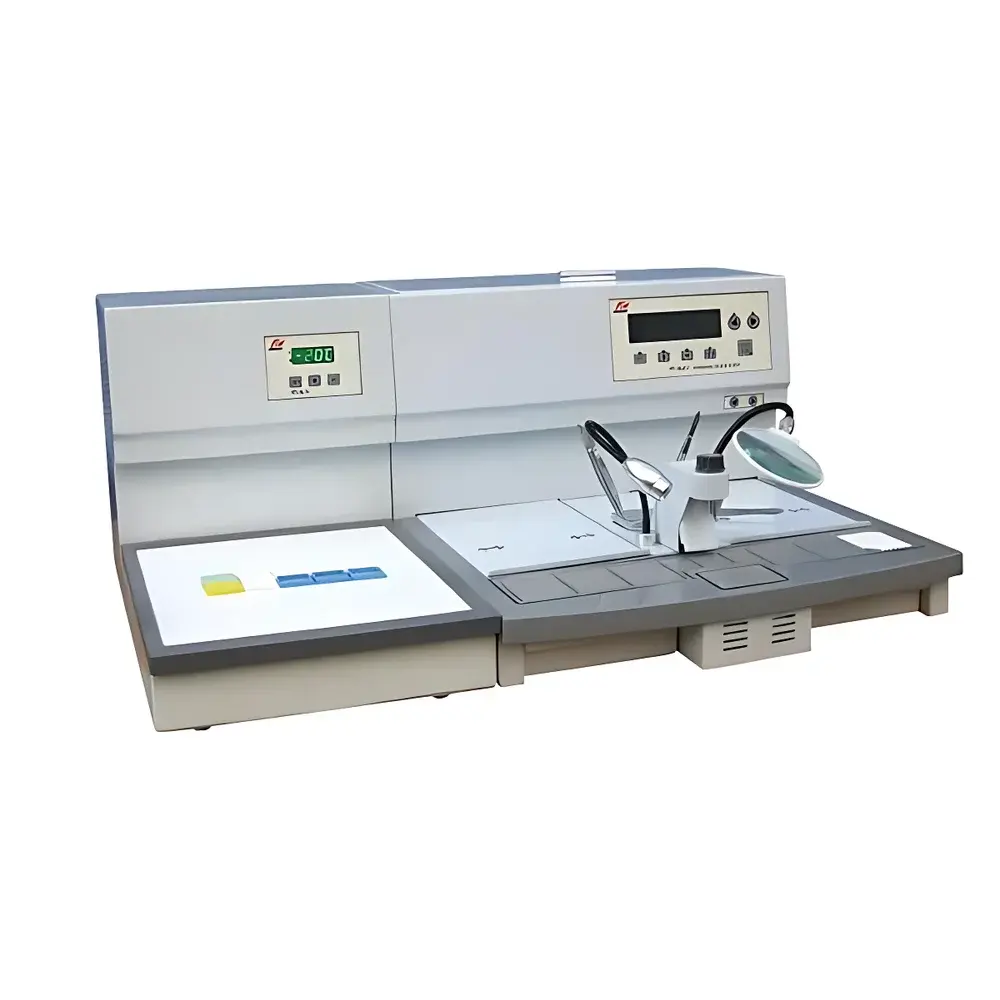
Kedao KD-BMIV & BLIV Cryogenic Tissue Embedding Station
| Origin | Beijing, China |
|---|---|
| Manufacturer Type | Authorized Distributor |
| Product Origin | Domestic (China) |
| Model | KD-BMIV, BLIV |
| Heating Zone Temperature Range | Ambient to 85 °C |
| Small Cold Plate Temperature Range | 30 to −15 °C |
| Main Cryo-Station Temperature Range | 30 to −35 °C |
| Temperature Control Accuracy | ±1 °C |
| Paraffin Reservoir Capacity | >6 L (495 × 132 × 95 mm) |
| Embedding Work Surface | 513 × 93 mm |
| Dual Preservation Boxes | 235 × 160 × 50 mm each |
| Cryo-Station Dimensions | 315 × 380 mm |
| Power Supply | AC 220 V ±10%, 50 Hz (standard) |
| Embedding Unit Power Consumption | 1000 VA |
| Cryo-Station Power Consumption | 100 VA |
| Overall Dimensions (Embedder) | 680 × 580 × 420 mm |
| Overall Dimensions (Cryo-Station) | 680 × 360 × 400 mm |
| Net Weight (Embedder) | 35 kg |
| Net Weight (Cryo-Station) | 25 kg |
Overview
The Kedao KD-BMIV & BLIV Cryogenic Tissue Embedding Station is an integrated, precision-engineered platform for histological specimen preparation in diagnostic pathology, academic research, and preclinical laboratories. Designed around cryo-embedding principles—where tissue specimens are rapidly immobilized in molten paraffin under controlled low-temperature conditions—the system enables reproducible orientation, infiltration, and solidification of biological samples prior to microtomy. Unlike conventional hot-stage embedding systems, this station employs a modular dual-temperature architecture: independent thermal control across seven functional zones (paraffin reservoir, left/right specimen preservation boxes, embedding work surface, tweezer storage platform, adjustable flow wax nozzle, small cold plate, and main cryo-station) ensures minimal thermal cross-talk and optimal phase stability during wax transition. The system supports both manual and programmable automated operation, conforming to routine histology workflow requirements while maintaining full compatibility with downstream IHC, H&E, and special staining protocols.
Key Features
- OLED display interface with 360° visibility, high-contrast data rendering, real-time operational iconography, and integrated precision clock with easy calibration.
- Seven-zone independent PID temperature control: five heated zones (wax reservoir, two preservation boxes, embedding surface, tweezer platform) and two refrigerated zones (small cold plate and main cryo-station), each with dual overheat protection circuits.
- Modular cryo-station design allows left- or right-side docking per user preference; equipped with green-digit LED temperature readout and auto-hold refrigeration at setpoint (−35 °C minimum).
- Adjustable gravity-fed paraffin delivery system with variable-flow wax nozzle for precise volume control during embedding.
- Integrated wax block finishing tool on the embedding surface for post-solidification edge trimming and dimensional uniformity.
- Removable waste paraffin drawer with sealed containment for safe, hygienic disposal.
- Dual-mode operation: fully manual (instant start/stop) and programmable auto-schedule (configurable down to minute-level granularity across any day/hour/minute within a 7-day cycle, with visual status indicators).
- Full memory retention of all thermal and timing parameters after power cycling.
- Adjustable low-voltage LED illumination (four-axis brightness control) paired with a detachable magnifying lens for high-fidelity handling of microspecimens (e.g., mouse embryos, neural biopsies).
- Redundant safety architecture: dual thermal cutoffs, current-limiting circuitry, and reinforced insulation compliant with IEC 61010-1 for laboratory electrical safety.
Sample Compatibility & Compliance
The KD-BMIV & BLIV accommodates a broad spectrum of soft-tissue specimens—including human biopsy cores, rodent organ sections, plant tissues, and decalcified bone fragments—without requiring pre-freezing or cryoprotectant immersion. Its rapid thermal stabilization (≤30 s from ambient to −30 °C at cryo-station surface) minimizes ice crystal formation and preserves ultrastructural integrity. All wetted components contact only medical-grade paraffin (melting point 56–58 °C), ensuring no leaching or residue accumulation. The system complies with ISO 13485:2016 (medical device quality management), meets essential requirements of the EU In Vitro Diagnostic Regulation (IVDR) Annex I for ancillary equipment, and supports GLP/GMP documentation workflows via timestamped operational logs and parameter traceability. Optional audit-trail configuration aligns with FDA 21 CFR Part 11 requirements for electronic records in regulated environments.
Software & Data Management
While the base unit operates via embedded firmware without external PC dependency, its programmable scheduler stores up to 16 independent time-based profiles with persistent non-volatile memory. Each profile includes start/stop timestamps, target zone temperatures, and operational mode flags—all accessible via the OLED interface with scroll navigation and confirmation prompts. For centralized lab management, optional RS-232 or USB-to-serial adapters enable integration into LIMS platforms for remote monitoring and batch log export (CSV format). Firmware updates are performed via secure SD card loading, with version verification and rollback capability. All temperature setpoints and schedule changes require physical keypress confirmation to prevent accidental modification—a design feature aligned with CAP and CLIA pre-analytical standard operating procedure (SOP) controls.
Applications
This embedding station serves core applications across clinical diagnostics, translational research, and pharmaceutical development. It is routinely deployed for high-throughput surgical pathology labs processing >200 specimens/day; neuroscience facilities embedding delicate hippocampal slices with minimal distortion; oncology centers preparing matched tumor-normal pairs for spatial transcriptomics; and contract research organizations (CROs) supporting GLP-compliant toxicology studies. Its stable wax viscosity control (enabled by ±1 °C thermal regulation) ensures consistent section adhesion during subsequent microtomy on rotary or cryostat-based instruments—including Kedao’s KD-3368AM and KD-2950 series. The system also supports dual-modality workflows where paraffin-embedded blocks undergo secondary cryosectioning for antigen retrieval optimization.
FAQ
Can the cryo-station operate independently of the embedding unit?
Yes—the main cryo-station is electrically and mechanically isolated and may be powered and used as a standalone cold plate for specimen pre-chilling or post-embedding hardening.
What paraffin types are compatible with the system?
The station is validated for use with standard medical-grade paraffin (e.g., Surgipath Paraplast®, Leica Histowax®) and low-melting-point formulations (52–54 °C); it does not support resin-based or methacrylate embedding media.
Is the system suitable for BSL-2 or higher containment labs?
Yes—its sealed waste drawer, smooth non-porous stainless-steel surfaces, and absence of internal air circulation pathways meet biosafety cabinet-compatible design criteria per NIH Guidelines Appendix A.
Does the system include validation documentation for IQ/OQ/PQ protocols?
Factory-installed calibration certificates (NIST-traceable thermistors) and a comprehensive User Qualification Guide (UQG) are provided, covering installation checks, operational range testing, and performance verification templates aligned with ASTM E2500 and ISO/IEC 17025.
What maintenance intervals are recommended?
Monthly cleaning of wax nozzles and preservation box seals; biannual verification of thermal sensor drift using certified reference baths (±0.3 °C tolerance); annual full-system safety inspection by authorized service personnel.



