
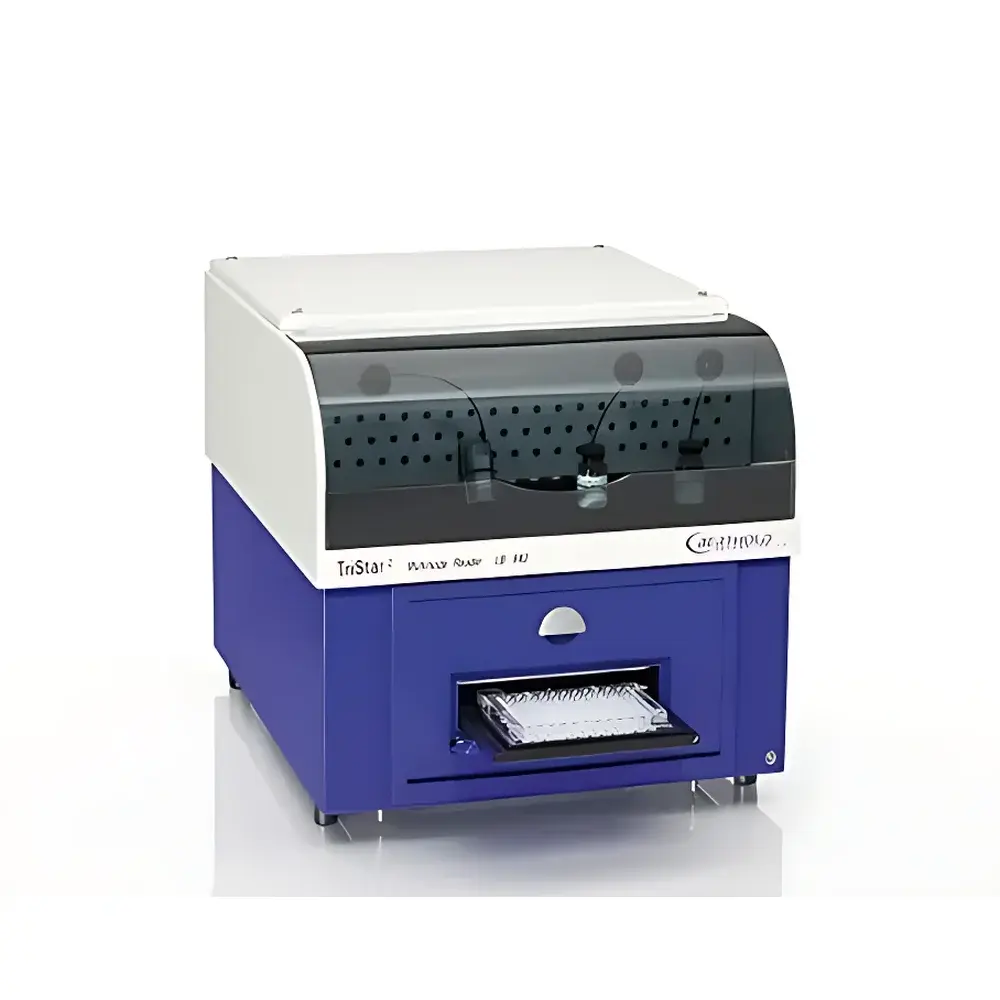
Berthold Technologies Tristar² S LB 942 Multimode Microplate Reader
| Brand | Berthold |
|---|---|
| Origin | Germany |
| Model | Tristar² S LB 942 |
| Detection Modes | Absorbance, Luminescence, Fluorescence (top/bottom read), Time-Resolved Fluorescence (TRF), Homogeneous Time-Resolved Fluorescence (HTRF®), Fluorescence Polarization (FP), Bioluminescence Resonance Energy Transfer (BRET/BRET²/NanoBRET), Fluorescence Resonance Energy Transfer (FRET) |
| Detector | Low-noise, high-speed single-photon counting PMT and photodiode |
| Absorbance Range | 0–4 OD |
| Absorbance Linearity | <0.1% |
| Wavelength Accuracy | ±1 nm |
| Wavelength Scanning Speed | 0.1 s per data point |
| Absorbance Precision | <0.3% |
| Luminescence Sensitivity | <6 amol ATP/well (96-well, glow assay) |
| Fluorescence Sensitivity | <0.2 fmol fluorescein/well (96-well) |
| TRF Sensitivity | <5 amol europium/well |
| Dynamic Range | >6 decades |
| Well-to-Well Crosstalk | <5×10⁻⁶ |
| Injector Options | Up to 3 programmable injectors (10–100 µL, 1 µL increment) |
| Temperature Control | Ambient +5 °C to 45 °C (optional) with cooled PMT |
| Compatible Plate Formats | 6–384-well microplates, Eppendorf µPlate GO.5, Terasaki plates, Petri dishes |
| Excitation Source | Xenon flash lamp |
| Monochromator | Dual grating (4–22 nm bandwidth, 1 nm increment) for absorbance/fluorescence excitation |
| Filter Capacity | Up to 30 high-transmission (>80%) interference filters (excitation & emission) |
| Software | ICE™ (Instrument Control & Evaluation), compliant with 21 CFR Part 11 audit trail and electronic signature requirements |
| Certifications | CE, RoHS, ISO 13485–aligned design |
| Operating Environment | 15–35 °C, 10–85% RH (non-condensing) |
| Storage | 0–40 °C |
| Power Supply | 110–240 V AC, 50/60 Hz |
Overview
The Berthold Technologies Tristar² S LB 942 is a high-performance, modular multimode microplate reader engineered for precision, reproducibility, and flexibility in life science laboratories. It employs a unified optical architecture—ONE-4-ALL—that integrates dual-grating monochromators, high-transmission interference filters, and low-noise single-photon counting photomultiplier tubes (PMTs) to support concurrent detection modalities without mechanical reconfiguration. Its core measurement principles include UV-Vis absorbance (based on Beer-Lambert law), luminescence (photonic integration over defined integration times), fluorescence (intensity, polarization, lifetime-resolved), and resonance energy transfer (FRET/BRET). Designed for rigorous academic, pharmaceutical, and diagnostic research environments, the Tristar² S LB 942 delivers trace-level sensitivity across all modes while maintaining strict adherence to GLP and GMP-aligned operational workflows.
Key Features
- ONE-4-ALL optical system: A fixed-path, zero-moving-part architecture eliminating alignment drift and maximizing photon collection efficiency for both luminescence and fluorescence applications.
- Dual-grating monochromator: Enables continuous spectral scanning (1 nm resolution) and variable bandwidth control (4–22 nm) for optimized signal-to-noise in absorbance, excitation, and TRF measurements.
- High-fidelity detection stack: Combines a thermoelectrically cooled single-photon counting PMT (for luminescence and TRF) and a fast-response photodiode (for high-throughput absorbance), each calibrated traceably to NIST standards.
- Triple injector capability: Supports up to three independent, software-synchronized dispensers (10–100 µL, 1 µL resolution) with real-time pressure monitoring and air-gap aspiration—critical for kinetic assays requiring precise reagent timing.
- Cooled PMT housing: Maintains detector thermal stability during extended acquisition, reducing dark current and enhancing low-light detection limits (e.g., <6 amol ATP/well in glow luciferase assays).
- Full plate temperature control (optional): Uniform thermal regulation from ambient +5 °C to 45 °C with ±0.3 °C stability—validated for cell-based assays requiring physiological or stress-conditioned incubation.
Sample Compatibility & Compliance
The Tristar² S LB 942 accommodates standard microplate formats (6-, 24-, 96-, and 384-well), specialized vessels (Eppendorf µPlate GO.5, Terasaki plates, Petri dishes), and custom geometries via adjustable plate-height calibration. Its optical path geometry supports both top- and bottom-read fluorescence, enabling membrane-bound or adherent-cell assays without signal attenuation. All detection modules comply with ASTM E2759 (microplate reader performance verification), ISO 20387 (biobanking quality), and EU IVDR Annex I essential requirements for in vitro diagnostic instrumentation. The system’s hardware and ICE™ software are designed to meet FDA 21 CFR Part 11 criteria, including full audit trail logging, role-based access control, electronic signatures, and data integrity validation per ALCOA+ principles.
Software & Data Management
ICE™ (Instrument Control & Evaluation) software provides a validated, wizard-driven interface for protocol development, instrument control, and quantitative analysis. It supports all major assay paradigms—including single/multiple endpoint, ratio-metric, kinetic, repeated long-term kinetics, well-scanning, delayed injection, and orbital shaking—with fully parameterized step sequencing. Built-in algorithms perform automatic background subtraction, Z-factor calculation, curve fitting (linear, log-log, 4PL, 5PL), and HTRF ratio correction. Raw data export is native to .xlsx, .csv, .txt, and .xml formats; metadata embedding (plate map, instrument ID, operator, timestamp) ensures FAIR data principles. Optional ICE™ Connect enables secure remote monitoring and centralized fleet management across multi-instrument labs.
Applications
The Tristar² S LB 942 serves as a primary platform for quantitative life science assays requiring multiplexed detection fidelity. It is routinely deployed in ELISA and immunoassay workflows using HRP/AP conjugates with chromogenic, fluorogenic, or chemiluminescent substrates—delivering >100× sensitivity gain in luminescent mode. In apoptosis research, it quantifies caspase-3/7/8/9 activity via cleavable peptide substrates (e.g., DEVD-aminoluciferin). Reporter gene assays leverage its dual-luciferase compatibility (firefly/Renilla) with BRET² and NanoBRET configurations for real-time GPCR signaling studies. Calcium flux assays use ratiometric dyes (Fura-2, Indo-1) with simultaneous dual-wavelength excitation. DNA quantification employs PicoGreen® or Hoechst 33342 with sub-picomolar LODs; protein assays include Bradford, Lowry, and fluorescent dye-binding methods. Kinase activity is measured via ADP-Glo™ or luciferase-coupled ATP depletion assays with sub-femtomole resolution.
FAQ
Does the Tristar² S LB 942 support HTRF® and AlphaScreen® assays?
Yes—it is factory-validated for HTRF® (Cisbio) with integrated time-gated detection and optimized excitation/emission optics for europium cryptate and d2 acceptor pairs. AlphaScreen® compatibility is confirmed via high-intensity laser-free excitation and ultra-low crosstalk (<5×10⁻⁶) between adjacent wells.
Can the instrument perform simultaneous dual-emission ratiometric measurements?
Yes—using programmable filter exchange and synchronized dual-PMT acquisition, it supports real-time ratio calculations (e.g., Fura-2 340/380 nm) with sub-second temporal resolution.
Is temperature control available for all plate formats?
Temperature regulation is uniform across 6–384-well plates and µPlates; Petri dishes and Terasaki plates require optional adapter trays to ensure thermal contact with the heated deck.
How is calibration traceability maintained?
Each unit ships with NIST-traceable absorbance (neutral density filters), fluorescence (quinine sulfate), and luminescence (ATP standard) calibration kits. ICE™ software logs all calibration events with operator ID, date, and deviation metrics.
What service and support options are available globally?
Berthold Technologies offers extended warranty packages, preventive maintenance contracts, on-site application support, and remote diagnostics via secure TLS-encrypted connection—backed by ISO 9001-certified service centers in North America, EMEA, and APAC.





