
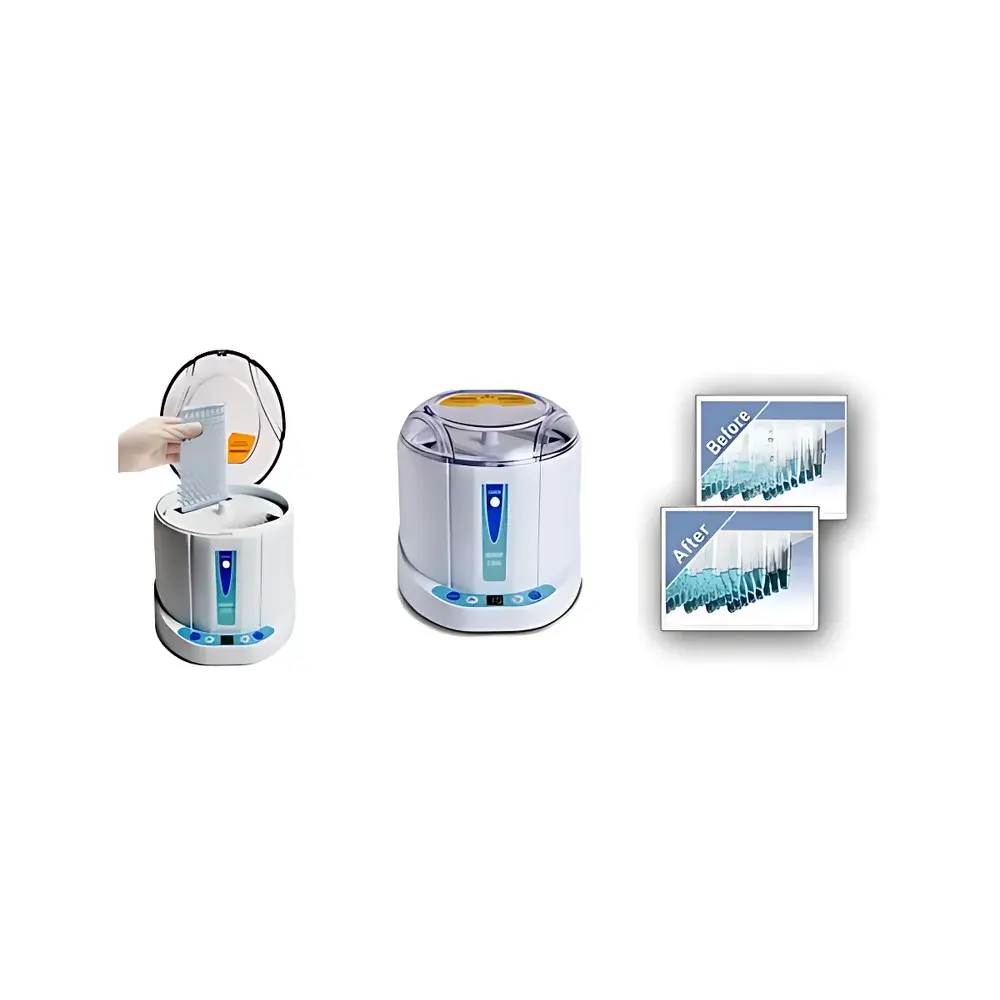
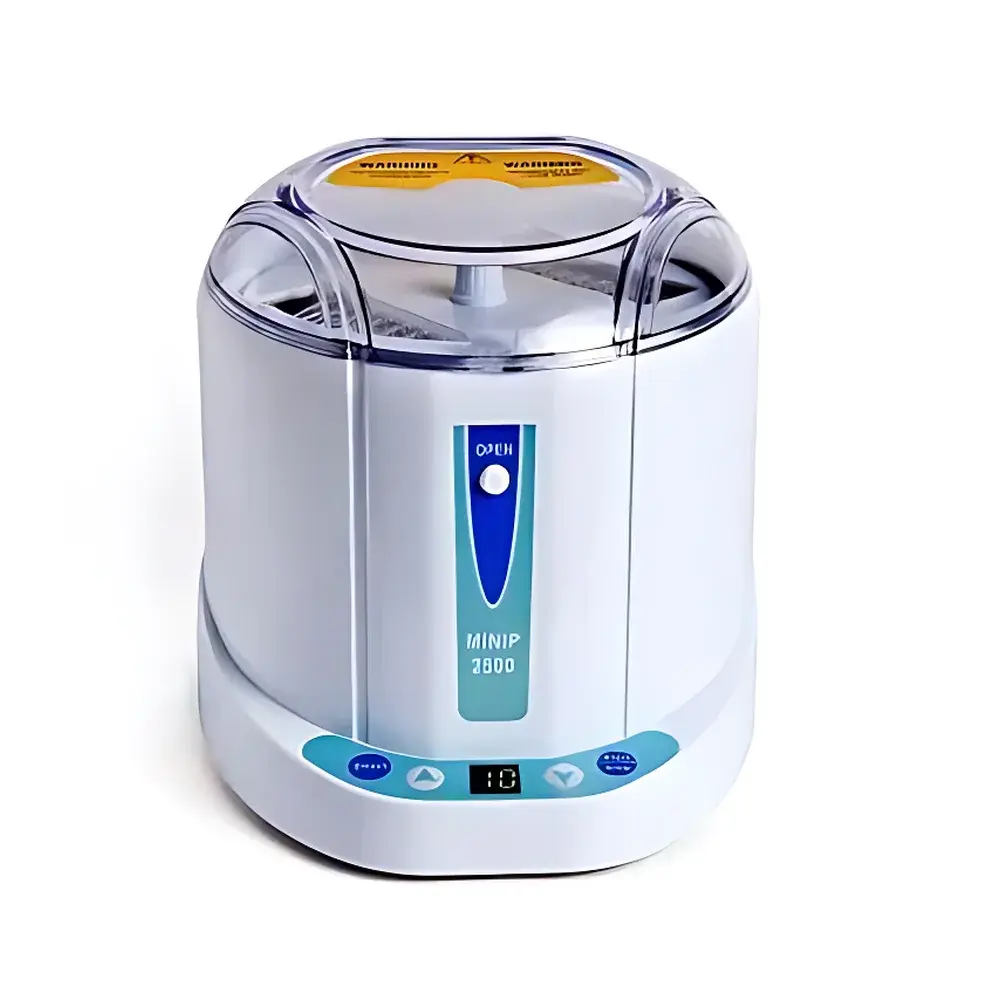
Jiayuan MiniP-2500 Microplate Mini Centrifuge
| Brand | Jiayuan |
|---|---|
| Origin | Beijing, China |
| Model | MiniP-2500 |
| Maximum Capacity | 2 × 96-well PCR plates |
| Maximum Speed | 2500 rpm |
| Relative Centrifugal Force (RCF) | 500 × g |
| Dimensions (W×D×H) | 23 × 20 × 19.3 cm |
| Weight | 3 kg |
| Power Supply | DC 24 V |
| Motor Type | Brushless DC motor |
| Acceleration Time to Max Speed | < 3 s |
| Deceleration Time from Max Speed to Stop | ≤ 10 s |
| Operating Environment | Compatible with cold room use (4–25 °C) |
| Lid Opening Angle | 95° vertical hinge |
Overview
The Jiayuan MiniP-2500 Microplate Mini Centrifuge is a compact, purpose-engineered centrifugation device designed exclusively for rapid and reliable pelleting of liquid contents in standard 96-well PCR microplates. Unlike general-purpose benchtop centrifuges, the MiniP-2500 employs a fixed-angle vertical rotor architecture optimized for uniform RCF distribution across all wells—ensuring consistent condensation of wall-adherent droplets without cross-well splashing or sample displacement. Its operation is based on rotational inertia-driven sedimentation under controlled acceleration profiles, delivering reproducible 500 × g force at 2500 rpm. Engineered for integration into high-throughput molecular biology workflows—including qPCR setup, library preparation, and post-PCR cleanup—the device operates silently (<45 dB(A)) and maintains thermal stability during extended use, even within refrigerated laboratory environments (4–25 °C). The absence of mechanical brushes eliminates carbon dust generation and extends service life beyond 20,000 operational cycles.
Key Features
- Brushless DC motor ensures maintenance-free operation, high torque density, and long-term speed stability—critical for repeatable microplate handling.
- Vertical fixed-rotor design accommodates both skirted and unskirted ANSI/SLAS-compliant 96-well PCR plates without adapters or alignment steps.
- Dual-mode control interface supports both momentary (“pulse”) and timed centrifugation (1–99 seconds), programmable via tactile membrane keypad with LED status feedback.
- 95° vertically hinged lid enables unobstructed access for rapid plate loading/unloading—minimizing workflow interruption and reducing risk of accidental plate tipping.
- Compact footprint (23 × 20 × 19.3 cm) and lightweight construction (3 kg) allow placement directly on biosafety cabinets, PCR workstations, or cold room benches without spatial compromise.
- Integrated electronic braking system achieves full deceleration from 2500 rpm to rest in ≤10 seconds, enabling immediate plate retrieval and minimizing thermal drift during sequential runs.
Sample Compatibility & Compliance
The MiniP-2500 is validated for use with all commercially available 96-well polypropylene PCR plates conforming to ANSI/SLAS standards (e.g., Bio-Rad HSP9601, Thermo Scientific AB-0700, Eppendorf EP384). It supports plates containing aqueous solutions, enzyme mixes, master mixes, and low-viscosity buffers (≤10 mPa·s). Not intended for use with deep-well plates, 384-well formats, or viscous reagents such as glycerol stocks or agarose solutions. The device complies with IEC 61010-1:2010 safety requirements for laboratory electrical equipment and meets EMC directive 2014/30/EU. While not certified for GLP/GMP production environments, its consistent RCF delivery and audit-ready operational logs (via optional USB data export firmware upgrade) support traceability in ISO/IEC 17025-accredited testing laboratories.
Software & Data Management
The MiniP-2500 operates via embedded firmware with no external PC dependency. All run parameters—including elapsed time, final speed, and total cycle count—are stored in non-volatile memory. An optional firmware update (v2.1+) enables USB-C data export of session logs in CSV format, including timestamp, duration, RPM, and lid open/close events—facilitating compliance with internal SOP documentation and FDA 21 CFR Part 11-aligned recordkeeping when paired with institutional electronic lab notebook (ELN) systems. No proprietary software installation is required; exported logs are natively readable in Excel, LabArchives, or Benchling.
Applications
- Rapid condensation of wall-adherent droplets prior to thermal cycling—reducing evaporation artifacts and improving reaction volume consistency.
- Post-amplification centrifugation to collect condensate from lid surfaces before optical reading on plate readers.
- Pre-sequencing library normalization steps requiring uniform pelleting across all wells without vortex-induced shearing.
- High-frequency plate conditioning in diagnostic assay development labs performing >100 daily runs.
- Field-deployable nucleic acid extraction support where space, power efficiency, and cold-chain compatibility are critical constraints.
FAQ
Can the MiniP-2500 accommodate 384-well plates?
No. The rotor geometry and plate clamping mechanism are dimensionally optimized for 96-well formats only.
Is the device compatible with refrigerated centrifugation (e.g., at 4 °C)?
Yes. It operates reliably within ambient temperatures ranging from 4 °C to 25 °C without performance degradation or condensation-related electrical risk.
Does it support variable speed settings?
No. The MiniP-2500 is calibrated and validated exclusively at 2500 rpm to ensure optimal RCF (500 × g) for microplate applications—eliminating user-induced variability.
What safety certifications does it hold?
It conforms to IEC 61010-1:2010 (Safety Requirements for Electrical Equipment for Measurement, Control, and Laboratory Use) and electromagnetic compatibility per EN 61326-1.
How is maintenance performed?
No scheduled maintenance is required. The brushless motor and sealed bearing assembly are rated for >20,000 cycles; routine cleaning of the rotor chamber with 70% ethanol is recommended after each use.



