
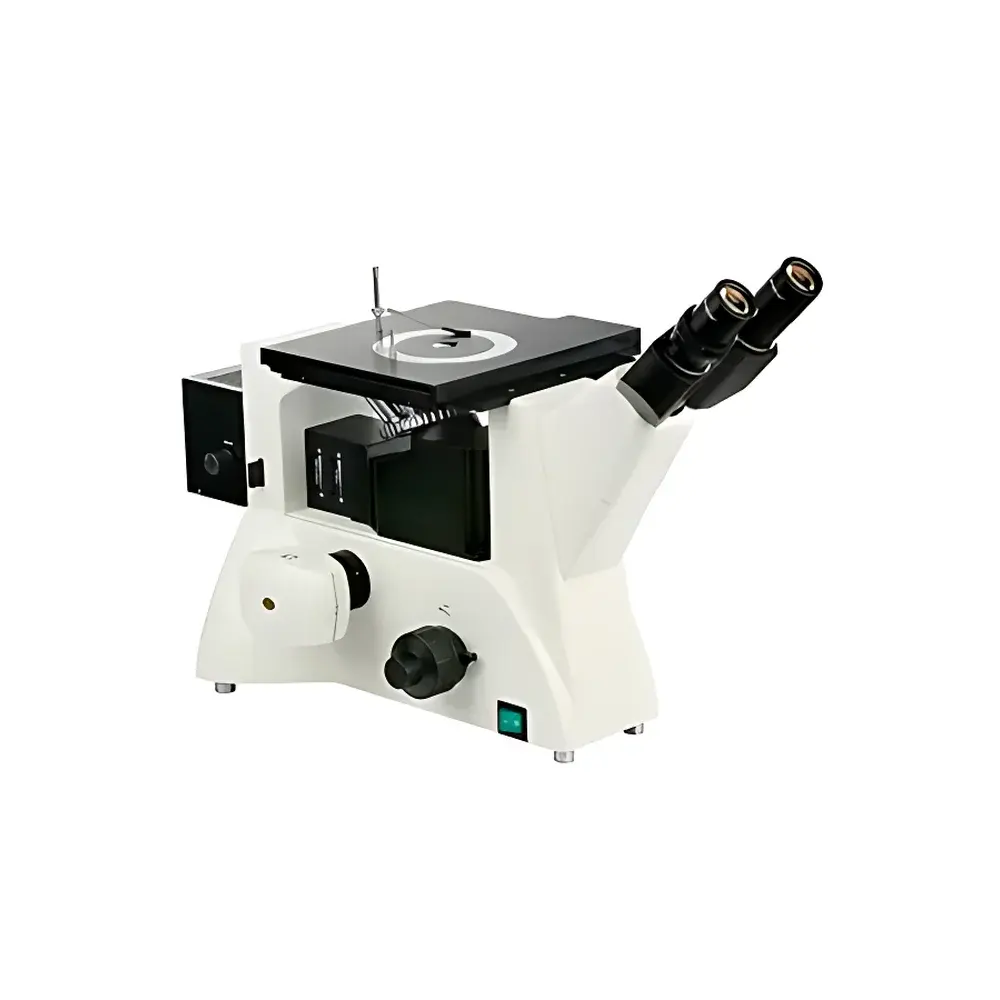
MDS-20 Inverted Metallurgical Microscope
| Origin | Guangdong, China |
|---|---|
| Manufacturer Type | Authorized Distributor |
| Origin Category | Domestic (China) |
| Model | MDS-20 |
| Price | USD 2,500 (FOB Guangdong) |
| Optical System | Infinity-Corrected |
| Observation Modes | Brightfield (BF), Optional Polarized & Darkfield (BD) |
| Eyepieces | Widefield WF10X, Field Number Φ22 mm |
| Objectives | Infinity Long Working Distance Plan Achromatic (PL L series), BF or BF/BD variants |
| Focusing | Coaxial coarse/fine focus with lock and 2 µm fine adjustment increment |
| Stage | Mechanical XY stage (30 × 30 mm travel), rotatable circular plate (Φ130 mm max, central aperture <Φ12 mm) |
| Illumination | 6V/30W halogen (MDS-20), 12V/50W halogen (MDS-20BD), adjustable intensity, built-in field & aperture diaphragms, slider-mounted polarizer, ground glass + yellow/green/blue filters |
Overview
The MDS-20 Inverted Metallurgical Microscope is engineered for high-fidelity microstructural analysis of opaque, polished specimens—primarily metals, alloys, ceramics, and composites. Its inverted optical configuration positions the objective lenses beneath the specimen stage, enabling stable observation of large, heavy, or irregularly shaped samples—including bulk castings, cross-sectioned welds, and mounted metallurgical specimens up to 30 mm in height. The system employs an infinity-corrected optical pathway with plan achromatic long working distance (LWD) objectives, ensuring minimal chromatic and spherical aberration across the full field of view. This architecture supports modular expansion into polarized light (POL), darkfield (DF), and differential interference contrast (DIC) imaging via accessory integration—without compromising mechanical stability or optical alignment fidelity. Designed for compliance with ISO 9001-manufactured quality control environments and routine laboratory use, the MDS-20 delivers consistent resolution, depth-of-field performance, and illumination uniformity required for ASTM E3, ISO 643, and GB/T 13298 standard-compliant microstructural evaluation.
Key Features
- Infinity-corrected optical design with parfocal, parcentric PL L-series objectives—ensuring seamless magnification transitions and precise focus retention during objective rotation.
- Robust inverted stand with high-rigidity aluminum alloy chassis and anti-vibration damping base—optimized for industrial lab floors and QC testing areas where ambient mechanical noise may affect image stability.
- 45° inclined trinocular head with interpupillary adjustment (53–75 mm) and standardized C-mount interface for digital imaging systems.
- Coaxial coarse/fine focusing mechanism featuring dual-scale vernier readout and mechanical lock—enabling repeatable Z-axis positioning with 2 µm graduation on the fine-focus knob.
- Five-position inward-facing ball-bearing objective turret with precision detent indexing—guaranteeing reproducible alignment and minimal lateral shift during objective exchange.
- Large mechanical stage (242 × 200 mm) with 30 × 30 mm XY travel range and interchangeable rotatable circular plate—facilitating rapid repositioning of multi-specimen mounts and directional grain structure assessment.
- Dual-configuration illumination: 6V/30W halogen (MDS-20, brightfield only) or 12V/50W halogen (MDS-20BD, BF/BD capable), both with continuous brightness control, integrated field and aperture diaphragms, and removable polarizing filter slider.
Sample Compatibility & Compliance
The MDS-20 accommodates standard 1″ (25.4 mm) and 1.2″ (30 mm) metallographic mounts, as well as oversized specimens requiring direct clamping onto the stage surface. Its extended working distances—from 20.2 mm at 10× to 0.40 mm at 100× dry—permit safe observation of rough-ground, etched, or coated surfaces without objective collision. The system meets mechanical and optical requirements outlined in ASTM E883 (Standard Guide for Reflected Light Photomicrography), ISO 4287 (Surface texture parameters), and GB/T 4336 (Carbon and low-alloy steel spark discharge atomic emission spectrometry). When equipped with BD objectives and appropriate condenser accessories, it supports darkfield evaluation per ASTM E112 (Grain Size Determination) and ISO 643. All optical components are coated for enhanced transmission in the visible spectrum (400–700 nm), and the halogen illumination complies with IEC 62471 photobiological safety standards for Class 1 LED-equivalent exposure.
Software & Data Management
The MDS-20 integrates seamlessly with third-party imaging platforms via standardized C-mount adapters (0.5×, 1×, or calibrated 0.5× with 0.1 mm/grad reticle). Compatible digital cameras—including DV-1 (USB + analog video), DV-2 (USB-only), and DV-3 (analog video)—support real-time capture, measurement annotation, and time-lapse acquisition. When paired with compliant software (e.g., ToupView, Ocular, or Image-Pro Express), the system enables GLP-aligned data handling: timestamped image metadata, user-defined calibration profiles, audit-trail-enabled measurement logs, and export to TIFF/PNG/DICOM formats. Optional USB-powered CCD interfaces support FDA 21 CFR Part 11–compliant electronic signatures when deployed in regulated GMP manufacturing QA labs.
Applications
- Quantitative metallography: grain size analysis (ASTM E112), inclusion rating (ASTM E45), phase distribution mapping, and precipitate morphology assessment.
- Failure analysis: crack propagation path identification, intergranular corrosion evaluation, and heat-affected zone (HAZ) characterization in welded joints.
- Quality assurance in foundries and forging facilities: porosity quantification, dendritic arm spacing (DAS) measurement, and casting defect documentation.
- Materials R&D: sintered density verification in powder metallurgy, coating thickness estimation (via edge contrast), and thermal oxidation layer analysis on high-temperature alloys.
- Geological and mineralogical studies: opaque mineral identification, reflectance measurement of sulfides and oxides, and textural classification of polished rock sections.
FAQ
What is the maximum specimen height supported by the MDS-20 stage?
The inverted configuration allows specimens up to 30 mm in vertical height to be observed without obstruction—ideal for large billets, engine blocks, or sectioned turbine blades.
Can the MDS-20 be upgraded to support darkfield observation after purchase?
Yes—by replacing the standard brightfield objectives with BD-compatible PL L-series objectives (e.g., PL L5X/0.12 BD, PL L50X/0.70 BD) and installing a matching darkfield condenser (sold separately), the system achieves full darkfield functionality.
Is the microscope compatible with automated stage controllers or motorized focus units?
While the base model features manual mechanics, the standardized dovetail mounting interface and electrical trigger port (for optional illuminator synchronization) enable integration with third-party motorized XY stages and Z-drive modules from major OEMs.
Does the MDS-20 meet international calibration traceability requirements?
All delivered systems include a factory calibration certificate referencing NIST-traceable reference standards for magnification accuracy and stage movement linearity; users may perform periodic verification using certified stage micrometers and resolution test targets (e.g., US Air Force 1951 or ISO 19432-1).
What warranty and service support is provided for international customers?
The MDS-20 carries a 24-month limited warranty covering parts and labor; technical documentation, firmware updates, and remote diagnostics are available through authorized regional service partners—with spare optics and mechanical subassemblies stocked in EU and North American distribution hubs.



