
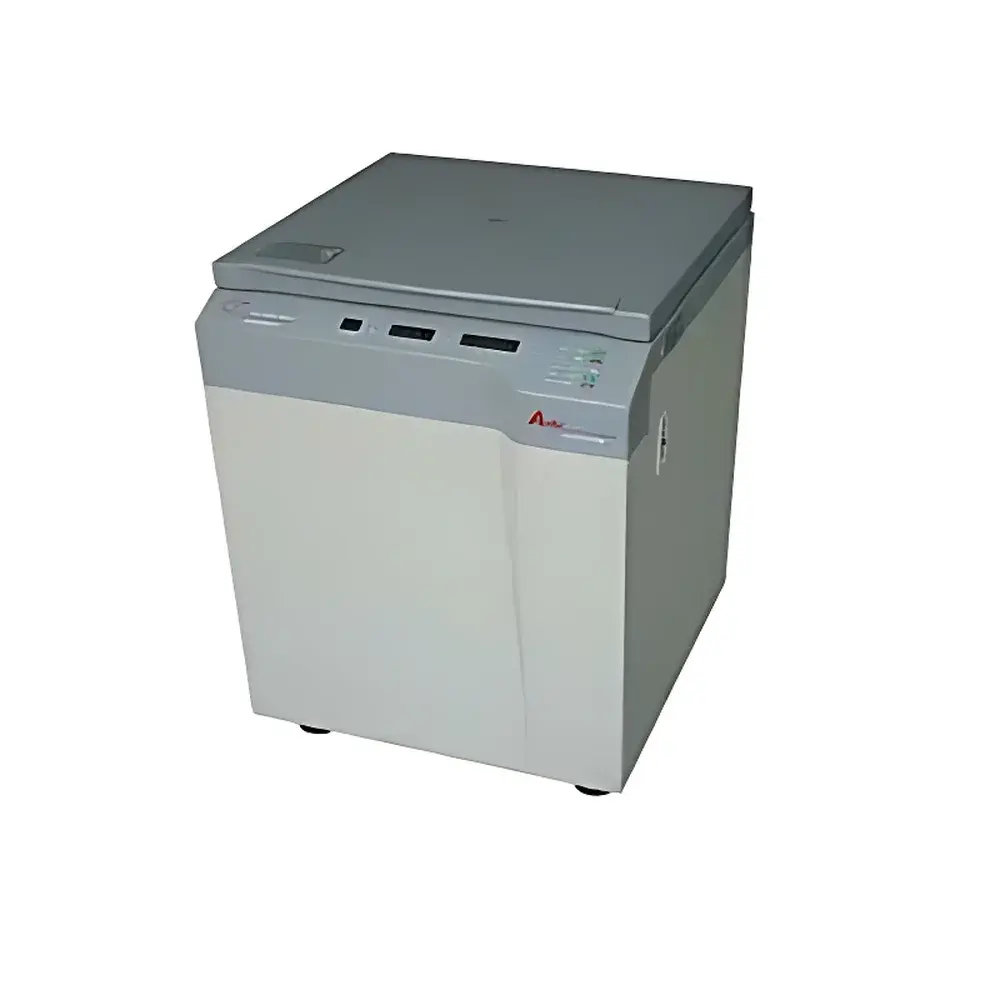
GL-20G-II High-Speed Refrigerated Centrifuge
| Origin | Shanghai, China |
|---|---|
| Manufacturer Type | Authorized Distributor |
| Origin Category | Domestic (China) |
| Model | GL-20G-II |
| Max Speed | 20,000 rpm |
| Max RCF | 25,480 ×g |
| Temperature Range | −5 °C to 30 °C |
| Temp. Accuracy | ±2 °C |
| Timer Range | 0–60 min |
| Noise Level | <75 dB(A) |
| Power Supply | 220 V, 50 Hz, 3 kW |
| Dimensions (L×W×H) | 460 × 480 × 720 mm |
| Weight | 72 kg |
| Rotor Configurations | 5 mL × 12 (20,000 rpm), 10 mL × 12 (16,000 rpm), 50 mL × 6 (14,000 rpm) |
| Cooling System | Imported Tecumseh (France) Compressor Unit |
| Drive System | Frequency-Controlled AC Motor |
| Control System | Microprocessor-Based with Touch-Sensitive Keypad & LCD Display |
| Safety | Automatic Electronic Lid Lock, Rotor Recognition (via Manual Selection), Over-Speed & Over-Temp Protection |
Overview
The GL-20G-II High-Speed Refrigerated Centrifuge is an engineered solution for laboratories requiring precise, reproducible separation of temperature-sensitive biological and biochemical samples under high gravitational forces. Designed according to core principles of rotor dynamics and thermally stabilized centrifugation, it operates on the principle of differential sedimentation—where particles separate based on size, density, and shape under controlled rotational acceleration and thermal environment. Its maximum speed of 20,000 rpm delivers a peak relative centrifugal force (RCF) of 25,480 ×g, enabling efficient pelleting of subcellular organelles, viral particles, macromolecular complexes, and precipitated nucleic acids. The integrated refrigeration system—based on a Tecumseh (France) hermetic compressor—maintains chamber temperature between −5 °C and 30 °C with ±2 °C accuracy, critical for preserving labile enzyme activity, preventing protein denaturation, and ensuring consistent RNA integrity during isolation workflows.
Key Features
- Microprocessor-based control architecture with intuitive touch-sensitive keypad and wide-angle backlit LCD display for real-time monitoring of speed, RCF, temperature, time remaining, and rotor identification status.
- Frequency-controlled AC motor ensures smooth acceleration/deceleration profiles, extended service life, low mechanical wear, and reduced electromagnetic interference—essential for long-duration or repetitive runs in QC/QA environments.
- Triple-layer safety design: automatic electronic lid lock engages at operational speeds; over-speed and over-temperature cut-off circuits comply with IEC 61010-2-020 safety standards for laboratory centrifuges.
- Ergonomic front panel with convex arc-shaped housing constructed from reinforced polymer composite—minimizing vibration transmission and acoustic emission (<75 dB[A] at 1 m).
- Modular rotor compatibility supporting three standard fixed-angle configurations: 5 mL × 12 (20,000 rpm), 10 mL × 12 (16,000 rpm), and 50 mL × 6 (14,000 rpm), each validated per ISO 15195:2018 for calibration traceability.
Sample Compatibility & Compliance
The GL-20G-II accommodates a broad range of sample formats including microcentrifuge tubes (1.5–2.0 mL), conical polypropylene tubes (15–50 mL), and sealed PCR strip tubes—suitable for applications spanning plasma fractionation, exosome isolation, cell lysate clarification, and antibody purification. Its temperature stability and RCF consistency meet routine requirements for protocols aligned with CLSI EP05-A3, ISO/IEC 17025:2017 (for accredited testing labs), and USP Analytical Instrument Qualification. While not inherently 21 CFR Part 11 compliant out-of-the-box, the system supports audit-ready operation when paired with validated third-party LIMS integration and electronic logbook solutions.
Software & Data Management
The embedded firmware records all run parameters—including setpoints, actual values, timestamps, rotor ID (manually entered), and fault logs—in non-volatile memory. Data export is supported via USB interface (no proprietary software required); CSV-formatted session reports can be transferred for integration into ELN platforms or statistical process control (SPC) dashboards. Optional firmware upgrades enable password-protected user access levels, cycle counter tracking, and configurable alarm thresholds—facilitating adherence to GLP/GMP documentation practices in regulated biopharma and clinical research settings.
Applications
- Preparative isolation of mitochondria, nuclei, and synaptic vesicles from tissue homogenates.
- Cold-step purification of monoclonal antibodies and recombinant proteins from CHO or HEK293 cell culture supernatants.
- High-yield extraction of total RNA and small RNAs from blood, serum, and FFPE-derived samples under cryo-stabilized conditions.
- Separation of lipoprotein subclasses (HDL, LDL, VLDL) in clinical lipidomics studies requiring strict thermal control.
- Routine quality control of vaccine formulations, including adjuvant dispersion verification and antigen aggregation screening.
FAQ
What is the maximum allowable imbalance tolerance for the GL-20G-II?
The unit is rated for ≤2 g mass imbalance across opposing tube positions when using matched rotors and balanced loads—consistent with ISO 21501-4 recommendations for high-speed instrumentation.
Can this centrifuge be validated for GMP production use?
Yes—when operated with documented IQ/OQ protocols, calibrated reference thermometers, and traceable tachometer verification, the GL-20G-II meets baseline requirements for equipment qualification in non-sterile manufacturing support labs.
Is rotor autoclaving supported?
Fixed-angle aluminum rotors are compatible with steam sterilization at 121 °C for 20 minutes; however, repeated autoclaving may affect anodized surface integrity and require periodic RCF recalibration per manufacturer guidelines.
Does the system support remote monitoring or network connectivity?
No native Ethernet or Wi-Fi interface is included; however, external IoT gateways with RS-232-to-MQTT bridging can be deployed for centralized fleet monitoring in multi-instrument facilities.
What maintenance intervals are recommended?
Compressor oil inspection every 12 months; bearing lubrication and vacuum seal check every 24 months; full rotor lifetime tracking advised per ANSI/AAMI ST79:2017 Annex K for centrifuge asset management.



