
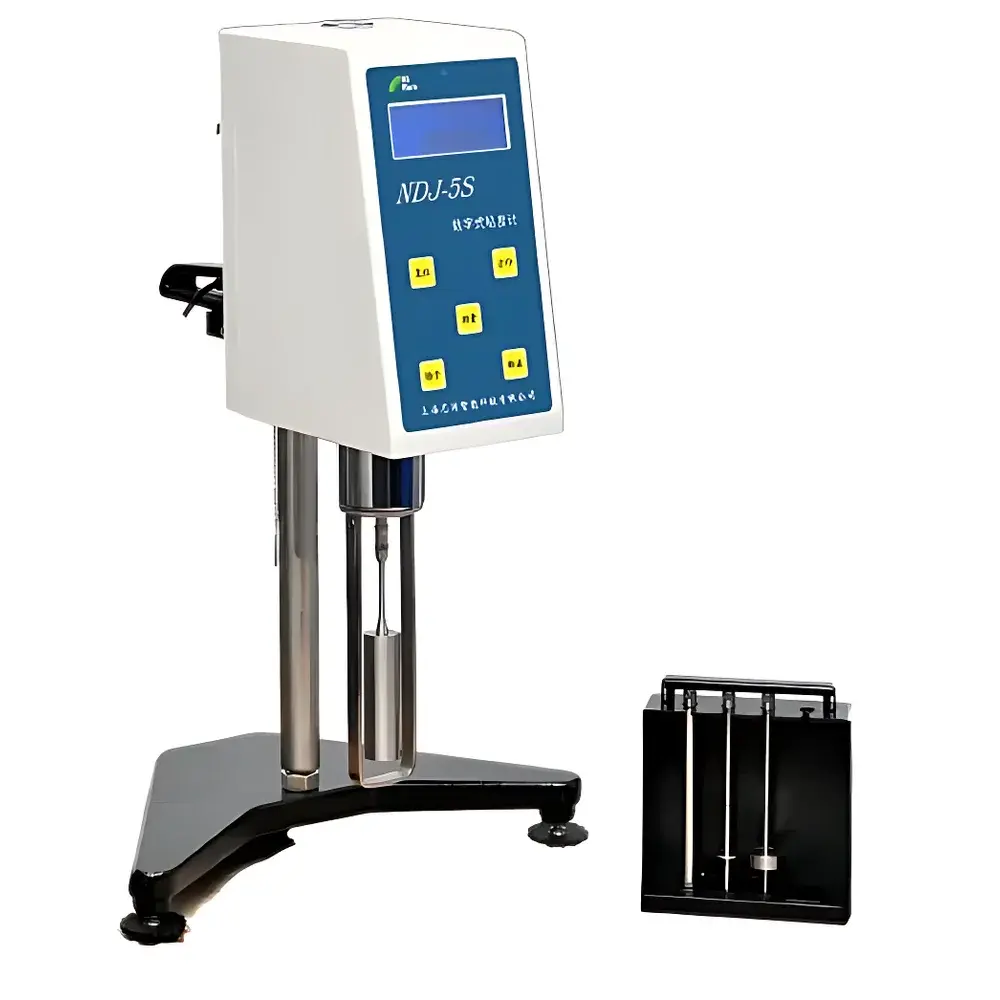
NDJ-5S Digital Rotational Viscometer
| Origin | Beijing, China |
|---|---|
| Manufacturer Type | Authorized Distributor |
| Origin Category | Domestic (China) |
| Model | NDJ-5S |
| Instrument Type | Rotational Viscometer |
| Measuring Range | 1–100,000 mPa·s |
| Spindle Speeds | 6, 12, 30, 60 rpm |
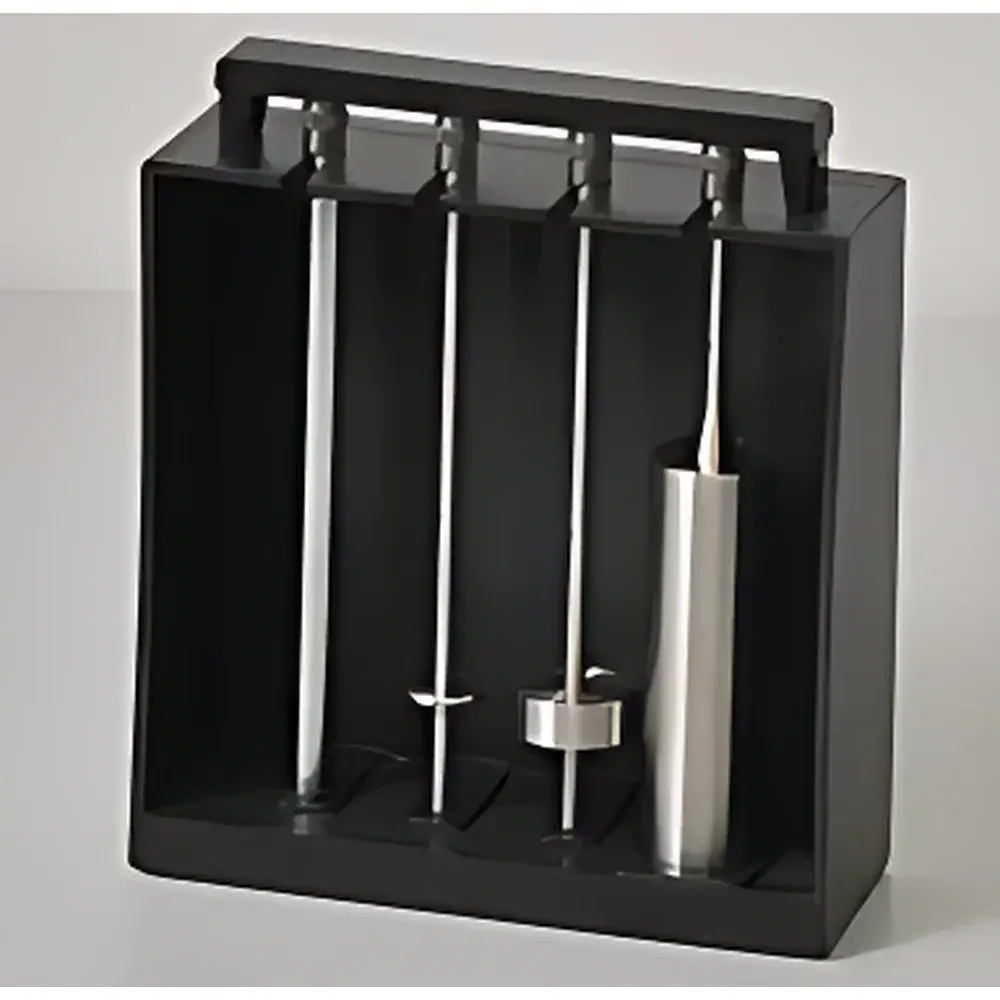
| Spindles | LV #1–#4 (optional #0 spindle available) |
| Accuracy | ±1.0% of full scale |
| Repeatability | 0.5% |
| Power Supply | AC 100–240 V, 50/60 Hz |
| Display | LCD with blue backlight |
| Features | Real-time viscosity readout, auto-range alert, programmable measurement timer, full-scale linear calibration, temperature probe interface (RTD-compatible) |
Overview
The NDJ-5S Digital Rotational Viscometer is a precision-engineered instrument designed for routine viscosity characterization of Newtonian and mildly non-Newtonian fluids in quality control, R&D, and production environments. Based on the Couette principle, it measures torque required to rotate a cylindrical spindle at a defined angular velocity within a fluid sample—converting mechanical resistance into quantitative dynamic viscosity (mPa·s). As the direct evolution of the legacy NDJ-1 and NDJ-4 models, the NDJ-5S replaces analog dials and mechanical gear trains with a stepper motor-driven transmission system, eliminating backlash, slippage, and speed drift. This architecture ensures stable, repeatable rotational speeds—critical for compliance with standardized test methods such as ASTM D2196, ISO 2555, and GB/T 2794 (Chinese national standard for adhesive viscosity testing). Its compact benchtop footprint and low power consumption make it suitable for laboratories with constrained space or multi-instrument workflows.
Key Features
- Stepper motor direct-drive system: Delivers precise, gear-free rotation at four fixed speeds (6, 12, 30, and 60 rpm), minimizing mechanical hysteresis and ensuring long-term speed stability.
- Backlit LCD display: Provides high-contrast, real-time visualization of viscosity (mPa·s), spindle number, rotational speed, and elapsed measurement time; dynamically calculates and displays the maximum measurable viscosity for the selected spindle/speed combination.
- Programmable timing function: Enables consistent dwell time for thixotropic or time-dependent samples—supporting reproducible shear history control per ASTM D1475 and ISO 3219 protocols.
- Over-range detection: Audible alert activates when torque exceeds transducer capacity, preventing sensor saturation and data corruption.
- Full-scale linear calibration: Factory-performed calibration traceable to NIST-traceable reference oils; supports user verification using certified standard fluids (e.g., Brookfield RV series or Cannon N-series).
- Universal AC input (100–240 V, 50/60 Hz): Integrated switching power supply with EMI filtering ensures operational reliability in electrically noisy industrial lab environments.
Sample Compatibility & Compliance
The NDJ-5S accommodates a broad spectrum of low-to-medium viscosity liquids—including solvent-based adhesives, polymer solutions, paints, inks, cosmetic emulsions, dairy products, pharmaceutical suspensions, and edible fluids. It is compatible with optional accessories that extend its functional envelope: an RTD temperature probe (for real-time sample temperature monitoring per ASTM D445 requirements), a thermostatic water bath for controlled-temperature measurements (±0.1 °C stability), ultra-low-viscosity adapter (for sub-10 mPa·s fluids), and external circulation cup for continuous-flow applications. While not inherently 21 CFR Part 11 compliant, audit-ready documentation—including calibration certificates, operation logs, and maintenance records—can be maintained manually or integrated into LIMS via optional RS-232 output (with appropriate terminal software). The instrument meets CE electromagnetic compatibility (EMC) directives and conforms to GB/T 2794–2013 for adhesive testing and GB/T 9269–2009 for architectural coating viscosity evaluation.
Software & Data Management
The NDJ-5S operates as a standalone instrument with no embedded firmware-based data logging. However, its RS-232 serial interface (standard) enables bidirectional communication with third-party acquisition software or custom LabVIEW/Python scripts for automated data capture, timestamped reporting, and statistical process control (SPC) charting. When paired with optional accessories—such as a thermal printer or PC-connected DAQ system—users can generate GLP-compliant reports including operator ID, sample ID, environmental conditions (temperature), spindle/speed selection, measured value, and pass/fail status against predefined specification limits. All calibration and verification events should be recorded in accordance with ISO/IEC 17025 internal audit requirements.
Applications
This viscometer serves critical functions across multiple regulated and non-regulated sectors. In coatings and ink manufacturing, it verifies batch consistency prior to filtration and packaging (per ISO 2884-1). In food & beverage QA labs, it monitors viscosity stability of milk-based beverages, fruit pulps, and flavor emulsions across shelf life. In adhesive formulation, it tracks solvent evaporation kinetics and resin crosslinking progression during cure studies. Pharmaceutical manufacturers apply it for preliminary screening of topical gel bases, syrup vehicles, and suspension stabilizers—aligning with USP <911> guidance on viscosity assessment of semisolid dosage forms. Its simplicity, robustness, and cost-efficiency make it especially valuable for contract testing labs performing routine QC on high-volume commodity materials.
FAQ
What spindle configurations are included with the NDJ-5S?
The base configuration includes four standard spindles (#1–#4) optimized for the 1–100,000 mPa·s range. Spindle #0 (ultra-low viscosity) is available as a separately ordered accessory.
Is temperature control integrated into the instrument?
No—temperature regulation requires external hardware. An optional RTD temperature probe connects directly to the rear panel, and a dedicated thermostatic water bath is recommended for ISO-compliant temperature-controlled measurements.
Can the NDJ-5S measure non-Newtonian fluids reliably?
It provides valid single-point apparent viscosity values under fixed shear rates. For full rheological profiling (e.g., flow curves, yield stress), a programmable rheometer with variable shear rate capability is required.
How often should calibration be performed?
Annual calibration is recommended for routine QC use. More frequent verification—using certified standard oils before each shift or daily—is advised for GMP-aligned operations.
Does the instrument support GLP/GMP documentation requirements?
While the NDJ-5S itself does not provide electronic audit trails, its analog output and RS-232 interface allow integration into validated data acquisition systems that meet 21 CFR Part 11 and Annex 11 expectations when properly configured and qualified.



