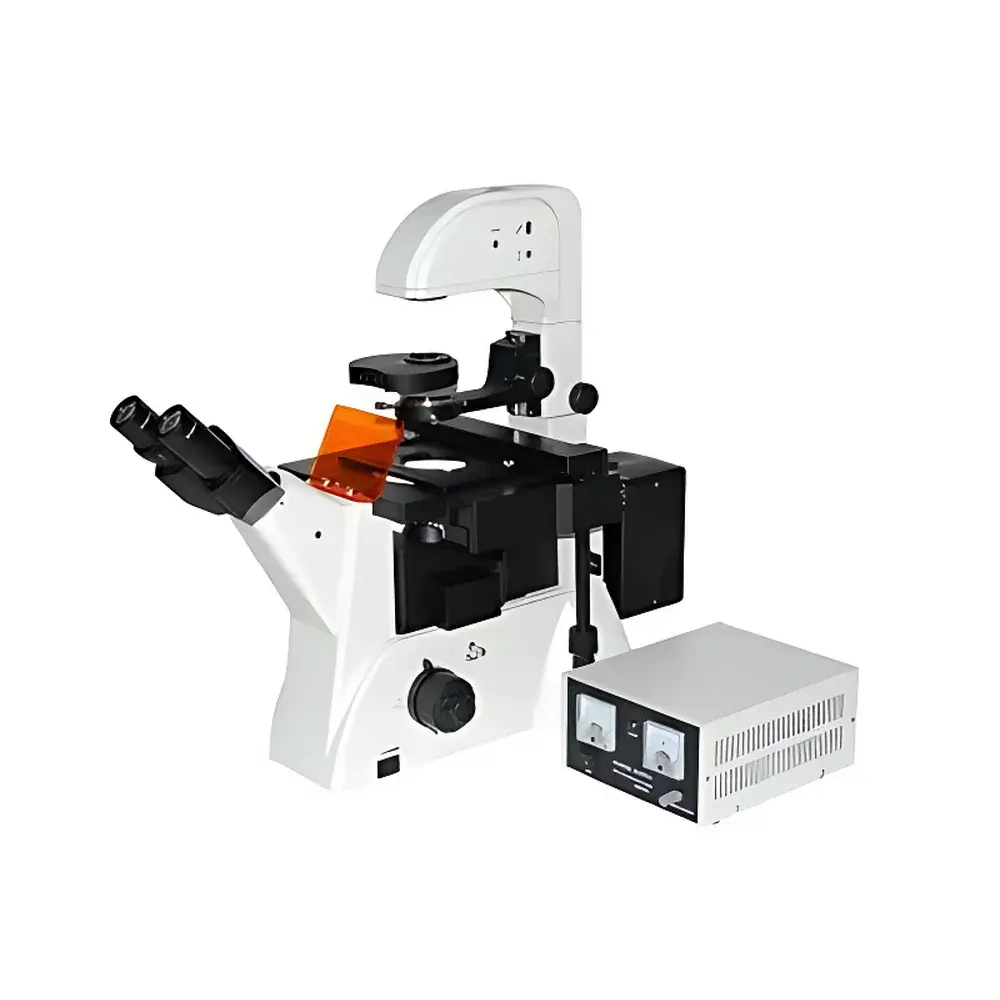
XD200-FL Inverted Fluorescence Biological Microscope
| Origin | Beijing, China |
|---|---|
| Manufacturer Type | Authorized Distributor |
| Origin Category | Domestic (China) |
| Model | XD200-FL |
| Price | USD 6,300 (FOB Beijing) |
| Optical Design | Infinity-Corrected Optical System |
| Objective Mount | Quintuple Nosepiece |
| Eyepiece | Widefield WF10X (Field Number Φ22 mm) |
| Objective Lenses | Plan Achromatic PLL 10X/0.25 (WD 4.3 mm), 20X/0.40 (WD 8.0 mm), 40X/0.60 (WD 3.5 mm) |
| Fluorescence Excitation Bands | UV (330–400 nm), Violet (395–415 nm), Blue (420–485 nm), Green (460–550 nm) |
| Emission Filters | 425 nm, 455 nm, 515 nm, 590 nm |
| Light Sources | 100 W DC Mercury Arc Lamp (Fluorescence), 6 V/30 W Halogen Lamp (Transmitted Light) |
| Focus Mechanism | Coaxial Coarse/Fine Adjustment with Locking & Upper/Lower Limits |
| Fine Focus Graduation | 2 µm |
| Stage | Fixed Mechanical Stage (227 × 208 mm) |
| Condenser | Rotating Phase Contrast Annulus Condenser (WD 55 mm) |
| Eyepiece Tube | 45° Inclined, Interpupillary Distance 53–75 mm |
Overview
The XD200-FL Inverted Fluorescence Biological Microscope is engineered for high-fidelity live-cell imaging and routine fluorescence observation in adherent and suspension cultures. Its inverted configuration places the objective lenses beneath the specimen stage—enabling direct optical access to cells growing in standard Petri dishes, multi-well plates, and cylindrical culture flasks without disturbing sterility or requiring sample mounting on slides. The system integrates two parallel optical pathways: a high-stability transmitted-light path supporting brightfield, phase contrast, and differential interference contrast (DIC)-compatible illumination; and a modular epi-fluorescence path built around a 100 W DC mercury arc lamp and four independently selectable filter sets optimized for common fluorophores including DAPI, Hoechst, FITC, GFP, TRITC, and Texas Red. All optics adhere to an infinity-corrected design, ensuring chromatic aberration correction across the full visible spectrum and compatibility with future digital imaging upgrades.
Key Features
- Inverted mechanical architecture with ultra-rigid base and vibration-damped column—designed to meet ISO 10993-compliant cell culture handling requirements and minimize focus drift during time-lapse acquisition.
- Rotating swing-out condenser assembly enabling unobstructed access to tall vessels (e.g., T-175 flasks) while maintaining Köhler illumination alignment for both phase contrast and brightfield modes.
- Quintuple nosepiece accommodating five objectives simultaneously—including matched plan achromatic PLL series with standardized 1.2 mm cover glass correction and extended working distances critical for imaging through plastic-bottom dishes.
- Modular fluorescence turret with quick-release filter cube slots—allowing tool-free exchange of excitation/emission dichroic combinations under Class II biosafety cabinet conditions.
- Dual independent illumination systems: 6 V/30 W adjustable halogen lamp for transmitted light (with blue/green filters and ground glass diffuser), and stabilized 100 W DC mercury lamp with thermal cutoff and lamp-hour counter for reproducible fluorescence excitation.
- Ergonomic 45° inclined trinocular tube with interpupillary adjustment (53–75 mm) and C-mount port compliant with ANSI/ISO 10110-7 for seamless integration with scientific CMOS or EMCCD cameras.
Sample Compatibility & Compliance
The XD200-FL supports direct observation of live mammalian, insect, and stem cell lines cultured in standard polystyrene or glass-bottom vessels ranging from 35 mm Petri dishes to 100 mm dishes and T-75/T-175 flasks. Its three interchangeable stage inserts accommodate diverse vessel geometries—including round, rectangular, and multi-well formats—without requiring adhesive mounting or coverslip inversion. The system complies with key international standards for laboratory instrumentation: ISO 9001:2015 (quality management), IEC 61000-6-3 (EMC emissions), and IEC 61010-1 (safety requirements for electrical equipment). While not certified for GMP manufacturing environments, its optical traceability, lamp intensity logging, and mechanical repeatability support GLP-aligned documentation workflows required in preclinical assay development and regulatory submission packages (e.g., FDA IND-enabling studies).
Software & Data Management
The microscope is fully compatible with third-party image acquisition platforms including NIS-Elements (Nikon), ZEN Blue (Zeiss), and open-source Micro-Manager v2.0+. It provides native USB 2.0 and RS-232 interfaces for synchronized control of shutter timing, filter wheel position, focus motor (optional upgrade), and lamp intensity. All hardware-triggered events—including exposure start, filter change, and Z-stack initiation—are timestamped and logged in CSV format for audit trail generation. When paired with validated software, the system supports 21 CFR Part 11-compliant user authentication, electronic signatures, and immutable data archiving—meeting baseline requirements for QC labs operating under pharmaceutical quality systems.
Applications
- Long-term live-cell tracking of proliferation, migration, and apoptosis using fluorescent reporters (e.g., CellTracker dyes, Annexin V-FITC, Caspase sensors).
- High-content screening in 96- and 384-well plates for drug discovery pipelines—leveraging phase contrast for confluence assessment and fluorescence for target engagement readouts.
- Stem cell differentiation monitoring via lineage-specific markers (e.g., Oct4-GFP, Sox2-mCherry) under physiological CO₂/humidity incubator-compatible stage enclosures (sold separately).
- Microbial biofilm formation assays on transparent substrates using SYTO 9/PI dual staining and quantitative intensity profiling.
- Quality control of monoclonal antibody production in CHO or HEK293 cultures—assessing viability, morphology, and intracellular protein expression prior to harvest.
FAQ
Is the XD200-FL compatible with environmental chambers for live-cell incubation?
Yes—the stage design accommodates commercially available heated, humidified, and CO₂-controlled chamber systems (e.g., Tokai Hit INU series) with minimal optical path deviation.
Can I upgrade to motorized Z-focus or automated filter wheels?
Motorized focus and filter turrets are available as factory-installed options with TTL/USB control interfaces and firmware integration.
Does the system support DIC or Hoffman modulation contrast?
While not included in the base configuration, the infinity-corrected optics and high-NA objectives are mechanically and optically compatible with aftermarket DIC sliders and condensers.
What is the expected lifetime of the 100 W mercury lamp?
Rated average life is 200 hours at rated power; lamp output stability is maintained within ±5% over the first 100 hours when operated with regulated DC current supply.
Are calibration certificates provided for optical performance verification?
A factory-issued optical alignment report (including centering, parfocality, and Köhler illumination verification) is included; NIST-traceable photometric calibration is available upon request.