
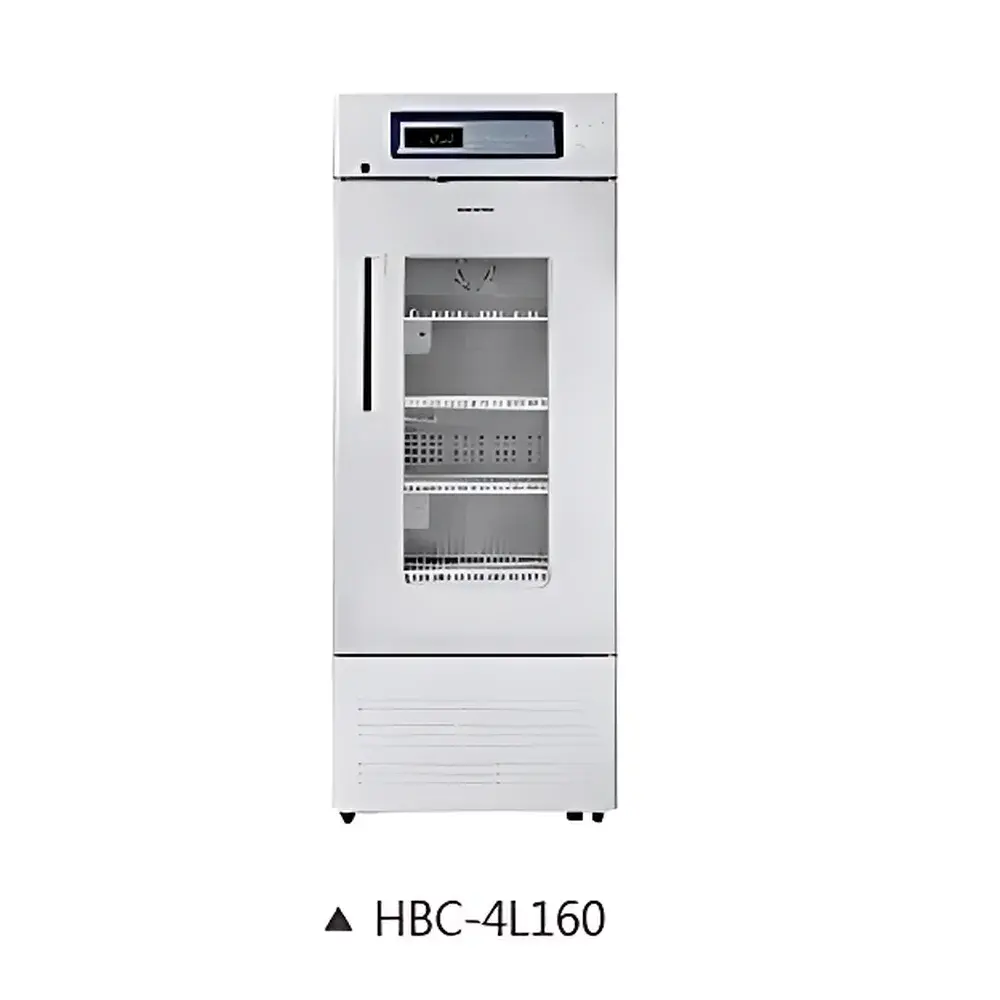
Hisense HBC-4L160 Blood Bank Refrigerator
| Brand | Hisense |
|---|---|
| Model | HBC-4L160 |
| Temperature Range | 4 ± 1 °C |
| Capacity | 160 L |
| Shelves | 4 adjustable wire shelves (3 blood bag baskets per shelf) |
| Dimensions (W×D×H) | 600 × 620 × 1600 mm |
| Net Weight | 106 kg |
| Power Supply | 220 V / 50 Hz |
| Compressor | International brand, R134a refrigerant |
| Defrosting | Automatic electric heating defrost |
| Display | High-brightness LED with real-time temperature and status indication |
| Sensors | 6 high-precision PT100 temperature sensors |
| Alarm Functions | High/low temperature, door open, power failure (≥48 h backup), sensor fault |
| Insulation | Microcellular polyurethane foam with uniform cell structure |
| Door | Dual inner doors + tempered glass observation window with anti-condensation heating |
| Safety | Independent mechanical lock, voltage range 187–242 V, low-noise operation (<42 dB(A)), four swivel casters, external temperature monitoring port |
| Compliance | Designed to meet ISO 13485, WHO PQS, and GB/T 28003–2011 requirements for blood storage equipment |
Overview
The Hisense HBC-4L160 Blood Bank Refrigerator is a purpose-built, Class II medical-grade refrigeration system engineered for the stable, compliant, and traceable storage of whole blood, packed red blood cells, platelet concentrates, plasma derivatives, vaccines, pharmaceuticals, and diagnostic reagents at a tightly controlled +4 °C operating temperature. Designed in accordance with international standards for blood bank infrastructure—including WHO Prequalification of In Vitro Diagnostics (PQS) guidelines and ISO 13485:2016 for medical device quality management—the unit employs a dual-door architecture with thermally insulated glass viewing windows and anti-condensation heating to enable non-intrusive visual verification of blood bag inventory without compromising thermal integrity. Its microprocessor-based temperature control system maintains setpoint stability within ±1 °C across the full 160 L working volume, utilizing six calibrated PT100 resistance temperature detectors (RTDs) distributed across multiple zones to ensure spatial uniformity and eliminate cold/hot spots. The cabinet’s structural design prioritizes operational safety, audit readiness, and long-term reliability in high-throughput clinical and public health environments.
Key Features
- Microcomputer-controlled temperature regulation with real-time LED display of internal temperature and operational status
- Anti-condensation heated glass door assembly—certified condensation-free at 25 °C ambient and 90% RH for uninterrupted visual monitoring
- Four independently adjustable wire shelves with epoxy-coated steel construction; each tier accommodates three standardized blood bag baskets (ISO 17664-compliant)
- Dual inner door configuration minimizes cold air loss during routine access and reduces thermal recovery time by >40% versus single-door designs
- High-efficiency R134a refrigeration system featuring an internationally certified hermetic compressor and large-area finned condenser for rapid pull-down and stable maintenance
- Automatic electric heating defrost cycle prevents ice accumulation without interrupting temperature control or requiring manual intervention
- Six distributed PT100 sensors enable multi-point temperature mapping and support continuous performance verification per CLSI GP35-A4 and AABB Standards
- Comprehensive alarm suite: audible/visual alerts for temperature excursions (>±2 °C), door ajar (>30 s), power failure (with ≥48-hour battery-backed logging), and sensor malfunction
- Independent mechanical lock mechanism with tamper-evident design ensures secure access control aligned with HIPAA and GDPR physical safeguards
Sample Compatibility & Compliance
The HBC-4L160 supports storage of human whole blood, leukoreduced RBCs, cryoprecipitate, fresh frozen plasma (FFP), thawed plasma, and temperature-sensitive biologics requiring strict +2 to +6 °C stabilization. Its interior layout conforms to AABB Technical Manual Chapter 5 (Blood Banking) recommendations for vertical segregation by blood group, expiration date, and processing status. All materials in direct contact with stored products—including basket trays, shelf coatings, and gasket seals—meet USP and cytotoxicity and extractables testing requirements. The unit is manufactured under an ISO 13485-certified quality management system and complies with China’s YY/T 0058–2022 standard for medical refrigerators, as well as IEC 61010-1:2010 safety requirements for laboratory equipment. Optional factory calibration documentation includes NIST-traceable certificates for all RTD sensors.
Software & Data Management
While the HBC-4L160 operates as a standalone analog-digital hybrid controller without embedded network connectivity, it features a dedicated external temperature monitoring port compatible with third-party data loggers (e.g., Dickson, DeltaTRAK, or ELPRO systems) meeting FDA 21 CFR Part 11 requirements. The unit supports continuous recording of min/max/average temperatures, alarm events, and door-open duration—enabling generation of GxP-compliant audit trails for GLP, GMP, and CAP-accredited laboratories. Sensor outputs are accessible via 4–20 mA or 0–5 V analog signals, facilitating integration into centralized BMS or LIS platforms. Firmware updates are performed via secure USB interface with version-controlled firmware signing.
Applications
This refrigerator serves critical roles in blood transfusion services (BTS), hospital central blood banks, regional donor centers, national disease prevention and control institutes (CDCs), vaccine distribution hubs, and academic research facilities conducting immunology, hematology, or cell therapy studies. It is routinely deployed for: short-term holding of donated units prior to component separation; post-processing storage of leukocyte-reduced RBCs; quarantine staging of serologically reactive units; temperature-controlled transport staging; and cold-chain validation studies supporting WHO cold box qualification protocols. Its wide input voltage tolerance (187–242 V AC) and low acoustic signature (<42 dB[A]) make it suitable for installation in generator-backed emergency response units and noise-sensitive clinical corridors.
FAQ
What temperature uniformity can be expected across the 160 L chamber?
Temperature variation remains ≤ ±0.8 °C between any two points at steady state, verified per ISO 23599 Annex C using nine-point mapping.
Is the unit suitable for storing platelets?
No—platelets require controlled agitation at 20–24 °C per AABB Standard 5.3.1; this unit is validated exclusively for +4 °C applications.
Can the internal temperature sensors be recalibrated onsite?
Yes—each PT100 sensor is individually addressable and supports two-point calibration using certified reference probes traceable to national metrology institutes.
Does the system include a printout function for temperature logs?
Not natively—but the analog output port enables connection to external thermal printers or cloud-connected loggers with auto-print capabilities.
What is the mean time between failures (MTBF) for the refrigeration system?
Based on accelerated life testing per IEC 60601-1 Annex F, MTBF exceeds 25,000 hours under continuous operation at rated load.




