
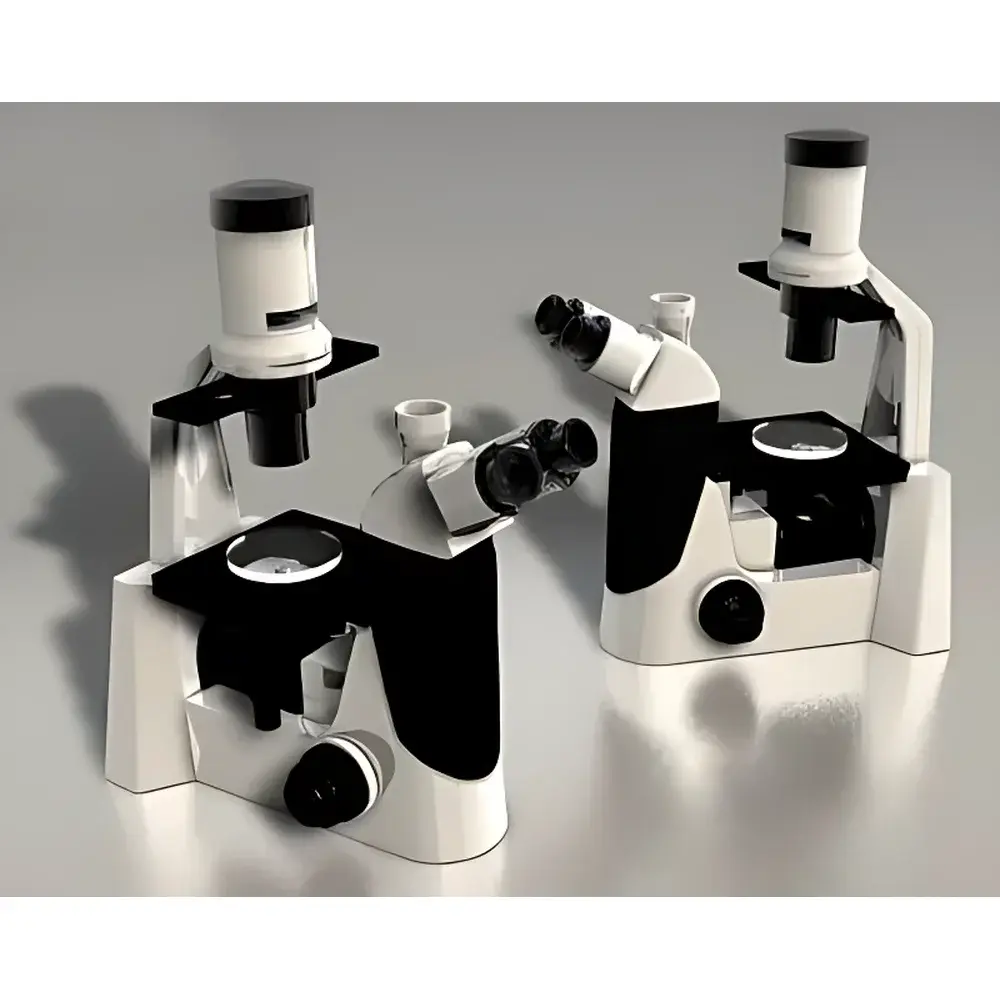
DZ2000 Inverted Biological Microscope
| Origin | Beijing, China |
|---|---|
| Manufacturer Type | Authorized Distributor |
| Origin Category | Domestic (PRC) |
| Model | DZ2000 |
| Price | USD 2,650 (FOB) |
| Optical System | UCIS Infinity-Corrected, Parfocal, Positive-Image Path |
| Magnification Range | 40×–400× (expandable to 960× with optional 60× objective) |
| Eyepieces | Widefield PL10×/20 mm (high-eye-point, reticle-compatible) |
| Objectives | Infinity Long Working Distance (LWD) Plan Achromatic: 4×, 10×, 20×, 40× |
| Phase Contrast | 10×, 20×, 40× LWD |
| Condenser | N.A. 0.70, WD 72 mm / 120 mm, removable, with aperture diaphragm |
| Focusing | Coaxial coarse/fine focus |
| Stage | Mechanical XY stage, 80 × 50 mm travel |
| Illumination | 6 V / 30 W halogen lamp with aspheric collector lens |
| Fluorescence Module | Rotating filter turret for dual-band (B/G) or quad-band (UV/V/B/G) excitation |
| Camera Port | Trinocular port with 80:20 beam splitter ratio |
| Compliance | Designed per ISO 10934-1 (Microscopes — Nomenclature of components), IEC 61010-1 (Safety requirements for electrical equipment), and GLP-aligned documentation architecture |
Overview
The DZ2000 Inverted Biological Microscope is engineered for routine and advanced live-cell observation, tissue culture monitoring, and in vitro assay validation in academic laboratories, biotech QC environments, and pharmaceutical R&D facilities. Its UCIS (Universal Chromatic Independent Correction System) infinity-corrected optical architecture delivers parfocal, positive-image-path imaging—ensuring directional correspondence between specimen movement and on-screen navigation. This design eliminates operator cognitive load during time-lapse experiments or multi-position scanning. The microscope employs a robust monolithic die-cast chassis that minimizes mechanical drift and thermal deformation, critical for extended-duration imaging sessions. With a standard magnification range of 40×–400× (extendable to 960× via optional 60× LWD objective), the DZ2000 supports both brightfield and phase contrast modalities out-of-the-box, while its modular fluorescence configuration enables seamless transition between transmitted-light and epifluorescence workflows.
Key Features
- Infinity-corrected long working distance (LWD) plan achromatic objectives (10×, 20×, 40×) with N.A. up to 0.70 and working distances ranging from 72 mm to 120 mm—enabling unobstructed access to Petri dishes, flasks, and multi-well plates without objective collision.
- Hinged trinocular observation tube (45° inclination) with interpupillary adjustment (52–75 mm) and diopter compensation—designed for ergonomic daily use across diverse user anthropometrics.
- Removable high-NA condenser (N.A. 0.70, WD 72 mm / 120 mm) with centerable aperture diaphragm—facilitating Köhler illumination optimization and accommodating large-volume culture vessels.
- Coaxial coarse/fine focusing mechanism with calibrated fine-focus scale (0.001 mm resolution), upper mechanical stop, and adjustable tension control—ensuring reproducible Z-stack acquisition and preventing stage overtravel.
- Widefield PL10×/20 mm eyepieces featuring high eye-point optics (≥20 mm eye relief) and optional reticle or graticule inserts—supporting quantitative morphometric analysis and compliant documentation under GLP audit conditions.
- Integrated 6 V / 30 W halogen illumination system with aspheric collector lens and continuous brightness control—delivering uniform, glare-free illumination across all magnifications and field diameters.
Sample Compatibility & Compliance
The DZ2000 accommodates standard cell culture formats including 35 mm, 60 mm, and 100 mm Petri dishes; T25, T75, and T175 flasks; and 6-, 12-, 24-, 48-, and 96-well plates. Its 72 mm minimum working distance permits unimpeded manipulation beneath objectives during micromanipulation or microinjection procedures. The system conforms to ISO 10934-1 for standardized nomenclature of microscope components and complies with IEC 61010-1 safety requirements for laboratory electrical equipment. While not certified for GMP manufacturing environments, its optical traceability, mechanical stability, and documentation-ready configuration support GLP-aligned experimental records—including metadata capture via integrated digital imaging systems.
Software & Data Management
The DZ2000 interfaces seamlessly with third-party imaging platforms via C-mount (0.5× or 1× reduction optics). Compatible digital modules include 3.3 MP, 8.1 MP, and 9.0 MP CMOS sensors with USB 3.0 or GigE output—each bundled with UOP Image Analysis Software supporting real-time measurement (area, perimeter, intensity profiling), time-lapse annotation, and TIFF/OME-TIFF export. For fluorescence applications requiring low-noise detection, thermoelectrically cooled CCD options (3 MP and 6 MP) are available. All software packages maintain audit-trail functionality compliant with FDA 21 CFR Part 11 principles—recording user ID, timestamp, exposure parameters, and calibration events for regulatory submissions.
Applications
- Long-term live-cell imaging of adherent and suspension cultures under controlled CO₂ incubator conditions.
- Phase contrast evaluation of unstained mammalian cells, primary neurons, and organoids—without fixation or staining artifacts.
- Quality control of hybridoma clones, stem cell passaging, and mycoplasma screening using high-contrast phase optics.
- Dual-mode (brightfield + fluorescence) assessment of transfected cell lines expressing GFP/RFP-tagged constructs.
- Preclinical cytotoxicity assays (e.g., MTT, LDH) where morphological endpoints must be correlated with biochemical readouts.
- Educational training in cell biology, microbiology, and pharmacology laboratories requiring durable, serviceable instrumentation.
FAQ
Is the DZ2000 compatible with environmental chambers for live-cell imaging?
Yes—the inverted configuration, long working distance objectives, and open-stage architecture allow integration with stage-top incubators (37°C, 5% CO₂) and humidity control units.
Can the fluorescence module be upgraded from dual-band to quad-band post-purchase?
Yes—rotating filter turrets are field-replaceable; users may order UV/V/B/G excitation sets separately and install them without recalibration.
What is the maximum recommended sensor resolution for optimal optical sampling?
For the 40× objective (N.A. 0.65), Nyquist sampling requires ≥3.3 MP at 1× C-mount coupling; higher resolutions (8.1–9.0 MP) are advised when using 0.5× reduction optics or performing pixel-binning for SNR optimization.
Does the system support motorized Z-axis or automated stage control?
No native motorization is included, but third-party XYZ motorized stages and focus controllers can be integrated via TTL/RS-232 interfaces supported by UOP software.
Are calibration certificates provided for objective magnification and stage micrometers?
Factory calibration data sheets are supplied with each unit; NIST-traceable stage micrometers and objective verification slides are available as optional accessories.



