
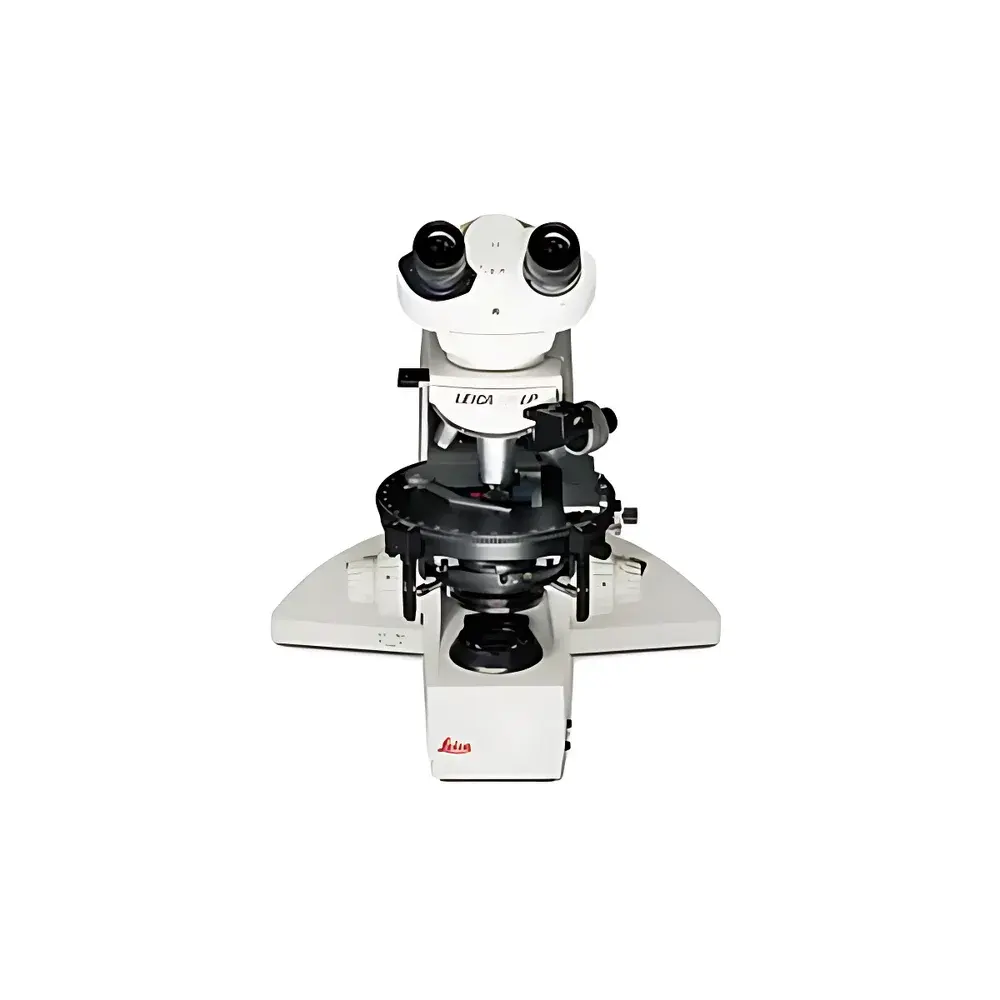
Leica DMLP Polarizing Microscope
| Brand | Leica |
|---|---|
| Origin | Germany |
| Model | DMLP |
| Optical System | Infinity-Corrected |
| Illumination | 12 V / 100 W Halogen (Transmitted & Reflected) |
| Eyepiece | 10×, FOV 22–25 mm |
| Observation Modes | Brightfield, Polarized Light, Optional DIC |
| Objective Turret | 5-Position, Centerable |
| Polarization Components | Rotatable Polarizer & Analyzer, Bertrand Lens, Conoscopic Viewing, λ/4 & λ/2 Retardation Plates, Adjustable Wedge Compensator |
| Objective Compatibility | Plan Achromat, Plan Semi-Apochromat, and Plan Apochromat Polarizing Objectives |
| Tube Configuration | Trinocular (Simultaneous Visual Observation & Imaging) |
| Software Compatibility | Leica Application Suite (LAS), Third-Party Image Analysis Platforms |
| Compliance | Designed for ISO 9001–certified manufacturing |
Overview
The Leica DMLP Polarizing Microscope is an engineered solution for quantitative birefringence analysis and crystallographic characterization in geological, petrological, materials science, and industrial quality control laboratories. Built upon a fully corrected infinity optical system, the DMLP delivers high-fidelity polarization contrast with minimal chromatic and spherical aberration—critical for accurate retardation measurement and extinction angle determination. Its dual-mode illumination architecture supports both transmitted and reflected polarized light observation, enabling comprehensive analysis of transparent thin sections (e.g., rock slices, polymer films) as well as opaque, polished samples (e.g., metals, ceramics). The instrument’s mechanical stability, precise rotational control of polarization elements, and calibrated compensator stages ensure repeatability required for ASTM D4123 (birefringence of plastics), ISO 10112 (optical mineralogy), and USP (pharmaceutical crystal identification).
Key Features
- Infinity-corrected optical path with strain-free, high-transmission polarizing components—including rotatable polarizer and analyzer assemblies with vernier-scale angular readout (±0.1° resolution)
- 5-position centerable objective turret accommodating Leica’s full line of strain-free plan apochromat polarizing objectives (5× to 100×), each optimized for uniform retardation response across the field of view
- Trinocular observation tube with fixed 20% / 80% beam splitting ratio—enabling simultaneous high-brightness visual inspection and low-noise digital imaging without optical compromise
- Dedicated conoscopic optics package including Bertrand lens, centered aperture diaphragm, and precision-aligned condenser for interference figure acquisition and optic axis orientation mapping
- Modular illumination system featuring 12 V / 100 W halogen lamp with integrated heat-absorbing filter and adjustable Köhler illumination controls for both transmission and incident-light polarization modes
- Comprehensive compensation suite: removable λ/4 and λ/2 retardation plates, rotating quartz wedge (0–55 nm range), and calibrated Berek-type compensator for quantitative retardation measurement
Sample Compatibility & Compliance
The DMLP accommodates standard 26 mm and 32 mm diameter thin sections, metallurgical mounts up to 40 mm in height, and custom sample holders for in-situ thermal or mechanical stages. All optical components are certified free of internal stress per DIN EN ISO 10110-5, ensuring no artifact-induced birefringence. The system meets CE marking requirements for laboratory equipment and conforms to IEC 61000-6-3 (EMC emissions) and IEC 61000-6-2 (immunity). When paired with Leica LAS X software configured for 21 CFR Part 11 compliance, the platform supports electronic signatures, user-level access control, and immutable audit trails—making it suitable for regulated environments in pharmaceutical development, forensic geology, and advanced materials certification.
Software & Data Management
The DMLP integrates natively with Leica Application Suite (LAS) X, offering real-time polarization parameter logging (e.g., analyzer angle, compensator position, exposure time), synchronized metadata tagging, and export of calibrated intensity profiles for FFT-based birefringence quantification. It also interoperates with third-party platforms including ImageJ/Fiji (via TWAIN/DirectShow drivers), MATLAB® Image Processing Toolbox, and commercial crystallography suites such as CrysTBox and JADE. Raw image data is stored in TIFF or Leica’s proprietary LIF format—with embedded EXIF tags containing objective magnification, NA, polarizer/analyzer angles, and compensator settings—ensuring full traceability from acquisition to publication.
Applications
- Petrographic analysis of igneous and metamorphic rocks using interference color charts and optic sign determination
- Pharmaceutical solid-state characterization: polymorph identification, hydrate/solvate differentiation, and crystallinity assessment in APIs
- Failure analysis of composite laminates and fiber-reinforced polymers via stress-induced birefringence mapping
- Quality assurance of liquid crystal displays (LCDs), optical films, and photoelastic coatings
- Mineral identification in ore processing and environmental sediment studies under standardized thin-section protocols
- Teaching laboratories for undergraduate and graduate instruction in optical mineralogy and materials physics
FAQ
Does the DMLP support motorized stage or focus automation?
No—the DMLP is a manually operated research-grade platform. Motorized components (e.g., Z-drive, XY stage, filter wheels) are available only on the Leica DM6 M and DM2700 P systems.
Can I use non-Leica polarizing objectives with the DMLP?
Only Leica-certified strain-free objectives are guaranteed to maintain polarization fidelity. Third-party objectives may introduce internal birefringence and invalidate quantitative measurements.
Is the 100 W halogen lamp replaceable with LED illumination?
Not without optical recalibration. The DMLP’s condenser and polarizer alignment are optimized for the spectral output and filament geometry of the specified 12 V / 100 W halogen source.
What is the maximum usable numerical aperture (NA) for polarized light work?
With the 100× plan apochromat polarizing objective (NA 0.95), the system achieves optimal resolution while preserving extinction contrast—validated per ISO 8576 Annex B for polarization microscopy.
How does the DMLP handle vibration-sensitive applications like interference figure imaging?
The base casting features a rigid, damped aluminum alloy chassis with reinforced pillar design. For critical conoscopy, optional anti-vibration table mounting and air-isolation feet are recommended.



