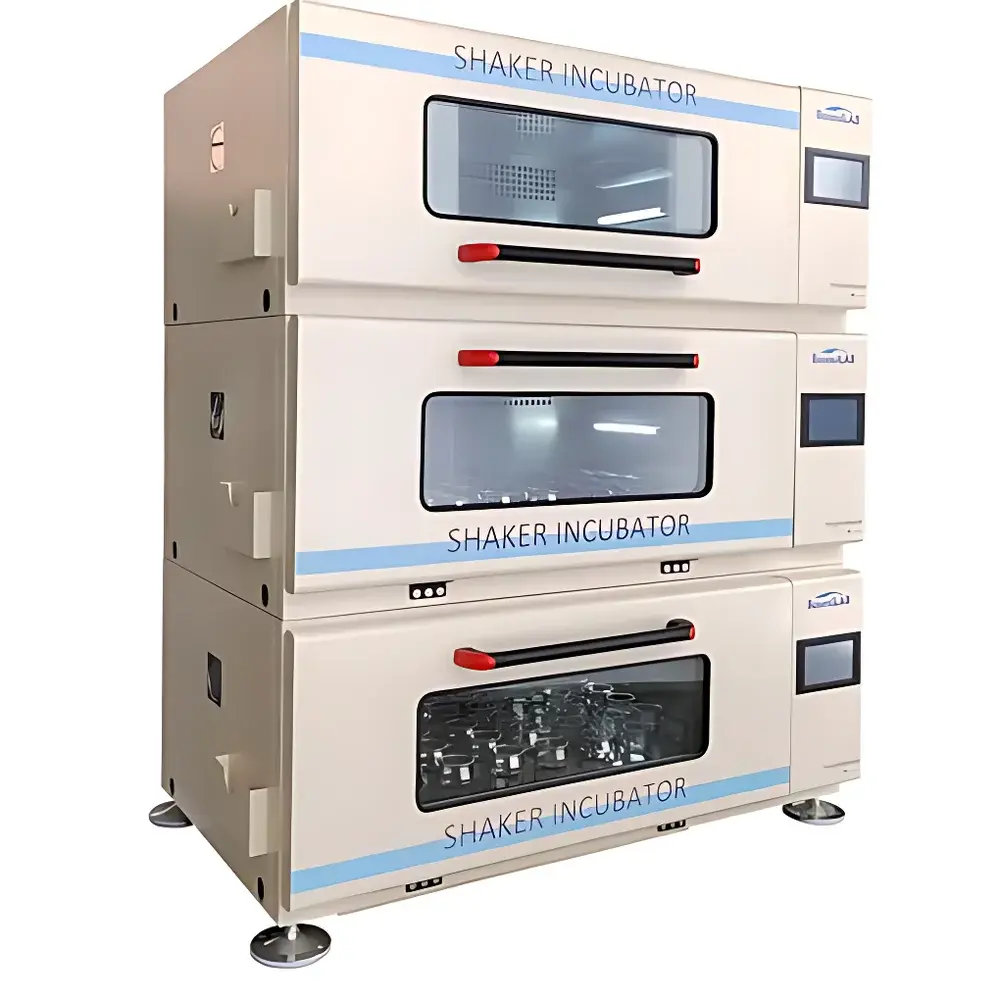
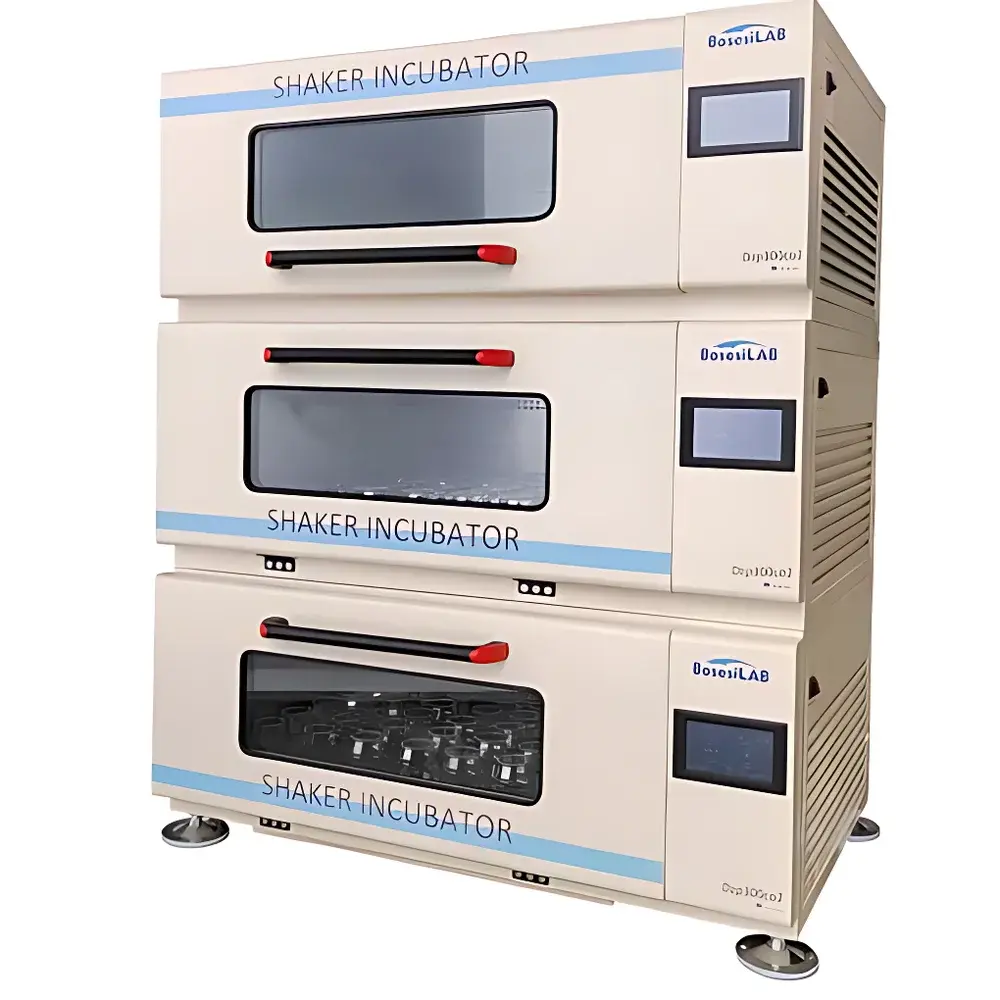
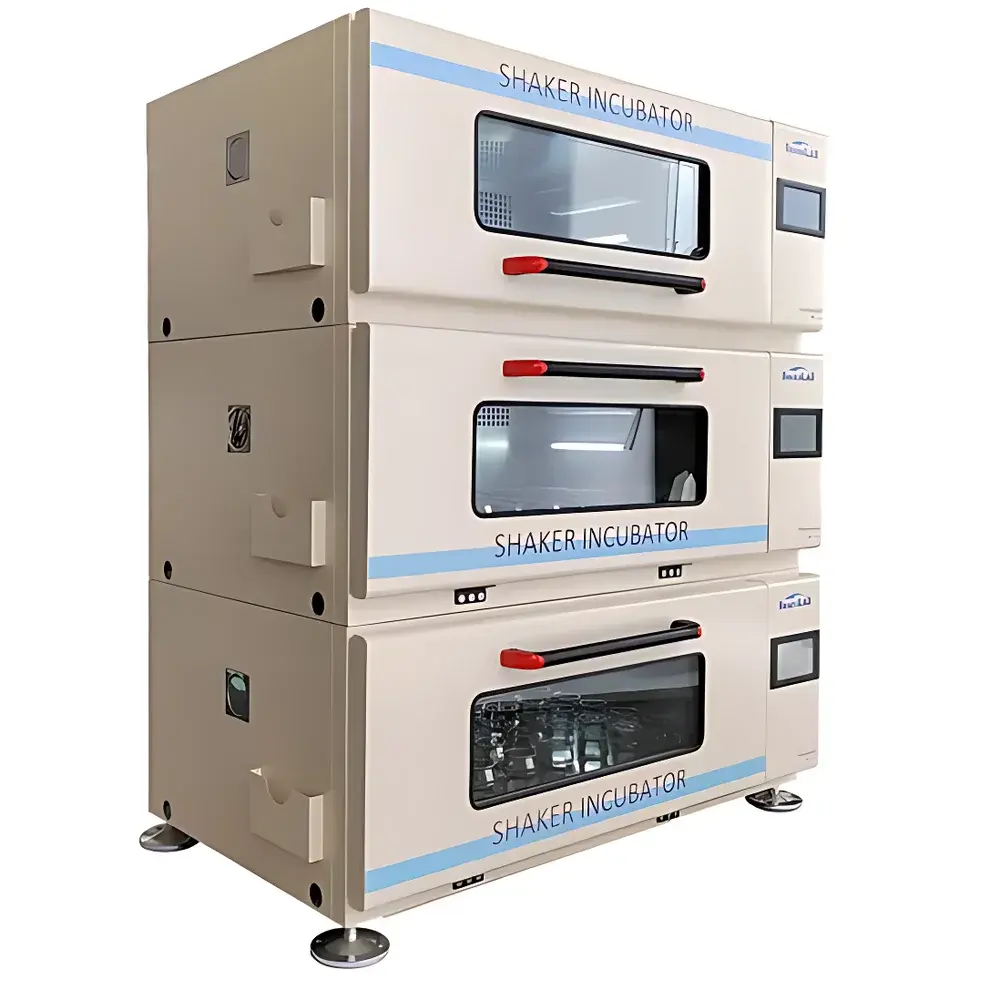
3P DZP300CO2 Multi-Layer CO₂-Regulated Orbital Shaking Incubator
| [Brand | 3P (Germany) |
|---|---|
| Origin | Jiangsu, China |
| Model | DZP300CO₂ |
| Instrument Type | Refrigerated/Heated CO₂ Orbital Shaker Incubator |
| Stacking Layers | 1–3 independent layers |
| Temperature Range | 4–60 °C (at 25 °C ambient) |
| CO₂ Range | 0–20% (±0.1% control accuracy) |
| Humidity Range | Ambient to 95% RH |
| Orbital Speed | 10–300 rpm (±1 rpm accuracy) |
| Orbit Diameter | 26 mm or 50 mm selectable |
| Timer Range | 0–999 h 59 min |
| Shelf Dimensions | 1010 × 580 mm |
| Internal Volume per Layer | 283 L |
| Power Supply | AC 220 V ±10%, 50–60 Hz |
| Drive System | Three-axis orbital drive with brushless motor & precision forged steel eccentric cam |
| Chamber Material | SUS304 brushed stainless steel |
| Control Interface | 7-inch true-color capacitive touchscreen |
| Compliance | Designed for GLP-compliant cell culture workflows |
Overview
The 3P DZP300CO₂ is a modular, multi-layer CO₂-regulated orbital shaking incubator engineered for high-fidelity suspension and adherent cell culture under dynamically controlled environmental conditions. Unlike conventional shakers or static CO₂ incubators, this system integrates precise orbital agitation (10–300 rpm), refrigerated/heated temperature control (4–60 °C), real-time CO₂ concentration regulation (0–20%, ±0.1%), and humidity management (ambient to 95% RH) within a single, stackable platform. Its core operating principle relies on P.I.D.-governed feedback loops across all critical parameters—ensuring stable gas-phase equilibrium, thermal homogeneity (±0.5 °C at 37 °C), and mechanical reproducibility in orbital motion. The unit employs a three-axis orbital drive mechanism with a forged steel eccentric cam and aluminum motor plate, minimizing harmonic vibration and maximizing sample mixing uniformity—critical for scalable bioprocess development, hybridoma expansion, insect cell transfection, and stem cell differentiation studies.
Key Features
- Modular 1–3 layer stacking architecture with fully independent parameter control per layer—enabling parallel experiments under distinct temperature, speed, CO₂, and humidity setpoints.
- True-color 7-inch capacitive touchscreen interface with intuitive icon-based navigation, real-time parameter visualization (temperature, CO₂ %, RH, rpm, time), and multi-segment programmable protocols.
- Three-axis orbital drive system powered by a custom brushless DC motor, coupled with Japan-made Samsung timing belts and Harbin Bearing (HaZhou) components for >20,000-hour operational durability.
- SUS304 brushed stainless-steel chamber with radiused corners and integrated drainage channel—facilitating ISO 14644-compliant cleaning and decontamination between runs.
- Comprehensive safety architecture: dual-limit temperature protection, CO₂ over/under-concentration alarms, motor stall detection, door interlock, leakage current protection, and compressor/ heater thermal cutoffs.
- Onboard data logging with UBS export capability—including timestamped temperature curves, CO₂ profiles, and speed history—supporting 21 CFR Part 11–aligned record retention when paired with optional audit trail software.
Sample Compatibility & Compliance
The DZP300CO₂ accommodates standard culture vessels including Erlenmeyer flasks (250–2000 mL), roller bottles, multi-well plates, and custom bioreactor bags mounted on its 1010 × 580 mm aluminum or SUS304 trays. Its forced-air convection system ensures uniform thermal distribution across all vessel positions, validated per ISO 13408-2 for aseptic processing environments. The CO₂ regulation subsystem utilizes infrared sensing and proportional solenoid valve actuation, calibrated against NIST-traceable reference gases. While not certified as an FDA-listed medical device, the system meets functional requirements for GLP and GMP-aligned upstream bioprocessing, including compliance with USP for cell culture equipment qualification and ASTM E2500-13 for user requirement specification (URS) traceability.
Software & Data Management
All operational parameters—including setpoints, real-time sensor readings, alarm events, and program execution logs—are stored internally with battery-backed memory. Users may export CSV-formatted datasets via USB flash drive for post-hoc analysis in MATLAB, Python (Pandas), or JMP. Optional Ethernet/WiFi modules enable remote monitoring and control through secure HTTPS endpoints, supporting role-based access control (RBAC) and TLS 1.2 encryption. Audit trail functionality—including operator ID, timestamp, parameter change history, and reason-for-change fields—is available via firmware upgrade, satisfying ALCOA+ principles for data integrity in regulated laboratories.
Applications
- Scalable mammalian cell culture (CHO, HEK293, hybridoma) requiring simultaneous optimization of pH (via CO₂), dissolved oxygen (via agitation), and temperature.
- Insect cell (Sf9, Sf21) baculovirus expression systems where shear-sensitive transfection benefits from low-speed orbital mixing (10–60 rpm) combined with humidified 27–28 °C environments.
- Plant cell suspension cultures demanding extended-duration agitation under elevated CO₂ to modulate secondary metabolite synthesis.
- Microbial fermentation screening (E. coli, Pichia) with integrated sterilization cycles and programmable ramp-and-soak temperature profiles.
- Stem cell expansion protocols requiring strict avoidance of static sedimentation—leveraging continuous orbital motion to maintain monolayer integrity during passaging.
FAQ
Is the DZP300CO₂ suitable for anaerobic cell culture?
No—it is configured exclusively for aerobic and CO₂-enriched (5–10%) environments; nitrogen or argon gas blending requires external manifold integration and is not supported out-of-the-box.
Can I validate temperature uniformity per ISO 13408-2 using this unit?
Yes—the chamber geometry, forced-air flow pattern, and documented thermal stability (±0.5 °C at 37 °C) permit formal mapping per Annex A of ISO 13408-2 using calibrated thermocouples and qualified data loggers.
Does the system support automated calibration of CO₂ sensors?
It includes manual zero/span calibration routines using certified gas standards; auto-calibration is not implemented due to regulatory preference for operator-initiated verification.
What is the maximum flask loading capacity per layer at 150 rpm and 37 °C?
At 150 rpm and 37 °C, full load (72 × 250 mL flasks) maintains thermal and mixing performance—verified via thermal imaging and dissolved oxygen profiling across 3×3 grid positions.
Are spare parts and service documentation available in English?
Yes—3P provides bilingual (EN/DE) technical manuals, schematic diagrams, firmware update packages, and a global spare parts catalog accessible via authorized distributor portals.