
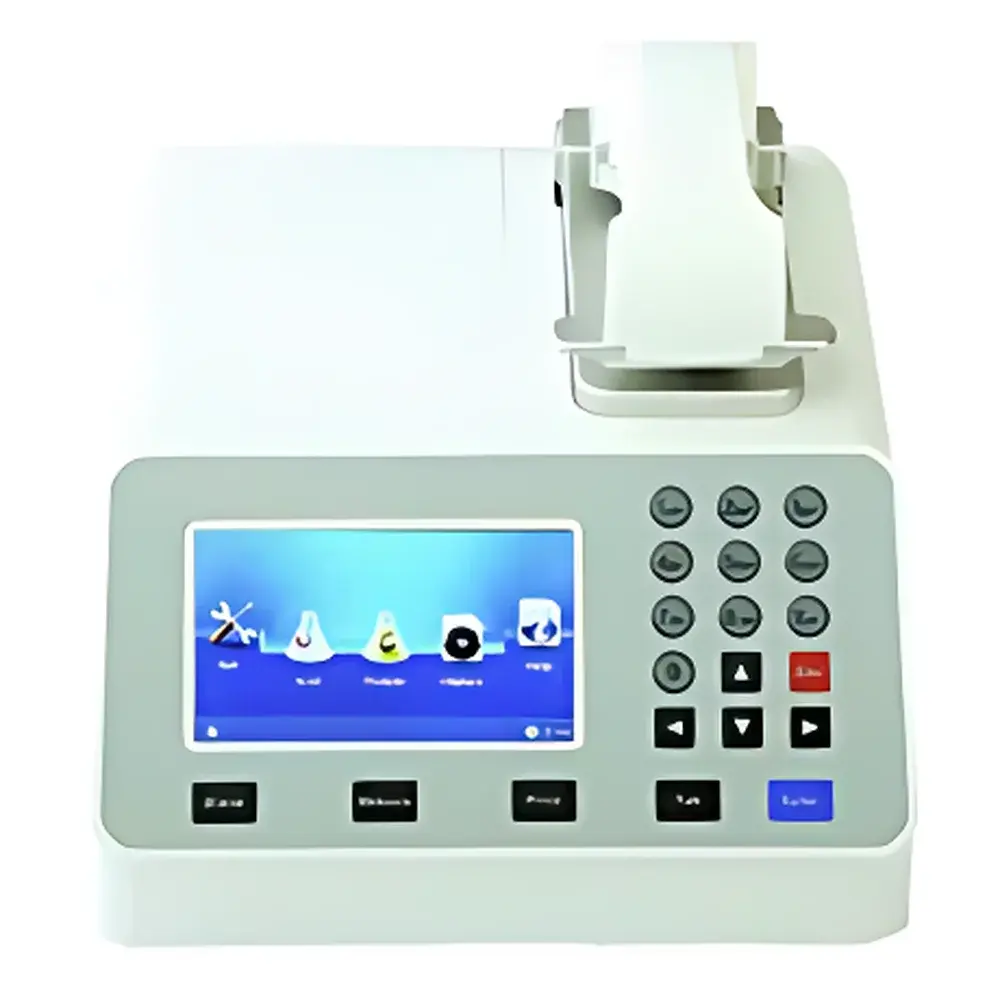
JIAYUAN NANO-200 Microvolume UV-Vis Spectrophotometer
| Brand | JIAYUAN |
|---|---|
| Origin | Beijing, China |
| Manufacturer Type | Authorized Distributor |
| Country of Origin | PRC |
| Model | NANO-200 |
| Price | USD 6,750 (FOB Beijing) |
| Sample Volume | 0.5–2 µL |
| Optical Pathlengths | 0.2 mm & 1.0 mm |
| Light Source | Xenon Flash Lamp (>10⁹ flashes) |
| Wavelengths | Fixed at 230 nm, 260 nm, 280 nm |
| Absorbance Accuracy | ±1% |
| Absorbance Precision | ±0.003 Abs |
| Absorbance Range | 0.02–80 (equivalent to 10 mm pathlength) |
| dsDNA Quantitation Range | 10–4000 ng/µL |
| Protein Quantitation Range | 0.1–100 mg/mL |
| Measurement Time | ≤5 s |
| Dimensions | 210 × 268 × 181 mm (W×D×H) |
| Sample Stage Material | Fused Silica Fiber + Hard-Anodized Aluminum |
| Power Supply | 24 V DC |
| Power Consumption | 40 W |
Overview
The JIAYUAN NANO-200 Microvolume UV-Vis Spectrophotometer is a benchtop, self-contained instrument engineered for rapid, accurate quantification and purity assessment of nucleic acids (DNA/RNA) and proteins using fixed-wavelength ultraviolet absorbance. It operates on the principle of surface tension-mediated microvolume measurement: sample droplets (0.5–2 µL) are deposited directly onto an optical quartz-fiber stage, where capillary action forms a stable liquid column between two precisely spaced fiber surfaces—eliminating the need for cuvettes, capillaries, or dilution steps. The integrated xenon flash lamp delivers high-intensity, stable pulses across three biologically critical wavelengths (230 nm, 260 nm, 280 nm), enabling simultaneous calculation of A260/A280 and A260/A230 ratios without spectral scanning. Designed for routine QC in molecular biology labs, core facilities, and point-of-use applications, the NANO-200 meets the functional requirements of ISO/IEC 17025-compliant workflows where traceability, repeatability, and minimal sample consumption are essential.
Key Features
- True microvolume operation: Requires only 0.5–2 µL of undiluted sample—reducing precious sample loss and eliminating pre-analytical dilution errors.
- Dual-pathlength optics: Automatic selection between 0.2 mm (for high-concentration samples up to 4000 ng/µL dsDNA) and 1.0 mm (for standard-range analysis) ensures optimal dynamic range without manual recalibration.
- Standalone architecture: No PC dependency—integrated 7-inch capacitive touchscreen and physical control panel enable full instrument operation, data review, and report generation offline.
- Xenon flash lamp technology: Delivers >10⁹ stable flashes with negligible intensity drift; auto-shutdown after 5 minutes of inactivity extends source lifetime and reduces thermal load on optical components.
- Direct concentration readout: Pre-programmed extinction coefficients for dsDNA, ssDNA, RNA, and BSA yield immediate concentration values (ng/µL or mg/mL) and purity ratios upon measurement completion.
- Robust mechanical design: Sample stage constructed from fused silica optical fiber and hard-anodized aluminum resists chemical corrosion, scratching, and thermal deformation during repeated cleaning cycles.
Sample Compatibility & Compliance
The NANO-200 accepts aqueous buffers commonly used in nucleic acid and protein purification—including TE, Tris-HCl, low-salt PBS, and nuclease-free water. It is incompatible with organic solvents, high-detergent formulations (e.g., >0.1% SDS), or viscous glycerol-containing solutions. While not certified to IEC 61010-1 or CE for clinical diagnostics, the instrument conforms to general laboratory equipment safety standards applicable to Class 1 UV optical systems. Its measurement methodology aligns with established UV-Vis quantitation principles referenced in ASTM E275, USP , and ISO 8655-7 for photometric accuracy verification. Data integrity is supported through timestamped local storage and audit-ready export logs.
Software & Data Management
All firmware, calibration parameters, and user-defined methods are stored internally in non-volatile memory. Measurement results—including raw absorbance values, calculated concentrations, purity ratios, and operator ID—are saved automatically with date/time stamps. Data export is supported via USB 2.0 interface (to FAT32-formatted flash drives) and optional SD-RAM card slot (up to 32 GB). Export formats include CSV (for spreadsheet integration) and PDF (for printable QC reports). No proprietary software installation is required; exported files are human-readable and compatible with LIMS platforms supporting flat-file ingestion. Audit trail functionality includes session start/end timestamps and user-initiated calibration events—supporting GLP-aligned documentation practices.
Applications
- Routine QC of extracted genomic DNA, plasmid preps, and PCR products prior to sequencing or transfection.
- Verification of RNA integrity and contamination screening (e.g., guanidine carryover, phenol residues) via A260/A230 ratio analysis.
- Quantification of purified recombinant proteins and antibody preparations in buffer exchange workflows.
- High-throughput sample screening in core genomics facilities where speed, footprint, and reagent economy are prioritized over full-spectrum acquisition.
- Educational laboratories requiring robust, low-maintenance instrumentation for undergraduate biochemistry teaching modules.
FAQ
Does the NANO-200 require regular recalibration?
Calibration is factory-performed using NIST-traceable neutral density filters; no user recalibration is needed under normal operating conditions. Optional annual verification using supplied reference standards is recommended for ISO/IEC 17025 compliance.
Can the instrument measure samples containing EDTA or ethanol?
Yes—EDTA concentrations ≤10 mM and residual ethanol ≤5% (v/v) do not interfere with A260/A280 measurements. Higher ethanol content causes refractive index shifts that affect pathlength accuracy.
Is the sample stage cleanable with common lab disinfectants?
Wipe gently with lint-free tissue moistened with 70% isopropanol or deionized water; avoid acetone, chloroform, or abrasive cleaners that may degrade the fused silica surface.
What is the minimum detectable dsDNA concentration?
At 0.5 µL volume and 1.0 mm pathlength, the lower limit of quantitation is 10 ng/µL (A260 ≈ 0.02), validated per CLSI EP17-A2 guidelines using serially diluted Lambda DNA standards.
Does the device support custom extinction coefficient entry?
Yes—users may define up to 10 custom biomolecule profiles via the touchscreen interface, specifying molecular weight, extinction coefficient, and default units for concentration output.



