
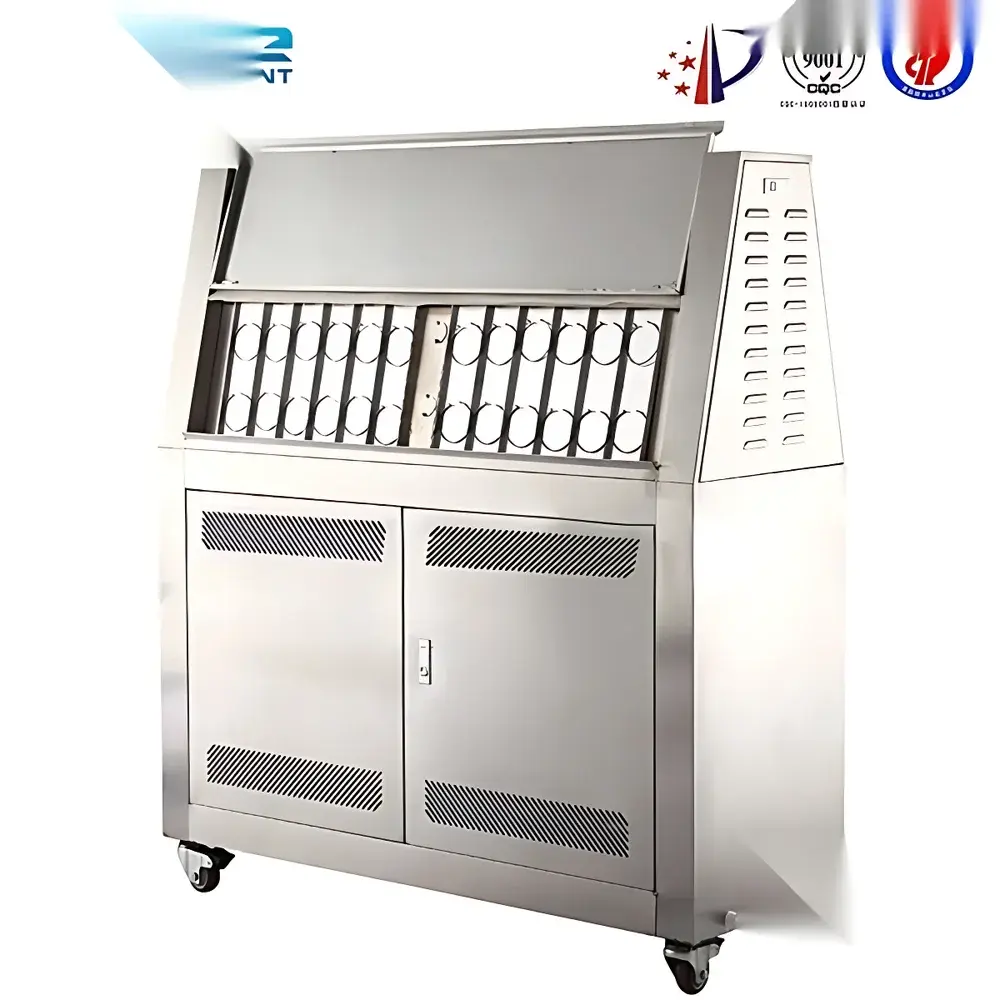
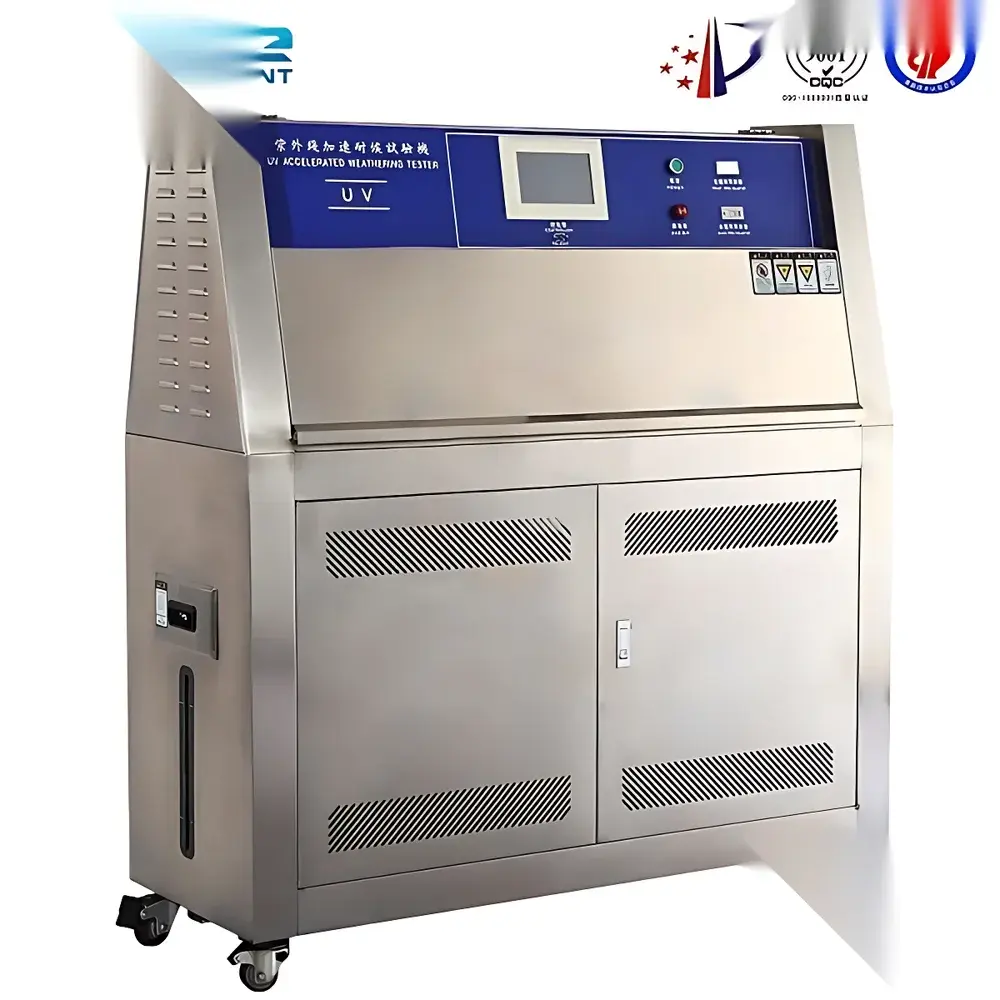
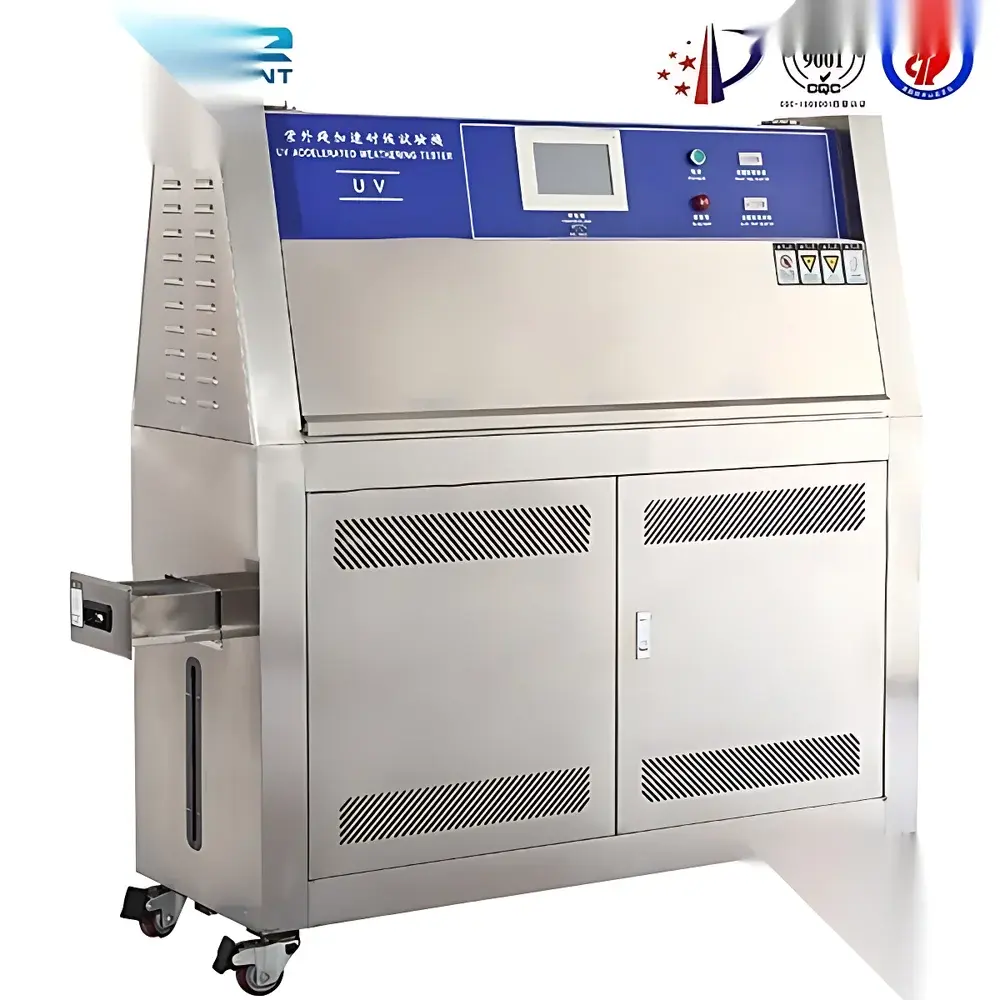
OK-UV-290 Fluorescent UV Accelerated Weathering Test Chamber
| Brand | OEM |
|---|---|
| Origin | Imported |
| Manufacturer Type | Authorized Distributor |
| Price | USD 3,150 (FOB) |
| Internal Dimensions (W×H×D) | 114 × 40 × 40 cm |
| External Dimensions (W×H×D) | 135 × 140 × 65 cm |
| Temperature Range | Ambient to 70 °C |
| Humidity Range | ≥95% RH |
| Temperature Control Accuracy | ≤±0.5 °C |
| Temperature Uniformity | ≤±2 °C (chamber) / ≤±3% (humidity) |
| UV Lamp Type | Fluorescent UV-B/UV-A tubes (e.g., UVA-340 or UVB-313 equivalent) |
| Spectral Range | 280–400 nm |
| Exposure Time | 0–999 h programmable |
| Chamber Material | Interior & exterior SUS#304 stainless steel |
| Heating System | U-shaped titanium alloy high-speed heating elements |
| Safety Features | Interlocked door cut-off for UV lamps, over-temperature protection, low-water level cutoff |
| Power Supply | AC 220 V ±5%, 50 Hz |
Overview
The OK-UV-290 Fluorescent UV Accelerated Weathering Test Chamber is an engineered solution for simulating the photochemical and hygrothermal degradation mechanisms induced by natural outdoor exposure—primarily solar ultraviolet radiation, moisture condensation, and thermal cycling. Based on the fundamental principles of accelerated photodegradation testing, this chamber employs fluorescent UV lamps emitting within the critical 280–400 nm spectral band (including UV-A and UV-B regions) to replicate the most damaging portion of terrestrial sunlight. Simultaneously, a controlled condensation cycle—achieved via saturated humidity at elevated temperatures—mimics dew formation, while optional water spray functionality (if equipped per configuration) reproduces rain-induced erosion and thermal shock. Unlike xenon arc or carbon arc systems, fluorescent UV chambers offer superior repeatability and lower operational cost for screening-level polymer stability assessment, particularly where UV-driven oxidation, chain scission, and surface embrittlement are dominant failure modes.
Key Features
- Programmable exposure cycles combining UV irradiation (up to 70 °C) with 100% RH dark condensation phases—aligned with ASTM G154 and ISO 4892-3 protocols
- High-stability SUS#304 stainless steel construction (interior and exterior) ensuring corrosion resistance and long-term dimensional integrity under cyclic humidity
- Precision temperature control system with ≤±0.5 °C accuracy and uniformity maintained within ±2 °C across the test volume
- Dual-safety interlock: automatic UV lamp de-energization upon door opening, plus redundant over-temperature and low-water-level cutoffs
- U-shaped titanium alloy heating elements enabling rapid thermal response and stable plateau maintenance during irradiation
- Modular UV lamp array with standardized G13 base sockets; compatible with industry-standard UVA-340 (sunlight simulation) or UVB-313 (accelerated degradation) fluorescent tubes (rated life ≈2000 h)
Sample Compatibility & Compliance
The OK-UV-290 accommodates flat-panel specimens up to 114 cm wide, with vertical mounting fixtures supporting standard 75 × 150 mm or custom-sized coupons. Its design conforms to the mechanical and environmental requirements of multiple international standards, including ASTM G154 (fluorescent UV exposure), ASTM D4329 (plastic durability), ASTM D4587 (coating weathering), ISO 4892-3 (methods for plastics), SAE J2020 (automotive exterior materials), and ASTM D4799 (wood coatings). While not inherently compliant with FDA 21 CFR Part 11 or GLP audit trails (as it lacks electronic signature and full audit-log architecture), its analog/digital hybrid controller supports manual calibration verification and traceable test logs—suitable for internal R&D, QC release testing, and supplier qualification in non-regulated environments.
Software & Data Management
This model features a microprocessor-based digital controller with LED display, offering intuitive programming of multi-step test sequences (e.g., 4 h UV @ 60 °C → 4 h condensation @ 50 °C). Real-time monitoring of chamber temperature and UV exposure duration is provided; however, no built-in data logging, USB export, or PC connectivity is included in the base configuration. Users may manually record cycle parameters and elapsed time using external calibrated thermometers and timers. For laboratories requiring automated documentation, third-party data acquisition modules (e.g., RS-485-to-USB adapters with Modbus RTU support) can be integrated with validated LabVIEW or Python-based logging scripts—enabling compliance with internal SOPs for instrument qualification (IQ/OQ) and routine performance verification.
Applications
- Formulation development and comparative ranking of UV stabilizers, HALS, and antioxidant packages in polyolefins, PVC, and engineering thermoplastics
- Coating performance validation for automotive clearcoats, architectural paints, and industrial powder coatings per OEM specifications
- Adhesion and gloss retention assessment of laminated composites and printed flexible packaging substrates
- Accelerated evaluation of weathering resistance in wood-plastic composites (WPC), sealants, and elastomeric roofing membranes
- Pre-screening of cosmetic packaging materials (e.g., PET, PP) for photolytic degradation of active ingredients under shelf-life conditions
- Corrosion inhibitor efficacy testing on pre-treated metal substrates exposed to UV/humidity synergistic stress
FAQ
What UV lamp types are supported, and how often must they be replaced?
The chamber accepts standard T8 or T12 fluorescent UV tubes (G13 base) compliant with ASTM G154 Class I or II spectral output—commonly UVA-340 (peak 340 nm, solar-simulating) or UVB-313 (peak 313 nm, highly aggressive). Lamp replacement is recommended every 2000 hours of cumulative operation or after 12 months, whichever occurs first, due to spectral output decay.
Does the OK-UV-290 meet ISO 17025 calibration requirements?
As supplied, the unit includes factory calibration certificates for temperature sensors but does not provide NIST-traceable UV irradiance calibration. For ISO/IEC 17025-compliant labs, users must implement periodic verification using a calibrated UV radiometer (e.g., Eppley TUVR or Gigahertz-Optik X1) and document uncertainty budgets per ILAC-G8.
Can humidity be controlled independently of temperature during UV exposure?
No. Humidity is generated exclusively via condensation—i.e., by maintaining saturated air at elevated temperature. Relative humidity is not actively regulated during UV phases; it rises passively as temperature increases, reaching ≥95% RH only during the designated dark condensation segment.
Is water spray functionality standard or optional?
Water spray is not included in the base OK-UV-290 configuration. It may be added as a factory-installed option (requiring separate plumbing and pressure regulation), subject to additional lead time and validation per ASTM D5238 or ISO 4892-2 Annex B.
What maintenance intervals are recommended for long-term reliability?
Monthly visual inspection of lamp sockets and quartz covers; quarterly cleaning of condensate trays and drain lines; biannual verification of temperature sensor drift using a calibrated reference thermometer; annual inspection of gasket integrity and electrical grounding continuity.



