
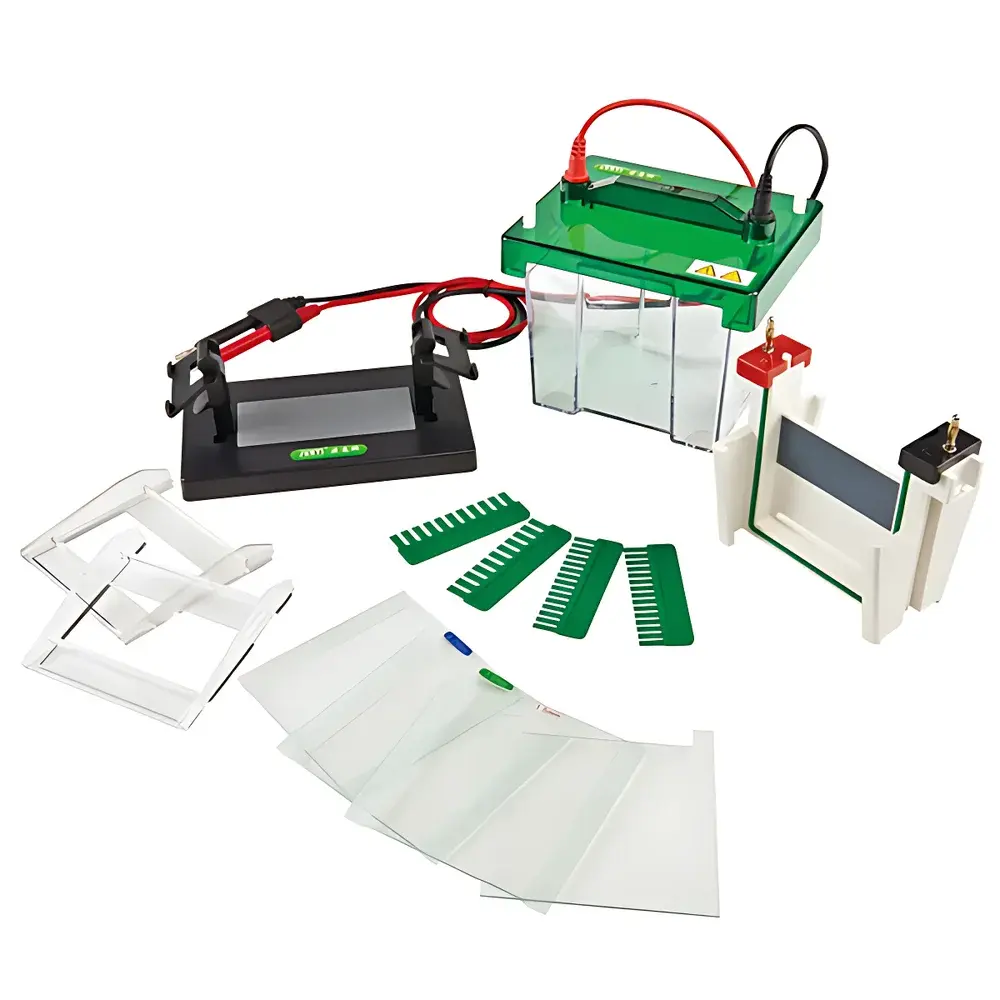
Junyi JY-SCZ2+ Vertical Protein Electrophoresis Tank
| Brand | Junyi |
|---|---|
| Origin | Beijing, China |
| Model | JY-SCZ2+ |
| Instrument Type | Protein Electrophoresis Apparatus |
| Gel Dimensions (W×L) | 82×88 mm |
| Gel Thickness Options | 0.75, 1.0, 1.5 mm |
| Number of Gels | 1–2 |
| Sample Capacity | 30 wells (11- or 15-well combs per gel) |
| Buffer Volume | ~750 mL |
| External Dimensions (L×W×H) | 150×120×115 mm |
| Net Weight | 1.5 kg |
| Material | Injection-molded polycarbonate |
| Safety Feature | Lid-actuated power cutoff |
Overview
The Junyi JY-SCZ2+ Vertical Protein Electrophoresis Tank is a precision-engineered, benchtop electrophoresis system designed for reliable SDS-PAGE and native PAGE separation of proteins and nucleic acids. Based on the fundamental principle of electrophoretic mobility—where charged biomolecules migrate through a polyacrylamide matrix under an applied electric field—the JY-SCZ2+ provides consistent resolution and reproducible band patterns across repeated runs. Its vertical configuration enables high-resolution separation of proteins in the range of 3–250 kDa, supporting both analytical and preparative workflows in academic research laboratories, quality control environments, and core facility settings. The unit operates without integrated power supply (requires external DC power source), allowing users to pair it with programmable electrophoresis power supplies meeting IEC 61010-1 safety standards.
Key Features
- Tool-free glass plate assembly: Secures two glass plates in ≤15 seconds using an integrated clamping mechanism—eliminating manual alignment and reducing risk of air bubble entrapment.
- Integrated in-situ gel casting system: Enables direct polymerization within the assembled chamber, removing the need for sealing tapes or adhesive spacers and preventing gel distortion during transfer from casting tray to electrophoresis unit.
- Optically transparent polycarbonate housing: Molded in a single injection cycle for structural integrity, chemical resistance to common electrophoresis buffers (e.g., Tris-Glycine, Tris-Tricine), thermal stability up to 60°C, and mechanical resilience against accidental impact.
- Lid-activated safety interlock: Automatically interrupts electrical current when the upper lid is opened—complying with basic laboratory electrical safety protocols and minimizing operator exposure to live electrodes.
- Enhanced visual monitoring: Dual-side transparent panels and optional background color inserts (e.g., blue or white) improve contrast for accurate well loading and real-time observation of dye front migration.
- Thermally stable buffer reservoir: 750 mL capacity ensures adequate thermal mass to minimize Joule heating-induced pH drift and maintain electrophoretic mobility consistency over extended runs (up to 90 min at 200 V).
Sample Compatibility & Compliance
The JY-SCZ2+ accommodates standard mini-gel formats compatible with widely adopted molecular weight markers and commercial precast gels. It supports variable gel thicknesses (0.75 mm, 1.0 mm, and 1.5 mm) and comb configurations (11- and 15-well), enabling optimization for sensitivity (thicker gels) or resolution (thinner gels). While the unit itself does not carry CE marking or FDA 510(k) clearance as a standalone device, its design aligns with general laboratory equipment safety expectations under ISO/IEC 17025-accredited environments. When used in conjunction with validated power supplies and reagents, the system supports compliance with GLP documentation requirements for protein purity assessment (e.g., USP , ICH Q5E) and nucleic acid fragment analysis (e.g., ISO 20387:2018 for biobanking applications).
Software & Data Management
As a hardware-only electrophoresis tank, the JY-SCZ2+ does not incorporate embedded firmware or proprietary software. All data acquisition—including image capture, band quantification, and molecular weight calibration—is performed externally using third-party gel documentation systems (e.g., Bio-Rad ChemiDoc, Azure Biosystems Sapphire, or open-source tools such as ImageJ/Fiji). Users are advised to implement version-controlled SOPs and audit-trail-enabled imaging workflows to satisfy 21 CFR Part 11 requirements where electronic records are maintained. The modular physical design allows seamless integration into automated gel-handling platforms via standardized mounting interfaces.
Applications
- SDS-PAGE for protein purity verification in recombinant expression workflows.
- Western blot sample preparation with consistent transfer efficiency due to uniform gel thickness and flatness.
- Native PAGE analysis of multi-subunit complexes and enzyme activity gels (zymograms).
- Preparative electrophoresis for excision and extraction of target protein bands.
- Agarose–polyacrylamide composite gels for high-resolution nucleic acid fragment separation (e.g., miRNA profiling).
- Teaching laboratory use: Robust construction and intuitive operation support hands-on instruction in molecular biology techniques.
FAQ
Does the JY-SCZ2+ include a power supply?
No. It is a passive electrophoresis tank requiring connection to an external DC power supply capable of delivering up to 300 V and 500 mA.
Can I use precast gels with this unit?
Yes—standard 82×88 mm mini-gels from major suppliers (e.g., Bio-Rad, Thermo Fisher, Lonza) fit without modification.
What buffer systems are compatible?
Tris-Glycine, Tris-Tricine, Bis-Tris MES, and low-pH urea-based systems have been validated; avoid strong oxidizers or organic solvents exceeding 15% v/v.
Is the unit suitable for radioactive or hazardous sample work?
Yes—the polycarbonate body resists common decontamination agents (e.g., 10% bleach, 70% ethanol); however, full containment requires secondary shielding and institutional radiation safety approval.
How often should the glass plates be replaced?
With proper cleaning (using non-abrasive detergents and lint-free wipes), borosilicate glass plates typically last >200 runs before optical degradation affects visualization.
Related Products




