
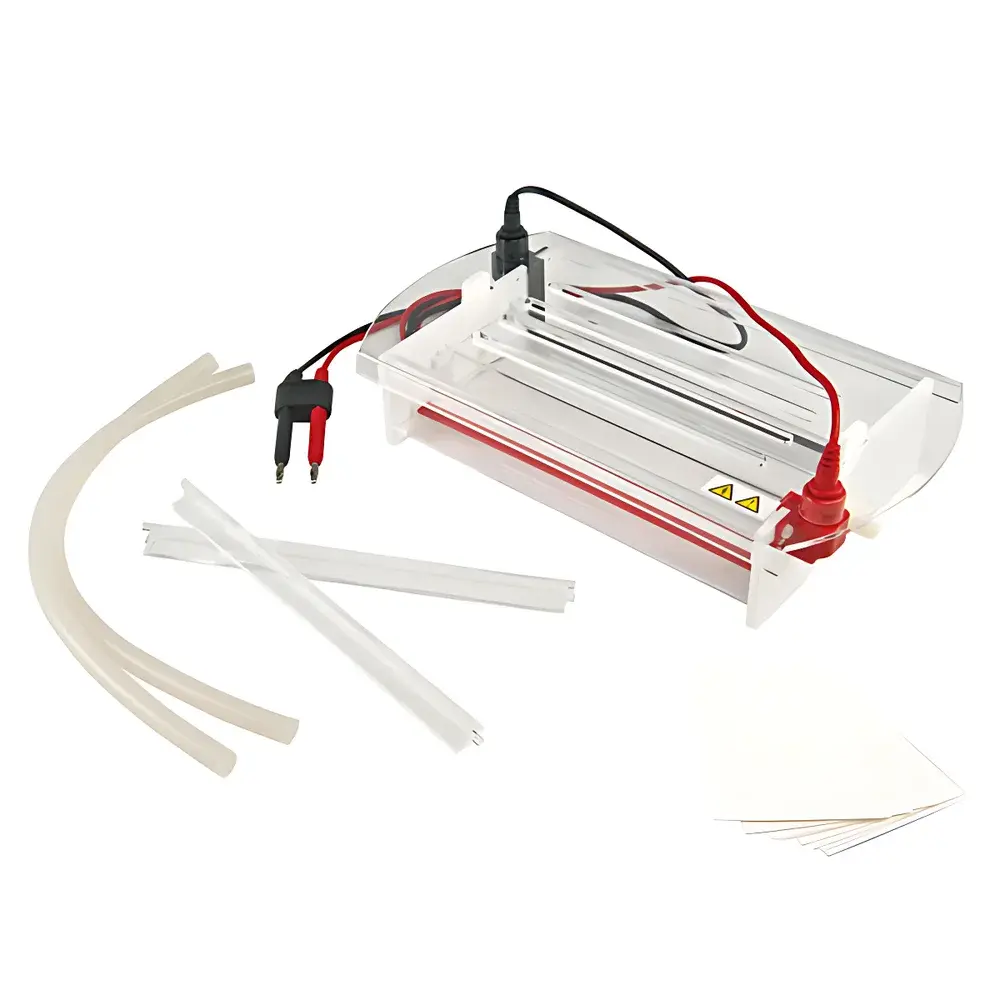
Junyi JY-SP7A Cellulose Acetate Membrane Electrophoresis Tank
| Brand | Junyi |
|---|---|
| Origin | Beijing, China |
| Manufacturer Type | Authorized Distributor |
| Product Category | Domestic |
| Model | JY-SP7A |
| Instrument Type | Transfer Electrophoresis Apparatus |
| Primary Component | Electrophoresis Tank |
| Gel Dimensions | 66 × 250 mm |
| Sample Capacity | 14 samples |
| Buffer Volume | ~560 mL |
| External Dimensions | 318 × 175 × 65 mm |
| Net Weight | 1.0 kg |
| Design | Single-bridge configuration with integrated cooling system |
| Safety Features | Automatic power cutoff upon lid opening, removable electrode assembly, adjustable bridge rod for variable migration distance |
Overview
The Junyi JY-SP7A Cellulose Acetate Membrane Electrophoresis Tank is a compact, purpose-engineered apparatus designed specifically for high-reproducibility electrophoretic separations on cellulose acetate membranes, filter paper, and microscope slides. It operates on the principle of zone electrophoresis under direct current (DC) electric fields, where charged biomolecules—such as serum proteins, hemoglobin variants, or isoenzymes—migrate at differential velocities through a hydrated cellulose acetate matrix based on their net charge-to-mass ratio and molecular conformation. Unlike horizontal slab-gel systems requiring polymerized matrices, the JY-SP7A supports rapid, low-cost, and single-use membrane-based assays widely adopted in clinical diagnostics laboratories for qualitative and semi-quantitative analysis. Its single-bridge architecture ensures uniform field distribution across the entire support medium, minimizing edge effects and band distortion. The unit is not intended for SDS-PAGE or native PAGE in polyacrylamide gels; rather, it fulfills standardized protocols aligned with CLSI EP28-A3c and ICSH guidelines for serum protein electrophoresis.
Key Features
- Single-bridge electrophoresis design optimized for cellulose acetate membranes (66 × 250 mm standard format), with optional dual-bridge compatibility (82 × 250 mm) via interchangeable components;
- Integrated passive cooling system that maintains buffer temperature stability within ±2 °C during extended runs (up to 90 min at 200–300 V), mitigating Joule heating-induced band smearing;
- Adjustable bridge rod mechanism enabling precise control over electrophoretic migration distance—from 4 cm to 12 cm—supporting method flexibility across assay types (e.g., HbA1c screening vs. immunofixation pre-electrophoresis);
- Fail-safe lid interlock: electrical circuit is automatically de-energized upon lid actuation, complying with IEC 61010-1 safety requirements for laboratory electrical equipment;
- Modular electrode assembly with gold-plated stainless-steel terminals and tool-free removal, facilitating routine cleaning, calibration verification, and replacement without disassembly of the main tank body;
- Low-profile footprint (318 × 175 × 65 mm) and lightweight construction (1.0 kg net weight) enable seamless integration into laminar flow hoods, biosafety cabinets, or shared benchtop workspaces.
Sample Compatibility & Compliance
The JY-SP7A accommodates standard commercial cellulose acetate membranes (e.g., Helena Laboratories, SPI Supplies), chromatography paper (Whatman 3MM, Schleicher & Schuell 2043), and glass or plastic microscope slides (75 × 25 mm). It supports up to 14 parallel sample lanes with consistent loading geometry and minimal cross-contamination risk due to physical channel separation. All wetted components are constructed from chemically resistant ABS and polycarbonate polymers, compatible with common electrophoresis buffers including barbital (pH 8.6), Veronal-acetate, and Tris-glycine systems. The device conforms to ISO 13485:2016 quality management principles for in vitro diagnostic support equipment and meets essential safety requirements per GB 4793.1–2019 (Chinese national adoption of IEC 61010-1).
Software & Data Management
As a standalone analog electrophoresis tank, the JY-SP7A does not incorporate embedded microcontrollers or digital interfaces. Voltage and current parameters are supplied externally via certified DC power supplies (e.g., Junyi JY200C or equivalent), which must comply with EN 61326-1 for electromagnetic compatibility in laboratory environments. Post-electrophoresis densitometric analysis is performed using external imaging systems (e.g., UVP BioSpectrum or Vilber Fusion Solo) calibrated per ISO/IEC 17025:2017. Audit trails for run conditions—including applied voltage, duration, ambient temperature, and operator ID—are maintained manually in laboratory notebooks or electronic lab notebooks (ELNs) compliant with FDA 21 CFR Part 11 when used in regulated clinical settings.
Applications
- Clinical serum protein electrophoresis (SPEP) for detection of monoclonal gammopathies, liver disease patterns, and acute-phase response profiles;
- Hemoglobin variant analysis (HbA, HbS, HbC, HbF) in sickle cell disease and thalassemia screening programs;
- Urinary protein electrophoresis (UPEP) for Bence-Jones protein identification;
- Enzyme isoform separation (e.g., LDH, CK, ALP) in tissue-specific diagnostics;
- Quality control testing of purified antibodies and recombinant proteins during upstream bioprocessing;
- Educational demonstrations of electrophoretic mobility, buffer ion dynamics, and electroosmotic flow in undergraduate biochemistry laboratories.
FAQ
Is the JY-SP7A compatible with polyacrylamide or agarose gels?
No. This unit is mechanically and thermally optimized exclusively for thin, non-polymerized supports such as cellulose acetate membranes, filter paper, and glass slides. It lacks gel-casting frames, comb holders, or cooling plates required for slab-gel electrophoresis.
What power supply specifications are recommended?
A constant-voltage DC supply rated for 100–400 V output and ≥10 mA current capacity is required. Output ripple must be ≤1% to ensure stable field strength. Units with programmable ramping and timer functions are preferred for method standardization.
Can the tank be sterilized or autoclaved?
No. Polycarbonate and ABS components are not autoclave-rated. Cleaning is performed with 70% ethanol followed by deionized water rinse and air drying. Avoid chlorinated solvents or strong oxidizers.
Does the JY-SP7A meet GLP or GMP documentation requirements?
The hardware itself is not validated as a computerized system. However, when operated within documented SOPs—including daily visual inspection, electrode resistance verification, and buffer pH monitoring—it supports GLP-compliant workflows under laboratory quality assurance oversight.



