
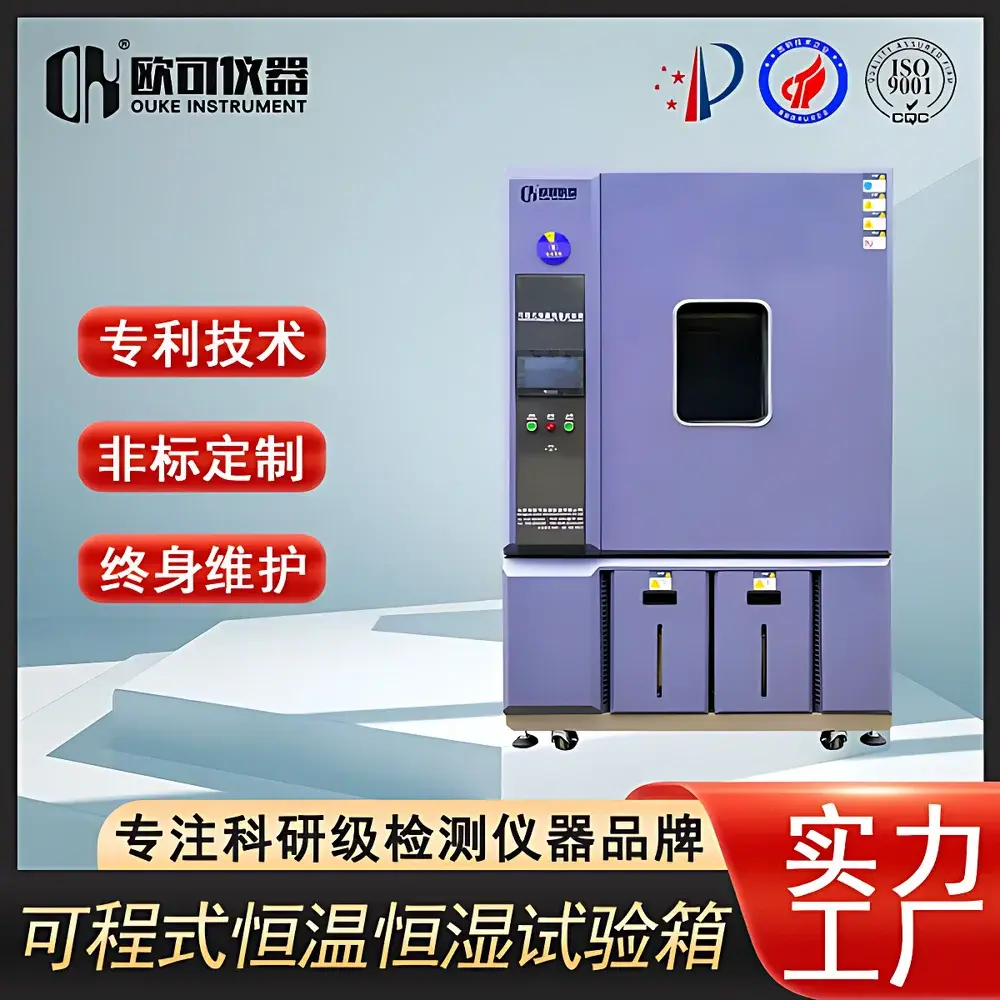
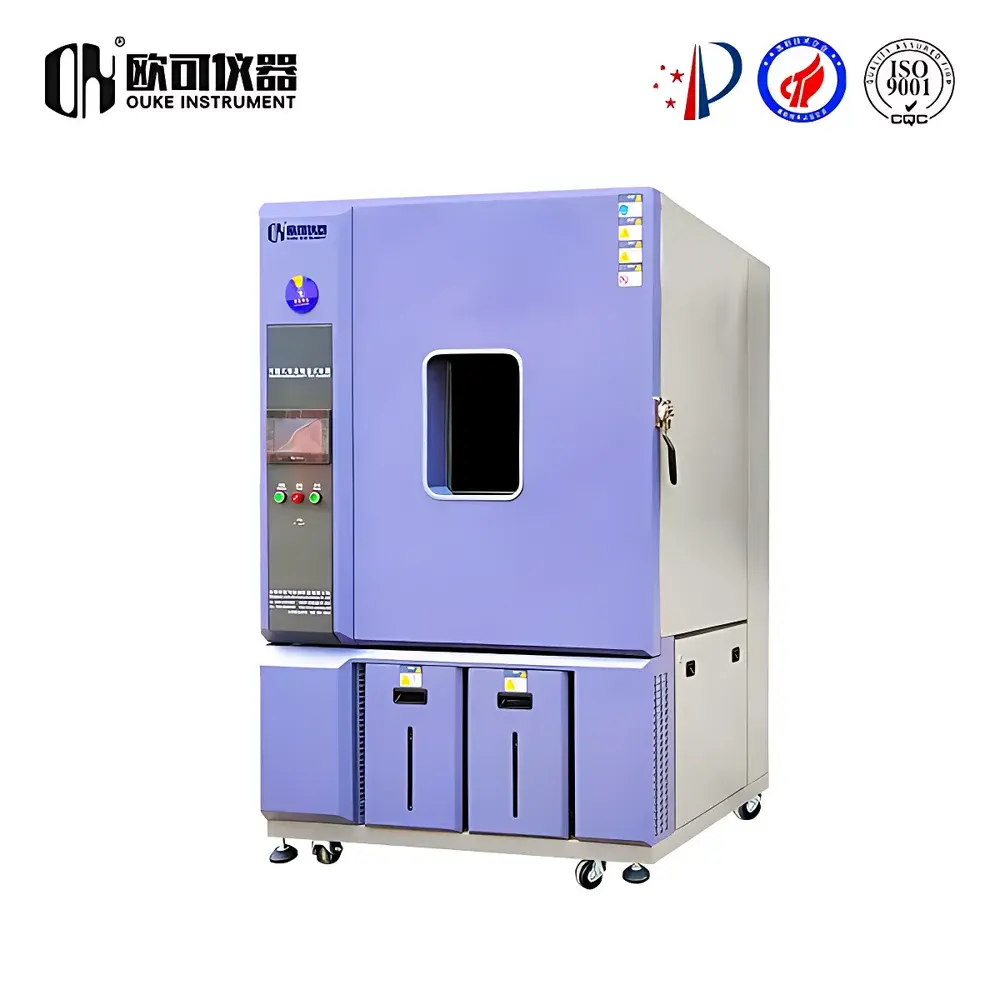
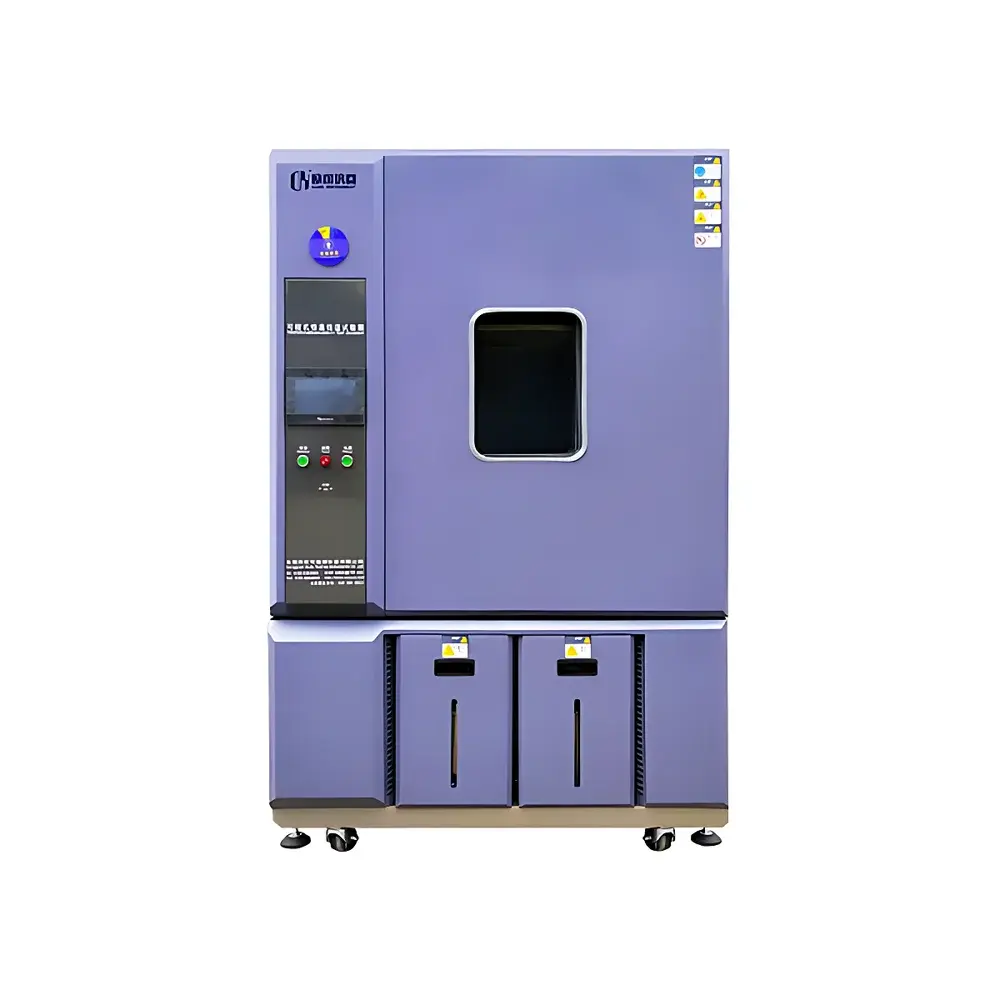
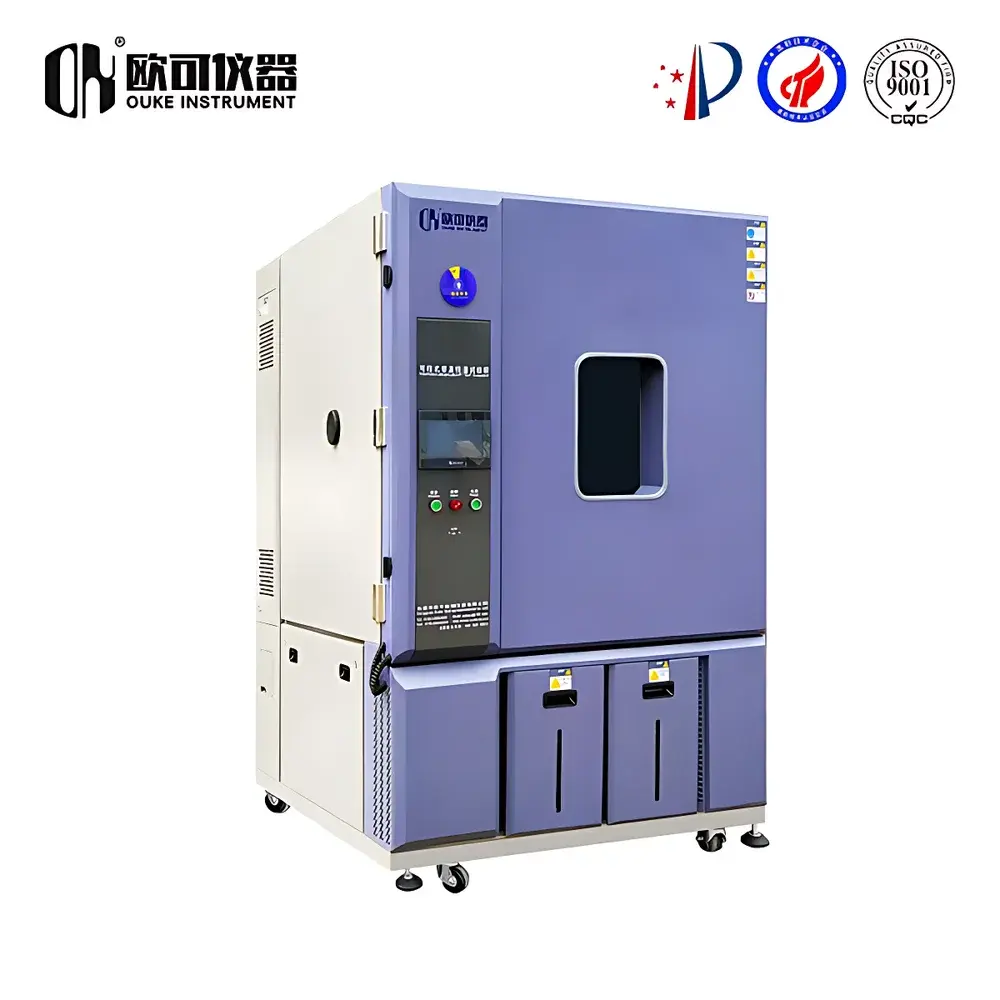
OK OK-TH-800.0 Programmable Temperature and Humidity Controlled Chamber
| Brand | OK |
|---|---|
| Origin | Guangdong, China |
| Manufacturer Type | Direct Manufacturer |
| Product Category | Domestic |
| Model | OK-TH-800.0 |
| Instrument Type | Benchtop |
| Condensation Method | Air-Cooled |
| Temperature Range | -40 °C to +150 °C |
| Humidity Range | 20–98 % RH |
| Temperature Deviation | ≤ ±2 °C |
| Temperature Uniformity | ±1 °C (High Temp), ±2 °C (Low Temp) |
| Humidity Deviation | ≤ ±3 % RH |
| Humidity Uniformity | ±3 % RH |
| Heating Rate | 1.0–3.0 °C/min |
| Internal Chamber Dimensions | 1000 × 1000 × 800 mm (W × D × H) |
Overview
The OK OK-TH-800.0 Programmable Temperature and Humidity Controlled Chamber is an engineered environmental test system designed for precise, repeatable simulation of climatic conditions across defined temperature and relative humidity (RH) profiles. It operates on a dual-loop control architecture: independent thermal regulation via resistive heating elements and refrigerant-based cooling circuits, coupled with humidity control through integrated water reservoir evaporation and condensate dehumidification. The chamber maintains stable setpoints by continuously monitoring real-time feedback from high-stability platinum resistance thermometers (PT100) and capacitive RH sensors, enabling closed-loop PID adjustment of actuator outputs—including expansion valve modulation, heater duty cycling, and ultrasonic humidifier activation. Its benchtop configuration delivers laboratory-grade environmental conditioning without requiring floor-standing infrastructure, making it suitable for QC labs, R&D facilities, and small-batch validation workflows where spatial constraints and operational flexibility are critical.
Key Features
- Robust dual-wall construction: Outer casing in brushed stainless steel (SUS304); interior chamber lined with mirror-finish SUS304 for corrosion resistance and ease of decontamination.
- High-efficiency thermal insulation: 100 mm thick composite layer comprising rigid polyurethane (PU) foam and high-density glass fiber cotton—minimizing thermal bridging and reducing energy consumption during extended dwell cycles.
- Uniform air distribution system: Long-life, high-torque axial fan with stainless steel multi-blade impeller ensures vertical laminar airflow and <±2 °C temperature uniformity across the full working volume (1000 × 1000 × 800 mm).
- Dual-seal door design: Dual-layer high-tension silicone gasket with compression locking mechanism achieves leak-tight integrity under dynamic RH cycling, preventing moisture ingress or vapor loss during low-humidity holds.
- Multi-layer observation window: Triple-glazed tempered safety glass with embedded conductive ITO film prevents fogging and enables unobstructed visual monitoring without compromising thermal or humidity stability.
- Comprehensive safety architecture: Over-temperature cutoff, compressor high-pressure shutdown, dry-run protection for humidifier, and real-time fault logging with audible/visual alarms per IEC 61000-4 EMC standards.
Sample Compatibility & Compliance
The OK-TH-800.0 accommodates a broad range of sample types—including PCB assemblies, polymer films, lithium-ion battery cells, coated metal substrates, and pharmaceutical packaging—without risk of cross-contamination or dimensional distortion. Its internal geometry supports standard ISO 17025-compliant calibration protocols using traceable NIST-certified reference sensors. The system meets essential requirements for environmental stress screening (ESS) per MIL-STD-810H Method 502.7 (Temperature), Method 507.6 (Humidity), and JEDEC JESD22-A101 (Steady-State Moisture Resistance). While not certified for regulatory submission out-of-the-box, its controller logs all setpoint changes, sensor readings, and alarm events with timestamping—enabling full audit trail reconstruction required for GLP/GMP-aligned validation (e.g., IQ/OQ/PQ documentation per ASTM E2500-13).
Software & Data Management
Equipped with an imported LCD touchscreen controller supporting both English and Chinese UI, the system provides intuitive programming of up to 120 segment cycles—including ramp-soak-step sequences, repeating loops, and conditional branching based on elapsed time or sensor thresholds. All operational data—including chamber temperature, RH, setpoint history, and event logs—are stored internally for ≥30 days and exportable via USB 2.0 to CSV format. Optional Ethernet interface enables integration into centralized lab management systems (LIMS) and supports Modbus TCP communication for remote monitoring. For regulated environments, optional firmware upgrade adds 21 CFR Part 11-compliant user authentication, electronic signatures, and immutable audit trails—fully compatible with FDA-mandated data integrity principles.
Applications
This chamber serves as a core tool for accelerated aging studies (ASTM D3045), thermal shock preconditioning prior to mechanical testing (ISO 11357-1), moisture absorption kinetics analysis (ISO 62), and reliability qualification of electronics under combined thermal-humidity stress (JEDEC J-STD-020). It is routinely deployed in automotive component validation (SAE J2233), aerospace material screening (AMS 2750E Annex C), and quality assurance of medical device packaging (ISO 11607-1). Its programmability supports complex profiles such as cyclic dew point tracking, humidity ramping at fixed temperature, or simultaneous gradient testing across multiple zones when used with external sensor arrays.
FAQ
What is the maximum allowable load mass inside the chamber without compromising performance?
The chamber is rated for static loads up to 50 kg distributed evenly on the standard stainless steel shelf; exceeding this may affect airflow uniformity and extend stabilization time.
Can the unit operate continuously at 150 °C and 20 % RH simultaneously?
Yes—its air-cooled refrigeration system and optimized heat exchanger design permit concurrent operation across the full specified range, including extreme low-RH/high-T combinations.
Is third-party calibration certification included with delivery?
Factory calibration is performed using traceable standards; formal ISO/IEC 17025 calibration certificates are available upon request at additional cost.
Does the controller support data export in real time during test execution?
Yes—via USB or optional Ethernet, live sensor values and control parameters can be streamed at user-defined intervals (1–60 s) directly to external PCs or SCADA platforms.
What maintenance intervals are recommended for optimal long-term accuracy?
Sensor verification every 6 months; refrigerant pressure check annually; humidifier reservoir cleaning after every 200 operational hours or weekly in high-use labs.



