
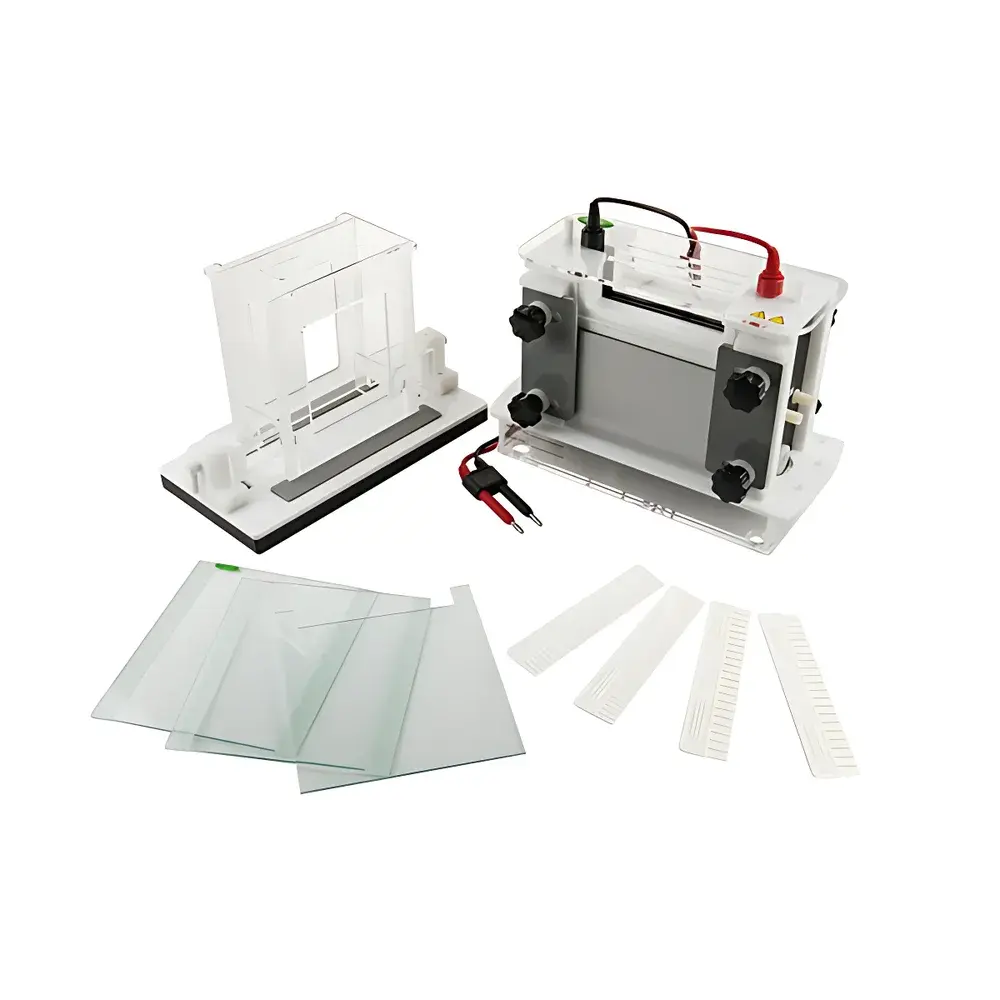
Junyi JY-SCZ9 Vertical Electrophoresis Tank
| Brand | Junyi |
|---|---|
| Origin | Beijing, China |
| Model | JY-SCZ9 |
| Instrument Type | Isoelectric Focusing (IEF) Electrophoresis System |
| Gel Dimensions (W×L) | 121 × 150 mm |
| Gel Thickness Options | 1.0 mm and 1.5 mm |
| Gel Capacity | 1–2 gels |
| Sample Capacity | 52 wells (16- or 23-well combs per gel, compatible with both thicknesses) |
| Buffer Volume | ~1200 mL |
| External Dimensions (L×W×H) | 296 × 130 × 200 mm |
| Net Weight | 6.6 kg |
| Heat Dissipation | Anodized aluminum plate with thermal uniformity design |
| Safety | Lid-interrupt interlock circuit (automatically cuts power upon lid opening) |
| Gel Casting | Integrated in-situ casting system with dedicated gel caster stand |
| Electrode Assembly | Removable and serviceable electrode holder |
| Buffer Efficiency | >50% reduction vs. conventional vertical tanks |
Overview
The Junyi JY-SCZ9 Vertical Electrophoresis Tank is an engineered platform for high-fidelity isoelectric focusing (IEF) and standard SDS-PAGE applications in molecular biology and protein biochemistry laboratories. Designed around the principles of controlled electric field homogeneity and thermal stability, the system employs a precision-machined anodized aluminum heat sink to ensure uniform temperature distribution across the gel surface—critical for minimizing band distortion and improving reproducibility in IEF separations. Unlike horizontal or mini-vertical systems, the JY-SCZ9 supports full-size gels (121 × 150 mm), enabling higher sample throughput and improved resolution for complex protein mixtures. Its modular architecture allows seamless integration with external recirculating chillers (via standard 4-mm tubing ports), permitting operation at constant temperatures between 4 °C and 25 °C—a requirement for sensitive IEF protocols where pH gradient stability is thermally dependent.
Key Features
- Thermally optimized aluminum baseplate with passive conduction and optional active cooling compatibility for consistent electrophoretic mobility.
- Lid-mounted safety interlock that de-energizes the electrode circuit immediately upon lid lift—compliant with IEC 61010-1 electrical safety standards for laboratory equipment.
- In-situ gel casting system with precision-aligned comb guides and adjustable spacers (1.0 mm and 1.5 mm), eliminating gel transfer artifacts and supporting both hand-cast and pre-cast gel workflows.
- Modular electrode assembly with corrosion-resistant platinum-coated stainless steel electrodes and tool-free removal—designed for long-term reliability and simplified maintenance under GLP-compliant lab environments.
- Low-volume buffer chamber design (~1200 mL total capacity) reduces reagent consumption by over 50% compared to legacy vertical tanks without compromising electrophoretic performance or run stability.
- Edge-field suppression geometry minimizes lateral current dispersion, yielding sharp, vertically aligned bands with minimal smile or streaking—particularly critical for narrow-range IPG strips (pH 3–10, 3.5–5.5, etc.).
Sample Compatibility & Compliance
The JY-SCZ9 accommodates standard polyacrylamide and agarose-based gels used in IEF, native PAGE, and denaturing SDS-PAGE. It supports commercially available immobilized pH gradient (IPG) strips (7 cm, 11 cm, and 13 cm formats) as well as hand-poured gels using acrylamide/bis-acrylamide monomer solutions. The system is compatible with common electrophoresis buffers including Tris-Glycine, Tris-Tricine, and ampholyte-based IEF running buffers. While not certified to ISO/IEC 17025, its mechanical and electrical design adheres to foundational requirements of ISO 15195 (laboratory medicine — requirements for reference measurement laboratories) and supports audit-ready documentation when paired with validated power supplies and imaging systems. No CE or FDA 510(k) designation applies, as it is classified as a general-purpose laboratory apparatus under EU Directive 2014/30/EU (EMC) and 2014/35/EU (LVD).
Software & Data Management
As a hardware-only electrophoresis tank, the JY-SCZ9 does not include embedded firmware or proprietary software. It operates independently of digital control interfaces and is fully compatible with third-party power supplies (e.g., Bio-Rad PowerPac HC, C.B.S. Scientific EPS-200) that support programmable voltage, current, and power ramping. All operational parameters—including voltage, current, time, and power—are logged externally via connected power supply units compliant with FDA 21 CFR Part 11 (when equipped with audit-trail-enabled models). Users may integrate the system into LIMS or ELN platforms through standard RS-232 or USB-to-serial adapters on compatible power supplies, enabling traceable recordkeeping for GMP/GLP workflows.
Applications
- Isoelectric focusing of mammalian cell lysates, serum fractions, and recombinant proteins for pI profiling and charge heterogeneity analysis.
- Two-dimensional electrophoresis (2-DE) first-dimension IEF separation prior to second-dimension SDS-PAGE.
- High-resolution separation of histone isoforms, antibody variants, and post-translationally modified proteins.
- Preparative electrophoresis for downstream mass spectrometry sample enrichment, particularly when coupled with low-fluorescence staining (e.g., SYPRO Ruby) and excision robotics.
- Teaching laboratories requiring robust, safe, and repeatable vertical electrophoresis platforms for undergraduate biochemistry curricula.
FAQ
Does the JY-SCZ9 support dual-gel simultaneous runs?
Yes—the tank accommodates one or two gels side-by-side within the same buffer chamber, maintaining uniform field strength and thermal conditions across both matrices.
What comb configurations are supported for 1.0 mm and 1.5 mm gels?
Standard 16-well and 23-well combs are provided for both thicknesses; custom comb geometries can be accommodated via third-party machining to ISO 80000-10 dimensional tolerances.
Is the tank compatible with UV-transparent gel trays for direct in-chamber visualization?
No—the base tray is opaque aluminum; however, optional quartz or UV-grade acrylic gel trays (sold separately) can be retrofitted for in-tank UV transillumination at 254 nm or 302 nm.
Can the JY-SCZ9 be used for DNA sequencing gels?
It is not optimized for high-resolution DNA sequencing due to lack of integrated temperature control below 10 °C and absence of thin-gel (0.4 mm) support; however, it remains suitable for routine DNA fragment analysis up to 1 kb.
What maintenance procedures are recommended for long-term electrode integrity?
Electrodes should be rinsed with deionized water after each run and inspected quarterly for platinum coating wear; replacement electrodes are field-serviceable and require no recalibration.





