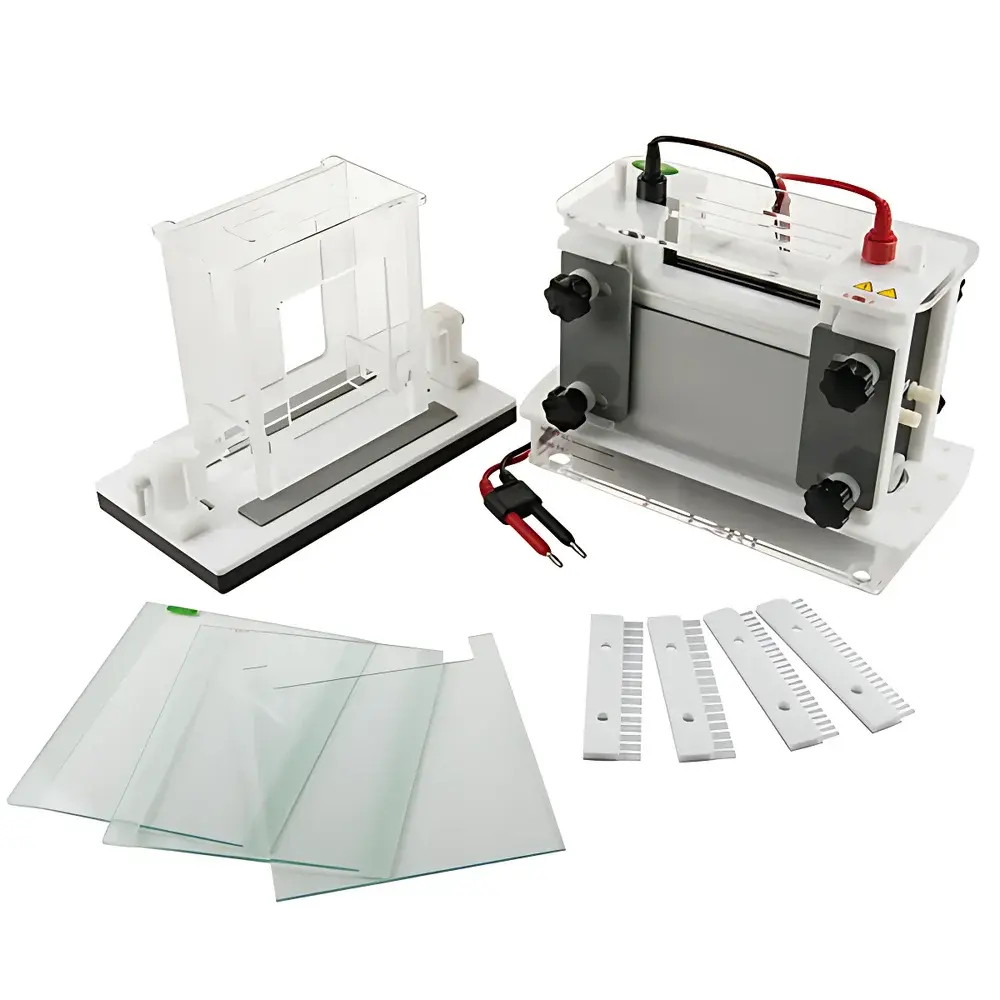
Junyi JY-SCZ8 Vertical Electrophoresis Tank
| Brand | Junyi |
|---|---|
| Origin | Beijing, China |
| Model | JY-SCZ8 |
| Instrument Type | Protein Electrophoresis Apparatus |
| Main Unit | Vertical Electrophoresis Tank |
| Gel Dimensions (W×L) | 174 × 195 mm |
| Gel Thickness Options | 1.0 mm and 1.5 mm |
| Number of Gels Supported | 1–2 |
| Sample Capacity | 21- or 35-well comb configurations per gel (at both thicknesses) |
| Buffer Volume | ~2200 mL |
| External Dimensions (L×W×H) | 320 × 140 × 260 mm |
| Net Weight | 13.4 kg |
| Thermal Management | Compatible with external recirculating chillers |
| Safety | Lid-actuated power cutoff, ergonomic release button |
| Gel Casting | Integrated in-situ casting system with dedicated gel casting stand |
| Electrode Assembly | Removable electrode holder |
| Edge Field Suppression | Optimized electrode geometry to eliminate fringe field distortion |
| Buffer Efficiency | >50% reduction in buffer consumption vs. conventional vertical tanks |
Overview
The Junyi JY-SCZ8 Vertical Electrophoresis Tank is an engineered platform for high-fidelity SDS-PAGE, native PAGE, and two-dimensional electrophoresis—specifically optimized for the second-dimension separation in 2D-PAGE workflows. Designed around the principles of uniform electric field distribution and thermal stability, the JY-SCZ8 employs a precision-machined aluminum heat-dissipating plate that ensures consistent temperature across the entire gel surface during prolonged runs. Its vertical configuration supports standard slab-gel formats with dimensions up to 174 mm (width) × 195 mm (length), accommodating both 1.0 mm and 1.5 mm thick gels. The system operates without integrated power supply—functioning strictly as a tank assembly compatible with external DC power sources rated for protein electrophoresis (typically 100–500 V, 50–500 mA). Its structural architecture eliminates parasitic edge fields through symmetrical electrode placement and insulating side barriers, resulting in sharp, vertically aligned electrophoretic bands with minimal lateral diffusion.
Key Features
- Aluminum heat-dissipation plate with uniform thermal conductivity—enables stable gel temperature during extended electrophoresis runs;
- External chiller port compatibility—supports integration with laboratory recirculating chillers (e.g., Julabo, Thermo Scientific) for precise temperature control between 4 °C and 25 °C;
- Lid-activated safety interlock—automatically interrupts electrical current upon lid opening, meeting IEC 61010-1 Class II requirements for operator protection;
- In-situ gel casting system—includes reusable glass plates, sealing gaskets, and comb holders enabling direct polymerization inside the assembled tank, eliminating post-casting handling and alignment errors;
- Dedicated gel casting stand—allows parallel preparation of gels while the electrophoresis unit remains operational, supporting high-throughput lab environments;
- Modular electrode assembly—stainless-steel electrodes mounted on detachable carriers simplify cleaning, replacement, and polarity reversal without tools;
- Low-volume buffer design—optimized chamber geometry reduces required running buffer to ~2200 mL, achieving >50% savings versus legacy vertical systems without compromising ion migration efficiency.
Sample Compatibility & Compliance
The JY-SCZ8 accommodates standard polyacrylamide gel formulations used in analytical and preparative protein electrophoresis—including Laemmli, Tris-Glycine, Bis-Tris, and Tris-Acetate systems. It supports both hand-cast and pre-cast gels when used with the optional casting stand. The unit complies with general laboratory safety standards under ISO/IEC 17025-accredited quality management frameworks. While not certified to specific regulatory mandates (e.g., FDA 21 CFR Part 11), its mechanical design and interlock functionality align with GLP/GMP-aligned lab practices for documented electrophoresis procedures. Buffer containment integrity meets ASTM D4169 performance criteria for leak-resistant liquid-handling apparatuses.
Software & Data Management
As a standalone electrophoresis tank, the JY-SCZ8 does not incorporate embedded firmware or digital interfaces. All operational parameters—including voltage, current, run time, and temperature—are controlled externally via compatible power supplies and chiller units. Data acquisition and image analysis are performed downstream using third-party imaging systems (e.g., Bio-Rad ChemiDoc, Azure Biosystems Sapphire) and software platforms such as ImageLab, AlphaView SA, or Fiji/ImageJ. Experimental metadata (gel dimensions, acrylamide concentration, sample loading volume) should be recorded manually or imported into LIMS-compatible templates for auditability.
Applications
- High-resolution denaturing protein separation (SDS-PAGE) for molecular weight estimation and purity assessment;
- Native PAGE analysis of protein complexes, enzymatic activity gels, and conformational studies;
- Second-dimension electrophoresis in two-dimensional gel electrophoresis (2D-PAGE), particularly following isoelectric focusing (IEF) on IPG strips;
- Preparative electrophoresis for protein extraction from excised gel bands prior to mass spectrometry;
- Quality control testing in biopharmaceutical manufacturing, including host-cell protein (HCP) profiling and product-related impurity detection.
FAQ
Does the JY-SCZ8 include a built-in power supply?
No—the JY-SCZ8 is a passive electrophoresis tank and requires an external DC power supply capable of delivering up to 500 V and 500 mA.
Can it be used for DNA electrophoresis?
While technically feasible, the JY-SCZ8 is optimized for protein applications; its large gel format and low-field geometry are less suited for routine nucleic acid separation compared to mini-vert or horizontal systems.
Is the tank compatible with commercially available precast gels?
Yes—when used with the optional gel casting stand, the JY-SCZ8 accepts standard 174 × 195 mm precast polyacrylamide gels with compatible thicknesses (1.0 mm or 1.5 mm).
What maintenance is required for long-term reliability?
Rinse all components with deionized water after each use; inspect gaskets for compression set annually; clean stainless-steel electrodes with 70% ethanol and verify continuity with a multimeter every six months.
How is traceability ensured in regulated environments?
Though hardware-based audit trails are absent, laboratories may implement procedural controls—such as standardized run logs, chiller calibration records, and power supply output verification—to satisfy internal QA/QC and ISO 13485 or GMP documentation requirements.