
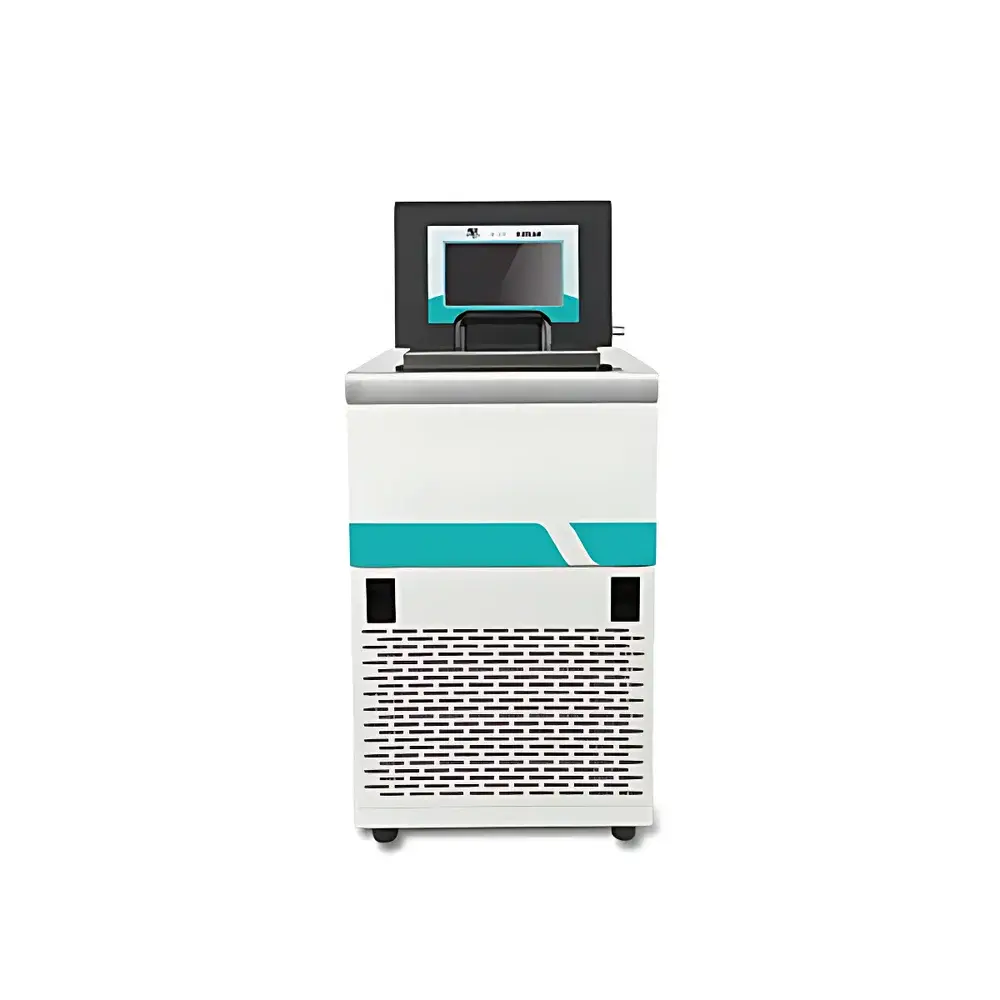
Scientz GDH-2008W High-Precision Low-Temperature Circulating Bath (Heating & Cooling)
| Brand | Scientz |
|---|---|
| Origin | Zhejiang, China |
| Manufacturer Type | Direct Manufacturer |
| Country of Origin | China |
| Model | GDH-2008W |
| Instrument Type | Circulating Temperature Bath |
| Circulation Mode | Internal & External |
| Temperature Control | Dual-mode (Heating & Refrigeration) |
| Bath Dimensions (L×W×H) | 280 × 250 × 140 mm |
| Temperature Range | −20 °C to +100 °C |
| Temperature Stability | ±0.005 °C to ±0.02 °C |
| Compressor | Hermetically Sealed Secop (Germany) |
| Refrigerant | R-134a (ODP = 0, GWP = 1430) |
| Control System | Microprocessor-based PID with Auto-Restart & Timer Function |
| Safety Protections | Compressor Overheat & Overload Protection |
| Pump Flow Rate | Adjustable, Max. 20 L/min |
Overview
The Scientz GDH-2008W is a high-precision, dual-mode circulating bath engineered for laboratory-grade thermal stability and long-term operational reliability. It operates on the principle of forced convection heat exchange within a sealed liquid medium—typically water or silicone oil—using a closed-loop circulation system to maintain uniform temperature distribution across both internal and external applications. The unit integrates a high-efficiency Secop (Germany) hermetic compressor, low-global-warming-potential R-134a refrigerant, and a microprocessor-controlled PID algorithm to achieve temperature stability as tight as ±0.005 °C under optimized conditions. Designed for use as either a self-contained thermal environment or an external temperature source for peripheral equipment (e.g., spectrophotometers, viscometers, or reaction blocks), the GDH-2008W meets the stringent thermal consistency requirements of calibration laboratories, QC/QA departments, and research facilities engaged in metrology, material characterization, and method validation.
Key Features
- Microprocessor-based PID temperature control with real-time digital display and user-configurable setpoint memory
- Dual circulation mode: switchable between internal bath circulation and external loop delivery via adjustable flow pump (0–20 L/min)
- Auto-restart function preserves user-defined parameters after power interruption—no manual reconfiguration required
- Programmable timer enables precise duration control; unit automatically terminates operation upon completion
- Low-noise refrigeration architecture featuring a fully enclosed Secop compressor and optimized thermal insulation
- Comprehensive safety system including compressor overheat protection, current overload cutoff, and dry-run prevention for external loops
- Environmentally compliant design using zero-ozone-depletion-potential (ODP = 0) R-134a refrigerant
Sample Compatibility & Compliance
The GDH-2008W accommodates a wide range of working fluids—including deionized water, ethylene glycol/water mixtures, and silicone oils—enabling operation across its full −20 °C to +100 °C range without fluid degradation or vapor lock. Its stainless-steel bath chamber (304 grade) resists corrosion from aqueous and mildly organic media. The unit complies with IEC 61010-1:2010 for electrical safety in laboratory equipment and conforms to ISO/IEC 17025:2017 requirements for temperature-controlled calibration environments when operated within specified stability limits. While not inherently 21 CFR Part 11 compliant, its logging-capable controller supports integration with validated third-party data acquisition systems for GLP/GMP-aligned workflows where audit trails and electronic signatures are mandated.
Software & Data Management
The GDH-2008W operates autonomously via its embedded microcontroller and does not require proprietary PC software for basic functionality. However, it features an RS-232 serial interface (optional RS-485 available) enabling remote parameter setting, real-time temperature monitoring, and event logging via industry-standard terminal emulators or custom SCADA integrations. When paired with compliant data acquisition platforms, the unit supports time-stamped temperature records with traceable timestamps, user ID tagging, and export in CSV format—facilitating alignment with ISO 17025 documentation protocols and internal quality management systems.
Applications
- Primary and secondary calibration of thermometers, RTDs, thermocouples, and infrared sensors per ASTM E74, ISO 17025 Annex C, and EURAMET cg-18 guidelines
- Thermal conditioning of optical components, laser diodes, and photodetectors requiring sub-0.01 °C drift control
- Temperature stabilization of analytical instruments such as HPLC column ovens, DSC sample holders, and rheometer Peltier stages
- Controlled-temperature reaction studies in synthetic chemistry and enzymology where kinetic reproducibility depends on thermal homogeneity
- Long-duration stability testing of electronic components under thermal stress per JEDEC JESD22-A104
- Reference bath for inter-laboratory comparison exercises in national metrology institutes and accredited calibration labs
FAQ
What is the minimum temperature achievable with water as the bath medium?
Water freezes at 0 °C under standard atmospheric pressure; therefore, sub-zero operation requires a water-glycol mixture or alternative fluid such as silicone oil. With 30% ethylene glycol, the bath reliably achieves −20 °C without freezing or viscosity-induced flow restriction.
Can the GDH-2008W be used for external temperature control of a jacketed reactor?
Yes—the external circulation mode delivers up to 20 L/min at adjustable pressure, compatible with most standard jacketed vessels (DN15–DN25 inlet/outlet ports). Ensure external loop volume and thermal mass are accounted for during ramp rate and stability optimization.
Is the temperature stability specification (±0.005 °C) guaranteed across the entire operating range?
That level of stability is empirically verified at setpoints near ambient (20–25 °C) under static internal circulation. At temperature extremes (e.g., −20 °C or +100 °C), stability is typically ±0.02 °C due to increased thermal gradients and compressor duty cycling.
Does the unit support protocol-driven operation for automated test sequences?
No built-in scripting capability exists; however, the RS-232 interface permits integration with programmable logic controllers (PLCs) or LabVIEW-based sequencers for multi-step thermal profiles.
What maintenance intervals are recommended for sustained accuracy?
Annual verification of temperature sensor linearity (using NIST-traceable reference probe) and biannual inspection of refrigerant charge integrity and pump seal integrity are advised per Scientz’s technical service bulletin TS-GDH-2008W-Rev.3.



