
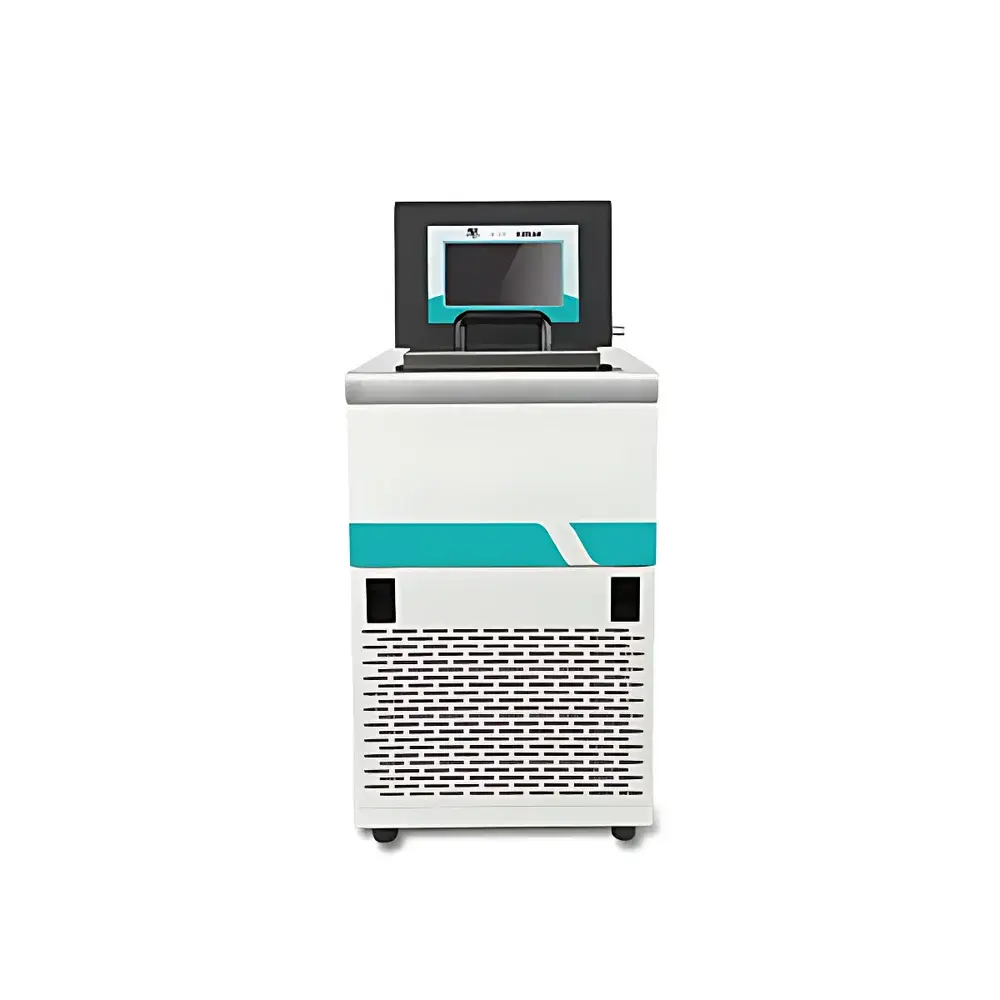
Scientz DC-2020 Low-Temperature Circulating Bath (Heating & Cooling)
| Brand | Scientz |
|---|---|
| Origin | Zhejiang, China |
| Manufacturer Type | Direct Manufacturer |
| Product Category | Domestic |
| Model | DC-2020 |
| Instrument Type | Constant-Temperature Bath |
| Circulation Mode | Internal & External Circulation |
| Temperature Control | Dual-mode (Heating & Refrigeration) |
| Bath Chamber Dimensions (W×D×H) | 300 × 250 × 260 mm |
| Temperature Range | −20 °C to +100 °C |
| Temperature Stability | ±0.05 °C |
| Display | 7-inch Tilted Touchscreen |
| Compressor | Secop (Germany) Hermetic Scroll Compressor |
| Refrigerant | R-134a (ODP = 0, GWP = 1430) |
| Safety Protections | Compressor Overheat & Overload Protection, Dry-run Protection, Overtemperature Alarm |
| Timer Function | Programmable Auto-Stop |
| Power-On Behavior | Configurable Auto-Start or Standby |
| Pump Flow Rate | Adjustable (0–20 L/min), Max Head: 8 m |
| Noise Level | ≤55 dB(A) at 1 m |
Overview
The Scientz DC-2020 Low-Temperature Circulating Bath is an engineered thermal management system designed for precise, stable, and reproducible temperature control across laboratory and industrial R&D environments. Operating on the principle of forced convection via a closed-loop liquid circulation system, it delivers both heating and refrigeration capabilities within a single compact unit. Its core thermodynamic architecture integrates a high-efficiency Secop hermetic scroll compressor, R-134a refrigerant (zero ozone depletion potential), and a PID-controlled dual-stage thermal regulation system—enabling seamless transition between sub-zero cooling and boiling-point heating without manual intervention. The bath chamber (300 × 250 × 260 mm) accommodates standard immersion applications while supporting external temperature control of auxiliary equipment—including rotary evaporator condensers, ultrasonic probe systems, jacketed reactors, and semiconductor test fixtures—via its dual-mode internal/external circulation interface. Engineered for long-term operational integrity, the DC-2020 meets fundamental requirements for GLP-compliant thermal validation workflows in analytical chemistry, materials science, and biopharmaceutical process development.
Key Features
- High-stability temperature control with ±0.05 °C uniformity across the bath volume and ±0.1 °C fluctuation tolerance—validated per ASTM E1137/E1137M for liquid-bath thermal performance.
- 7-inch angled capacitive touchscreen interface with real-time display of setpoint, actual temperature, elapsed time, pump status, and alarm history—designed for ergonomic operation and visibility from benchtop distance.
- Adjustable circulation pump (0–20 L/min flow rate, max head 8 m) supporting both internal recirculation and external load coupling; flow rate digitally calibrated and repeatable within ±2% full scale.
- Secop (Germany)-sourced hermetic compressor with integrated thermal overload and overcurrent protection, ensuring >20,000 hours MTBF under continuous duty cycles.
- Programmable timer function enabling autonomous run termination after user-defined duration; supports multi-step protocols when synchronized with external controllers.
- Configurable power-resume behavior: retains last-used parameters and allows user-defined default state (standby or auto-start) following grid interruption—critical for unattended overnight experiments.
- Acoustically optimized enclosure achieving ≤55 dB(A) noise emission at 1-meter distance—compliant with ISO 7779 and ANSI S1.13 standards for laboratory ambient noise limits.
Sample Compatibility & Compliance
The DC-2020 accommodates aqueous, ethylene glycol/water mixtures, silicone oils, and other non-corrosive heat-transfer fluids compatible with stainless-steel (SUS304) bath construction and fluoropolymer-sealed pump components. It supports ISO/IEC 17025-accredited calibration procedures for temperature uniformity mapping and stability verification. While not intrinsically rated for hazardous area use, its electrical design conforms to IEC 61010-1:2010 (Safety Requirements for Electrical Equipment for Measurement, Control, and Laboratory Use), including reinforced insulation, double-pole switching, and earth leakage current <0.75 mA. All firmware logic adheres to traceable version control, supporting audit-ready documentation for FDA 21 CFR Part 11–aligned environments where electronic records and signatures are required.
Software & Data Management
The DC-2020 operates autonomously via embedded microcontroller firmware with no dependency on PC software. All operational parameters—including setpoint, ramp rate, hold time, pump speed, and alarm thresholds—are stored in non-volatile memory with write-cycle endurance exceeding 100,000 cycles. Optional RS485 Modbus RTU interface enables integration into SCADA or LIMS platforms for centralized monitoring and event logging. Timestamped alarm records (e.g., “Overtemp Event – 2024-06-12 14:22:08”) are retained for up to 1,000 entries and exportable via USB flash drive in CSV format—supporting root-cause analysis and CAPA documentation per ISO 9001:2015 clause 10.2.
Applications
- Condenser temperature control for rotary evaporation systems requiring consistent vapor pressure management across solvent boiling points.
- Thermal stabilization of non-contact ultrasonic disruptors during cell lysis or nanoparticle dispersion to prevent acoustic cavitation-induced thermal runaway.
- Reaction calorimetry support for exothermic/endothermic synthesis monitoring under isothermal conditions (−20 to 100 °C).
- Biological sample incubation and preservation where narrow thermal excursions (<±0.1 °C) are critical for enzyme kinetics or protein folding studies.
- Calibration of platinum resistance thermometers (PRTs), thermocouples, and digital temperature sensors against NIST-traceable references.
- Thermal stress testing of electronic components and PCB assemblies under controlled ramp-and-soak profiles.
FAQ
What is the maximum allowable viscosity of heat-transfer fluid for stable pump operation?
The DC-2020 is validated for fluids with dynamic viscosity up to 50 cP at operating temperature; higher viscosities may reduce flow linearity and require derated head pressure.
Can the unit maintain temperature stability during external load fluctuations?
Yes—its adaptive PID algorithm continuously modulates compressor output and heater duty cycle to compensate for thermal load changes up to 500 W, as verified under ISO 17025 thermal disturbance testing.
Is the bath chamber drain port fitted with a standard NPT thread?
Yes—the rear-mounted drain valve uses 1/2″ NPT female threading, compatible with common laboratory tubing adapters and waste collection systems.
Does the device support external temperature sensor feedback for cascade control?
No—the DC-2020 relies solely on its internal PRT sensor array; external feedback loops require third-party programmable logic controllers or temperature controllers with analog input capability.
What maintenance intervals are recommended for optimal long-term performance?
Compressor oil inspection every 24 months; refrigerant circuit integrity check every 36 months; touchscreen calibration verification annually using a certified reference thermometer.



