
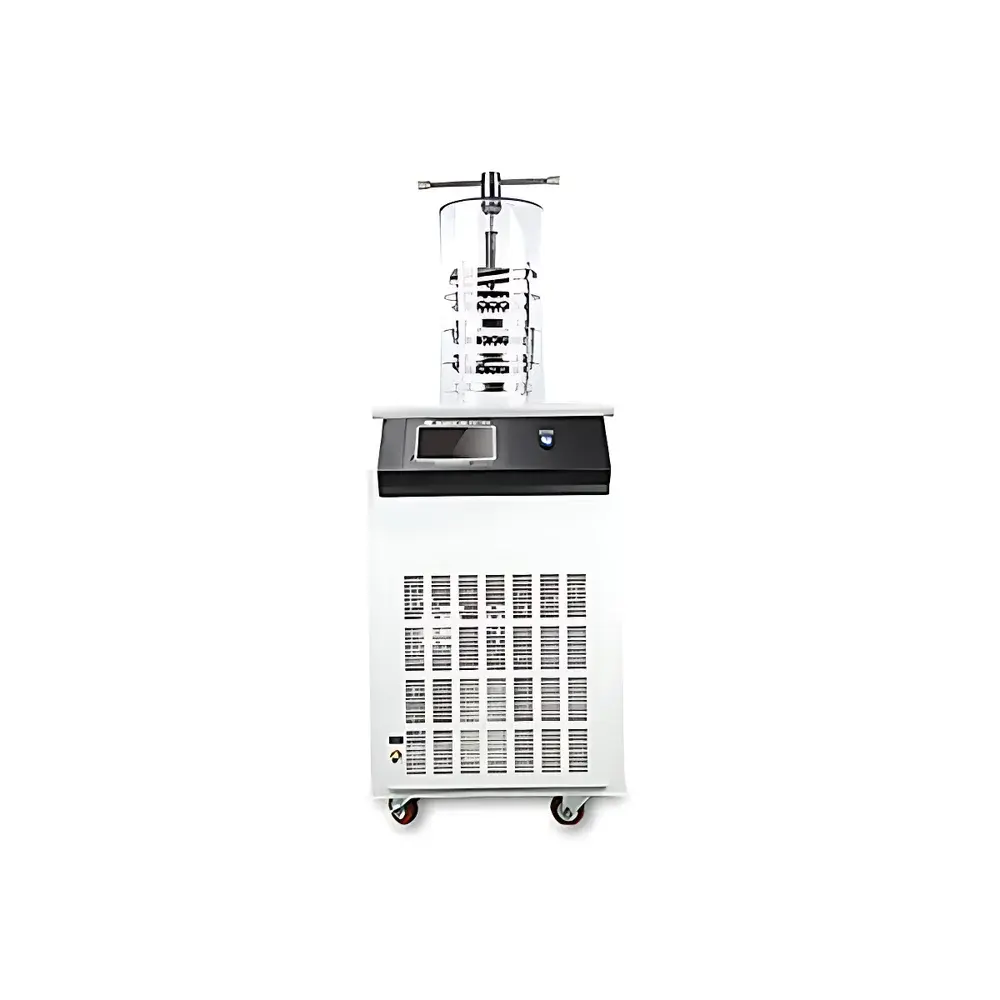
Ningbo Scientz SCIENTZ-18N/B Benchtop Lyophilizer with Stoppering Bell Jar
| Brand | Scientz |
|---|---|
| Origin | Zhejiang, China |
| Manufacturer Type | Direct Manufacturer |
| Instrument Type | Standard Shelf-Type Lyophilizer |
| Application Scope | Pilot-Scale |
| Freeze-Drying Area | 0.12 m² |
| Ultimate Vacuum | ≤5 Pa |
| Condensate Capacity (24 h) | 4 kg/batch |
| Cold Trap Temperature | ≤−56 °C |
| Main Unit Dimensions (L×W×H) | 600 × 450 × 720 mm + 440 mm (bell jar height) |
Overview
The Ningbo Scientz SCIENTZ-18N/B is a pilot-scale benchtop lyophilizer engineered for reproducible, high-integrity freeze-drying of thermolabile biologicals, pharmaceuticals, and research-grade materials. It operates on the principle of sublimation under deep vacuum—where ice transitions directly from solid to vapor without passing through the liquid phase—preserving structural integrity, bioactivity, and chemical conformation of sensitive compounds. Designed around a robust bell-jar configuration with integrated stoppering capability, the system enables batch processing of vials under sterile or inert conditions post-drying. Its compact footprint (600 × 450 × 720 mm main unit + 440 mm bell jar), combined with a 0.12 m² drying area and 4 kg/24 h condensate capacity, positions it as an optimal solution for laboratories requiring scalable, non-destructive dehydration without full production-line infrastructure.
Key Features
- High-efficiency dual-stage refrigeration system featuring imported compressors, delivering stable cold trap temperatures ≤−56 °C (optionally upgradeable to ≤−80 °C with cascade compressor)
- 7-inch true-color capacitive touchscreen interface with industrial-grade embedded OS; real-time display of critical parameters including cold trap temperature, chamber pressure, shelf temperature (if equipped), and vacuum level
- Intelligent vacuum control logic: vacuum pump activation is inhibited until cold trap reaches preset temperature, extending pump service life and minimizing oil backstreaming risk
- Optically transparent, one-piece polycarbonate drying chamber—chemically resistant, shatter-resistant, and fully sealable—with integrated inert gas inlet valve (N₂ or argon compatible)
- Automated data logging: all process variables timestamped and stored internally; exportable via USB to PC for GMP-compliant review and long-term archival
- Optional accessories include vacuum oil mist filter, automatic pressure differential valve (prevents oil ingress), eutectic point measurement module, and electrothermal defrost system for accelerated cycle turnaround
Sample Compatibility & Compliance
The SCIENTZ-18N/B accommodates diverse sample formats—including serum vials (standard 13–22 mm neck diameter), custom glassware, and open petri dishes—via its wide-mouth manifold (8-port standard). Its design supports lyophilization of proteins, monoclonal antibodies, viral vectors, bacterial cultures, plant extracts, nanomaterial dispersions, and food matrices without aggregation or denaturation. The system complies with fundamental requirements for GLP and early-phase GMP environments: audit-trail-capable data storage, user-access-level controls (admin/operator), and configurable alarm thresholds (e.g., ambient temperature override, vacuum breach, condenser overload). While not pre-certified to ISO 22000 or FDA 21 CFR Part 11 out-of-the-box, its architecture permits integration into validated workflows when paired with documented SOPs and third-party IQ/OQ protocols.
Software & Data Management
Process data—including time-stamped vacuum profiles, temperature curves, and condensation mass estimates—is recorded at user-defined intervals (1–60 sec resolution) and retained in non-volatile memory for ≥10,000 cycles. Export formats include CSV and proprietary .lyo files, readable via Scientz’s free desktop software for comparative analysis, overlay plotting, and report generation (PDF/Excel). The system supports USB-based backup and restoration of freeze-drying recipes, enabling cross-instrument method transfer. Optional firmware upgrades provide enhanced security features such as password-protected parameter locking and encrypted data export—aligning with institutional IT policies for regulated research environments.
Applications
This lyophilizer serves multidisciplinary research and development needs across academic, governmental, and industrial laboratories. In life sciences, it preserves microbial strains, viral stocks, and primary cell lysates while maintaining viability and antigenicity. Pharmaceutical labs use it for formulation screening of injectables, oral disintegrating tablets, and biopolymer-based delivery systems. Food science applications include stabilization of probiotics, enzymes, and volatile flavor compounds. Environmental and agricultural researchers rely on it for soil, sludge, and plant tissue preservation prior to elemental or genomic analysis. Materials scientists apply it to dry colloidal nanoparticles and catalytic precursors without sintering or agglomeration—leveraging the porous microstructure inherent to lyophilized matrices.
FAQ
What is the maximum batch volume supported by the SCIENTZ-18N/B?
Standard operation supports up to 4 L total sample volume across the 0.12 m² drying area, assuming typical 5–10 mm frozen layer thickness and 10–20% solids content. Actual capacity depends on solute concentration, container geometry, and thermal conductivity.
Can the system be validated for GMP use?
Yes—the hardware architecture supports IQ/OQ qualification. Users must implement procedural controls (e.g., calibration logs, change management, electronic signature protocols) and may engage third-party vendors for formal 21 CFR Part 11 compliance validation.
Is the cold trap temperature uniform across the surface?
Temperature gradients are <±2 °C across the condenser surface under steady-state operation, verified via calibrated PT100 sensors mounted at multiple radial positions.
Does the unit include a built-in vacuum gauge?
Yes—a capacitance manometer provides direct, oil-free pressure measurement with accuracy ±0.1 Pa in the 0.1–100 Pa range, essential for precise primary drying endpoint detection.
What maintenance intervals are recommended for the compressor and vacuum pump?
Compressor oil inspection every 2,000 operating hours; vacuum pump oil replacement every 500 hours or per manufacturer specifications—especially critical when processing solvent-laden vapors.



