
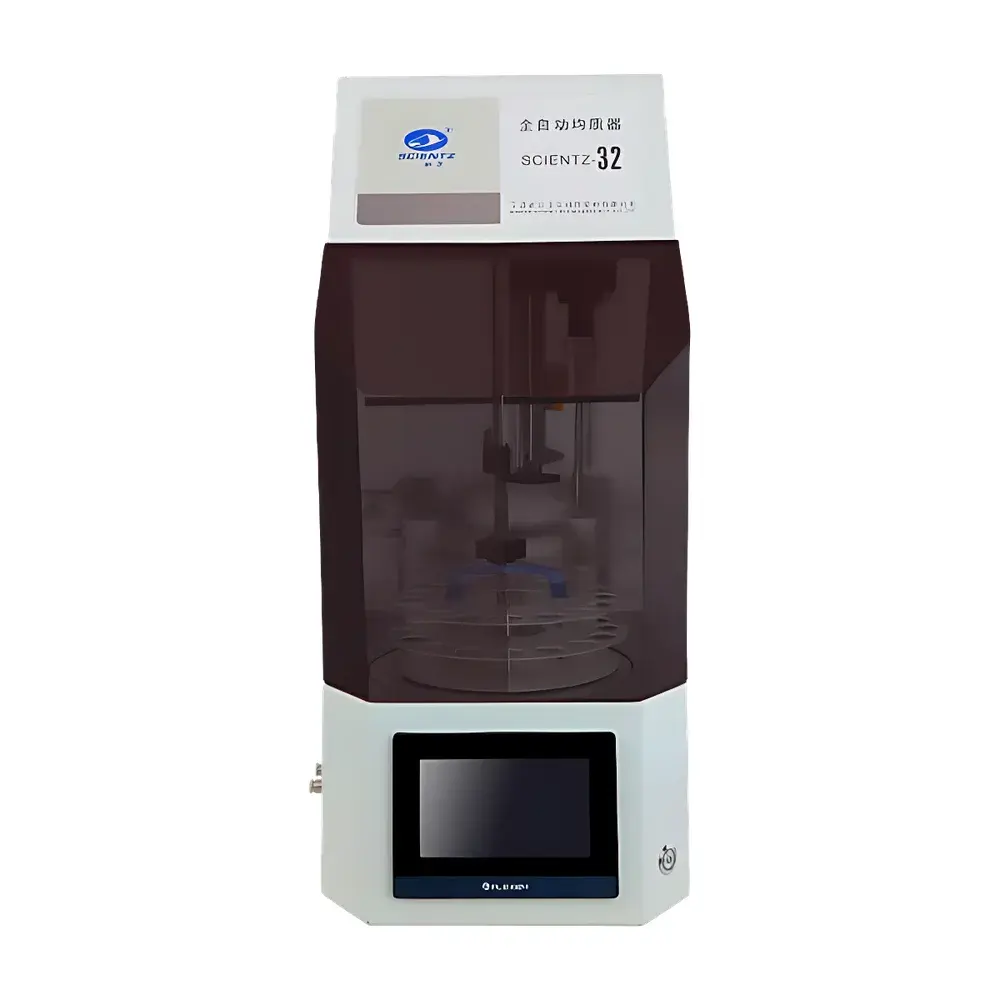
Scientz SCIENTZ-32 Fully Automated High-Throughput Homogenizer
| Brand | Scientz |
|---|---|
| Origin | Zhejiang, China |
| Manufacturer Type | Direct Manufacturer |
| Instrument Type | Sample Homogenizer / Tissue Disruptor |
| Sample Compatibility | Soft to semi-soft biological and organic materials |
| Maximum Feed Size | <15 mm |
| Final Particle Size | <40 µm |
| Output Granularity Range | ≥0.5 mm (pre-homogenized feed) |
| Batch Processing Volume | Up to 200 mL per tube |
| Throughput Capacity | 8–32 samples per cycle |
| Noise Level | <60 dB(A) |
| Motor Type | High-speed brushless DC motor with electronic speed control |
Overview
The Scientz SCIENTZ-32 Fully Automated High-Throughput Homogenizer is an engineered solution for reproducible, scalable, and contamination-controlled sample preparation in regulated life science and food safety laboratories. It operates on the principle of high-shear mechanical homogenization—utilizing a precision-engineered dual-motion system where a rotating梅花-shaped (star-pattern) rotor assembly engages both axial translation and rotational motion within sealed sample tubes. This design ensures uniform energy distribution across heterogeneous soft-tissue matrices, enabling efficient cell lysis, tissue disruption, emulsification, and particle size reduction without thermal degradation or operator-induced variability. Unlike manual or semi-automated homogenizers, the SCIENTZ-32 integrates end-to-end workflow automation—including post-cycle blade positioning, programmable cleaning protocols, and real-time environmental monitoring—making it suitable for GLP-compliant environments where traceability and process consistency are mandatory.
Key Features
- High-throughput processing: Configurable 8–32 sample capacity per run using standardized 10–200 mL tubes, minimizing hands-on time and inter-sample variability.
- Integrated self-cleaning system: Programmable wash sequences support water rinse, organic solvent flush (e.g., ethanol, acetone), or ultrasonic spray cleaning with adjustable duration and dwell time—critical for cross-contamination prevention in multi-analyte workflows.
- Intelligent parameter management: Stores >100 user-defined homogenization protocols (speed, duration, pulse pattern, pause intervals) with timestamped recall directly from the front-panel touchscreen interface.
- Remote operation via WiFi: Compatible with Windows, macOS, iOS, and Android platforms; enables real-time status monitoring, protocol upload/download, and emergency stop functionality through a secure web-based dashboard.
- Acoustically optimized architecture: Brushless DC motor and vibration-damped chassis maintain operational noise below 60 dB(A) at 1 m distance—meeting ISO 7779 and ANSI S12.2 standards for laboratory equipment noise emission.
- Safety-critical subsystems: Built-in exhaust ventilation actively removes volatile vapors (e.g., chloroform, phenol, alcohols) during homogenization; automatic shutdown triggers upon temperature or rotational speed deviation beyond preset thresholds (±5% tolerance).
Sample Compatibility & Compliance
The SCIENTZ-32 is validated for soft and semi-soft biological matrices including mammalian tissues (liver, kidney, brain, spleen), plant organs (roots, leaves, seeds), protein suspensions (myofibrillar, soy whey, peanut, sweet potato), and biopolymer systems (alginate, chitosan, calcium phosphate cements). It complies with ISO 17025 requirements for method validation in accredited testing labs and supports audit-ready documentation when paired with optional LIMS integration. While not certified under FDA 21 CFR Part 11 out-of-the-box, its logging architecture—recording operator ID, timestamp, protocol ID, and system health metrics—provides foundational traceability aligned with GMP/GLP data integrity expectations.
Software & Data Management
The embedded control firmware logs all operational events—including homogenization cycles, cleaning sequences, error flags, and sensor diagnostics—in non-volatile memory. Data export is supported via USB flash drive (CSV format) or network transfer (SFTP/HTTPS). Optional Scientz LabLink software enables centralized fleet management, protocol versioning, and automated report generation compliant with ISO/IEC 17025 Clause 7.7 (result reporting). Audit trails include immutable timestamps and user authentication logs, facilitating internal quality reviews and regulatory inspections.
Applications
- Food safety analysis: Extraction of pesticide and veterinary drug residues from muscle, liver, and dairy matrices prior to LC-MS/MS quantification.
- Biopharmaceutical development: Preparation of microcapsule suspensions and controlled-release polymer carriers requiring narrow particle size distribution (PSD) and high batch-to-batch repeatability.
- Proteomics & enzymology: Rapid lysis of tissue samples for downstream SDS-PAGE, Western blotting, or activity assays—preserving native conformation where applicable.
- Material science: Homogenization of hydrogel precursors and ceramic slurries for injectable biomaterial formulations.
- Academic research: Standardized disruption of model organisms (e.g., C. elegans, zebrafish embryos) in high-content screening pipelines.
FAQ
What types of sample tubes are compatible with the SCIENTZ-32?
Standard conical-bottom polypropylene or stainless-steel tubes ranging from 10 mL to 200 mL volume, with maximum outer diameter ≤75 mm and height ≤120 mm.
Can the SCIENTZ-32 be integrated into a robotic liquid handling workflow?
Yes—via optional RS-232 or Ethernet TCP/IP interface for trigger-based start/stop commands and status polling, supporting third-party scheduler integration.
Is validation documentation available for IQ/OQ/PQ protocols?
Scientz provides a comprehensive User Requirement Specification (URS) template and factory-verified performance qualification reports covering speed accuracy, temperature stability, and cleaning efficacy—customizable for site-specific IQ/OQ execution.
Does the system meet international electrical safety standards?
It conforms to IEC 61010-1:2010 for laboratory electrical equipment, including protection against electric shock, mechanical hazards, and abnormal heat generation.
How often does the homogenization blade require recalibration or replacement?
Blade wear is monitored via torque signature analysis; typical service interval is 5,000–8,000 cycles depending on sample abrasiveness—replacement kits include traceable calibration certificates.
Related Products



