
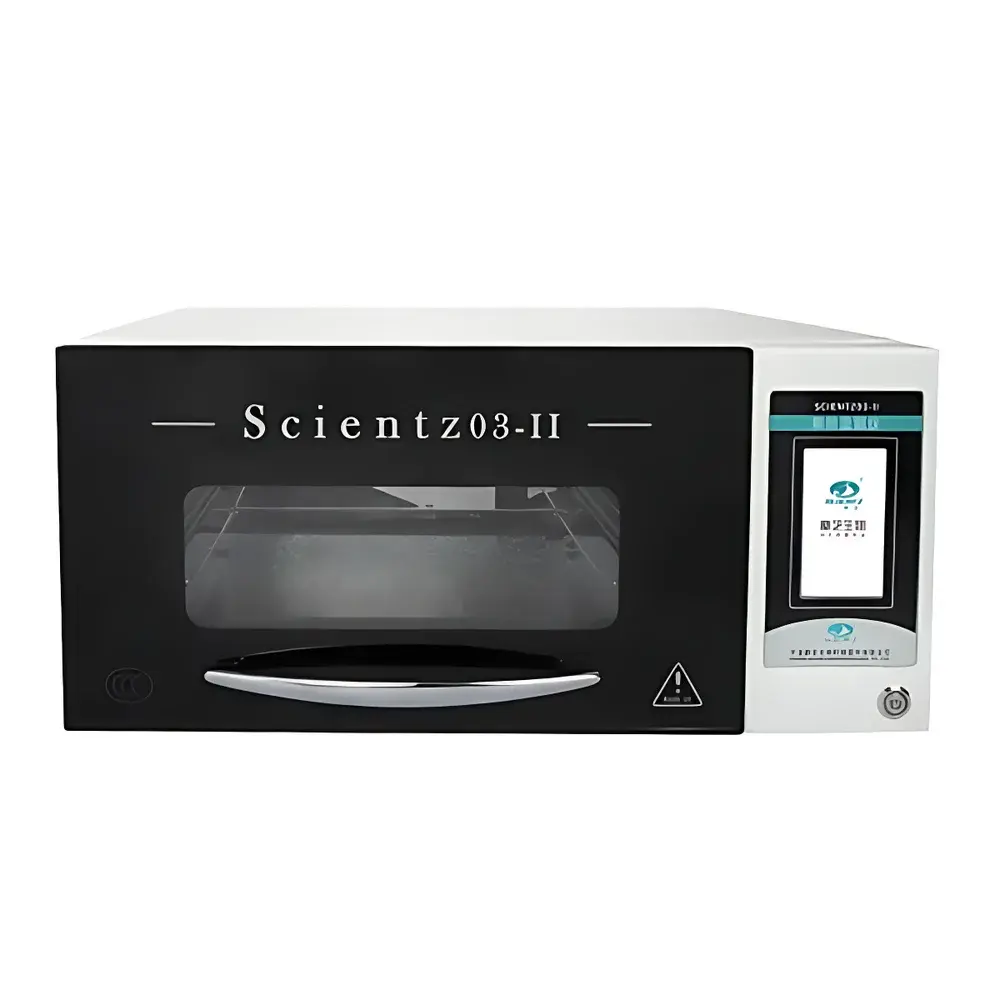
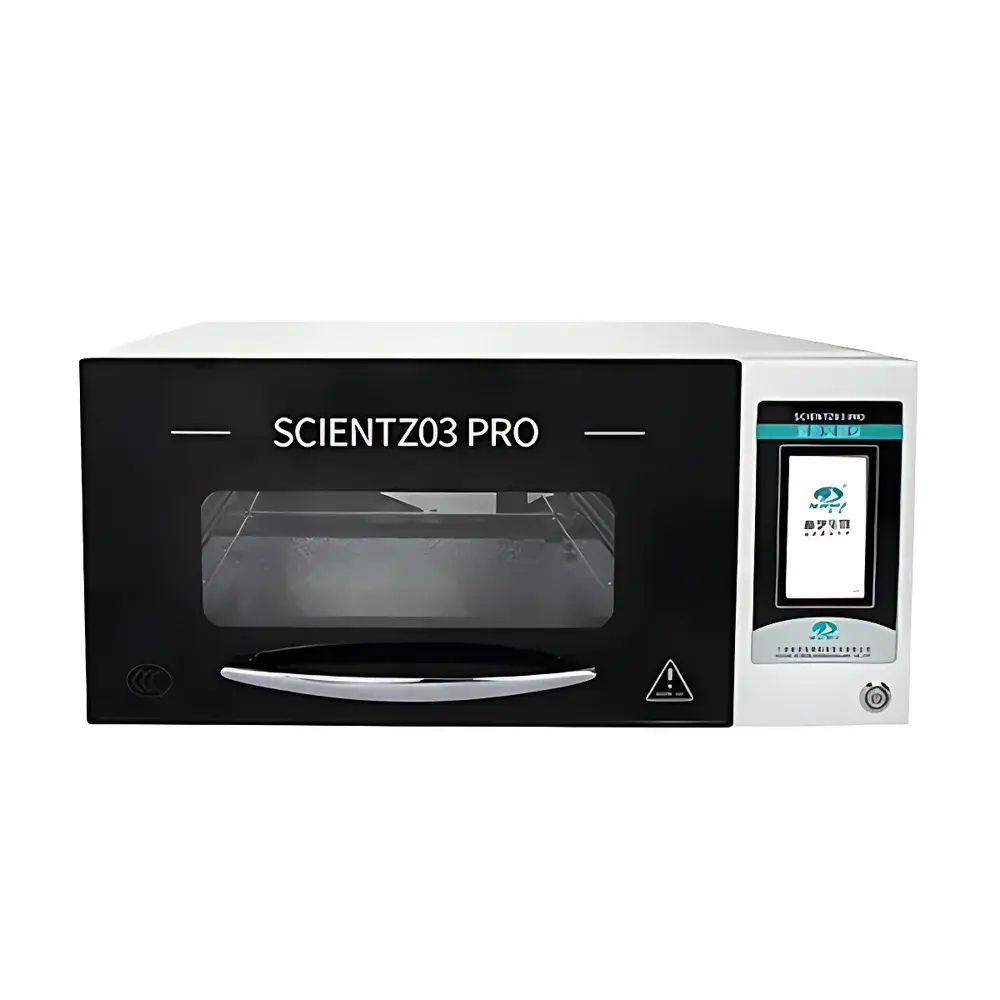
Ningbo Scientz SCIENTZ03-II UV Crosslinker
| Brand | Scientz |
|---|---|
| Origin | Zhejiang, China |
| Manufacturer Type | Direct Manufacturer |
| Country of Origin | China |
| Model | SCIENTZ03-II |
| Pricing | Available Upon Request |
| UV Wavelength | 254 nm |
| Optional Blue Light Source | 470 nm (for gel visualization) |
| Active Irradiation Area | 880 cm² |
| Dose Control | Microprocessor-regulated energy mode (J/cm²) and time mode |
| Safety Features | Interlocked safety door with UV-blocking viewing window |
| Operation Interface | LED display with auto-memory function |
| Design | Drawer-type sample chamber |
Overview
The Ningbo Scientz SCIENTZ03-II UV Crosslinker is a laboratory-grade, microprocessor-controlled ultraviolet irradiation system engineered for precise nucleic acid immobilization and UV-mediated molecular biology applications. It operates at a primary emission wavelength of 254 nm — the optimal peak for thymine dimer formation and covalent crosslinking of DNA/RNA to nylon or nitrocellulose membranes. Unlike thermal baking, which relies on passive diffusion and weak hydrophobic binding, UV crosslinking induces direct photochemical bonding between nucleic acids and membrane functional groups, significantly enhancing hybridization signal intensity and reproducibility. The instrument integrates real-time radiometric dosimetry: a calibrated photodiode sensor continuously measures incident UV fluence (in J/cm²), enabling endpoint-driven exposure control that compensates for lamp aging, ambient temperature drift, and chamber geometry variations. This ensures consistent crosslinking efficiency across batches and users — a critical requirement for quantitative Northern/Southern blotting, library screening, and diagnostic probe validation.
Key Features
- Precision Dose Delivery: Dual-mode operation — selectable energy-integrated (J/cm²) or fixed-time protocols — with LED-displayed real-time dose accumulation and automatic termination upon target threshold.
- Enhanced Biosafety Architecture: Electromechanical interlock system disables UV emission when the drawer-style chamber door is opened; integrated UV-absorbing acrylic viewport permits visual monitoring without exposure risk.
- Optimized Irradiation Uniformity: Reflective aluminum chamber interior and symmetrically arranged low-pressure mercury lamps ensure ±8% spatial fluence homogeneity across the full 880 cm² active area (29.5 × 30 cm).
- Dual-Wavelength Utility: Dedicated 470 nm blue LED array (wireless power delivery) enables safe, high-contrast visualization of ethidium bromide- or SYBR-stained DNA in agarose gels without UV-induced DNA damage or photobleaching.
- Robust Operational Workflow: Drawer mechanism minimizes sample handling time; non-volatile memory retains last-used parameters, eliminating repeated setup for routine assays.
Sample Compatibility & Compliance
The SCIENTZ03-II accommodates standard blotting membranes (nylon, nitrocellulose, PVDF), agarose gels (up to 15 × 20 cm), microtiter plates (96-well format), and sterilizable labware surfaces. Its 254 nm output conforms to ISO 15195:2019 requirements for UV-based nucleic acid immobilization validation. For decontamination workflows targeting PCR carryover, the system delivers validated log3–log4 reduction of amplicon residues on pipette tips, tube racks, and benchtops per ASTM E2197-22 guidelines. While not certified for GMP cleanroom use, its design supports GLP-aligned documentation practices including manual log entry of exposure parameters, operator ID, and date/time stamps.
Software & Data Management
The SCIENTZ03-II operates via embedded firmware with no external PC dependency. All operational parameters — selected mode (energy/time), setpoint value, elapsed exposure, and final delivered dose — are displayed and retained in non-volatile memory. Though lacking network connectivity or FDA 21 CFR Part 11-compliant electronic signatures, the device supports audit-ready traceability when paired with laboratory notebook entries documenting batch-specific settings and observed outcomes (e.g., chemiluminescent signal intensity relative to controls). Users may export dose logs manually via timestamped handwritten records aligned with SOP-087 (UV Crosslinking Validation Protocol).
Applications
- Nucleic acid immobilization on solid supports for Southern, Northern, and dot-blot hybridization
- UV-mediated generation of cyclobutane pyrimidine dimers (CPDs) for DNA repair studies and RecA-dependent recombination assays
- Site-specific cleavage of UV-damaged DNA in agarose gels prior to fragment recovery
- Routine decontamination of PCR workstations, pipettes, and consumables to prevent false-positive amplification
- Controlled induction of UV mutagenesis in bacterial or yeast strain construction workflows
- Validation of membrane-binding efficiency in diagnostic assay development (e.g., oligonucleotide capture arrays)
FAQ
What is the typical exposure time required for efficient DNA crosslinking to nylon membranes?
For most 10–20 ng DNA spots on positively charged nylon membranes, 120–180 mJ/cm² (equivalent to ~45–60 s at nominal lamp output) yields optimal signal-to-noise ratio in subsequent hybridization.
Can the SCIENTZ03-II be used for RNA crosslinking?
Yes — though RNA exhibits lower crosslinking efficiency than DNA due to ribose conformational constraints, standard 254 nm exposure at 250–300 mJ/cm² achieves robust immobilization for Northern blotting.
Is calibration verification required before use?
Scientz recommends annual verification using a NIST-traceable UV radiometer; users should record baseline irradiance measurements at chamber center and four corners to confirm uniformity compliance.
Does the blue light module emit UV radiation?
No — the 470 nm blue LEDs produce visible light only and pose no photochemical hazard to nucleic acids or personnel.
How often should the UV lamps be replaced?
Lamp output declines by ~20% after 1,000 hours of cumulative operation; replacement is advised at 800–1,000 hr intervals to maintain dose accuracy within ±5%.





